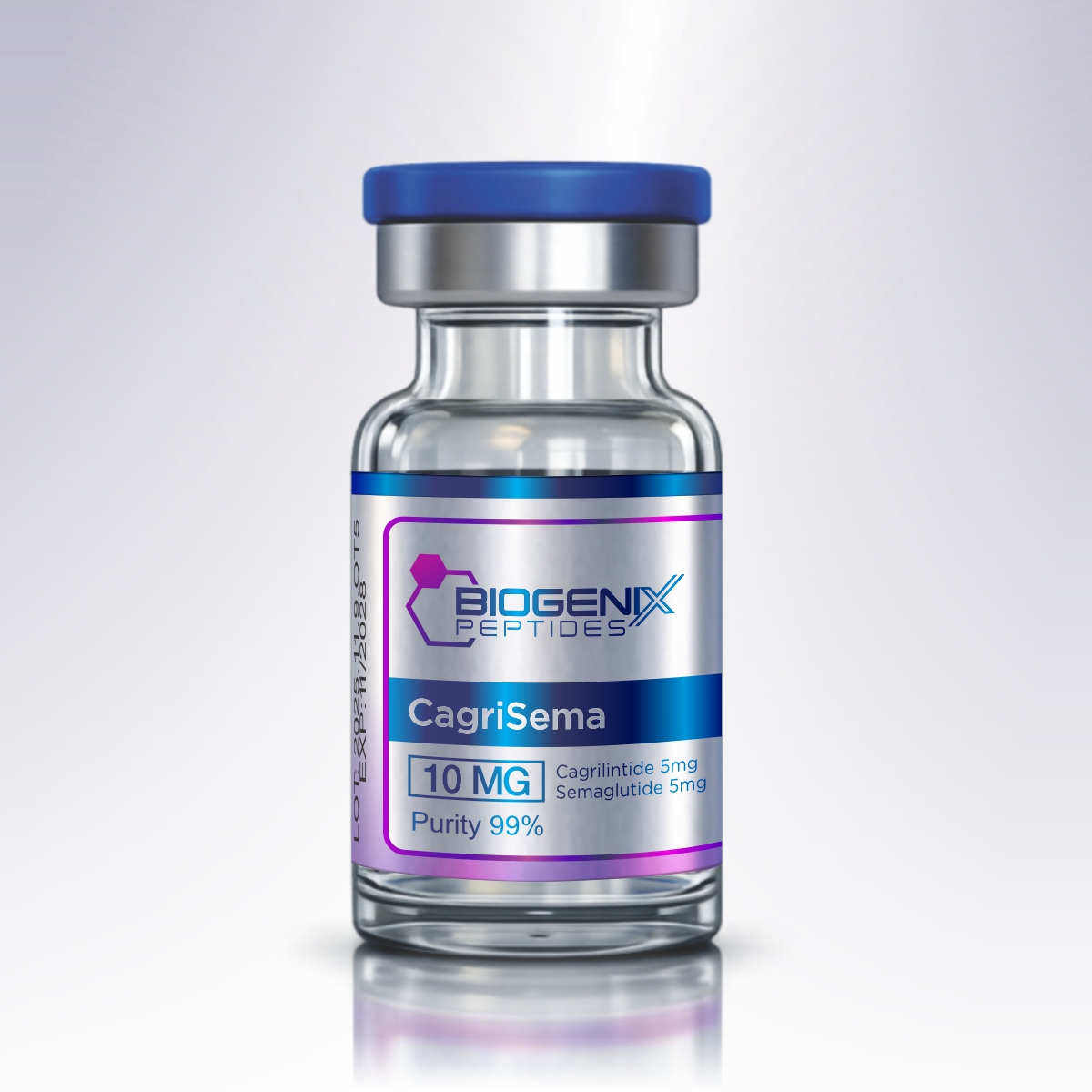
Cagrilintide | Semaglutide Blend 10 mg
$165.00
Cagrilintide + Semaglutide is a dual-agonist research pairing that targets complementary pathways in appetite control, energy regulation, and metabolic balance. Cagrilintide, a long-acting amylin analogue, enhances satiety, slows gastric emptying, and influences reward-driven feeding signals. Semaglutide, an extended-duration GLP-1 receptor agonist, modulates glucose handling, gastric motility, and overall energy intake. When examined together, the two peptides demonstrate additive—potentially synergistic—effects on weight reduction, appetite suppression, and metabolic outcomes by engaging both homeostatic and hedonic appetite-regulation systems.
In Stock
Cagrilintide + Semaglutide — Research Overview
Introduction
Cagrilintide + Semaglutide represents a novel dual-agonist research approach targeting complementary mechanisms in appetite regulation, energy balance, and glycemic control. Cagrilintide is a long-acting amylin analogue that enhances satiety, slows gastric emptying, and modulates hedonic appetite pathways. Semaglutide is a potent GLP-1 receptor agonist designed for extended exposure and once-weekly administration, influencing glucose metabolism, gastric motility, and energy intake.When studied together, these two peptides have shown additive and potentially synergistic effects on weight reduction, appetite suppression, and metabolic outcomes. This dual approach engages both homeostatic (energy balance) and hedonic (reward-driven) appetite regulation systems.
Chemical Characteristics
| Compound | Type | Molecular Formula | Molecular Weight |
| Cagrilintide | Long-acting amylin analogue | C₁₉₄H₃₁₂N₅₄O₅₉S₂ | 4409 g/mol |
| Semaglutide | Long-acting GLP-1 receptor agonist | C₁₈₇H₂₉₁N₄₅O₅₉ | ~4113.6 g/mol |
Mechanisms of Action
Cagrilintide
• Central Satiety: Enhances hypothalamic signaling to promote satiety and reduce caloric intake.• Gastrointestinal Regulation: Slows gastric emptying, prolonging nutrient absorption and stabilizing postprandial glucose.• Hedonic Regulation: Modulates reward circuits involved in non-homeostatic eating.
Semaglutide
• GLP-1 Receptor Activation: Enhances glucose-dependent insulin secretion, suppresses glucagon when glucose is elevated, and delays gastric emptying.• Metabolic & Appetite Effects: Reduces energy intake, promotes weight loss, and improves glycemic markers in prolonged research protocols.
Combination Research & Applications
Studies indicate that co-administration of Cagrilintide + Semaglutide yields greater weight reduction and appetite suppression than either compound alone, without disproportionate increases in GI adverse events:• Frias et al. (2021) conducted a multicentre, double-blind, randomized phase 2 trial evaluating Cagrilintide alone and in combination with Semaglutide in adults with overweight and obesity. The combination produced additive weight loss and improvements in metabolic markers versus monotherapy.• Additional crossover studies observed enhanced satiety and reduced hedonic food preference under dual therapy compared to either agent individually. This dual approach is under active investigation for metabolic research models involving:• Weight regulation and appetite control• Glycemic modulation and incretin physiology• Gastric emptying dynamics• Cardiometabolic biomarker panels
Pharmacokinetics & Dosing (Research Context)
• Cagrilintide: Long-acting via N-terminal lipidation, typically administered subcutaneously in extended dosing protocols.• Semaglutide: Half-life ~1 week; administered subcutaneously or orally (SNAC-enabled) in research. Oral formulations evaluate bioavailability and dose proportionality under controlled protocols. Co-administration leverages complementary pharmacokinetics for sustained satiety and metabolic effects across weekly intervals.
Safety & Tolerability
Across studies, GI-related signals (e.g., nausea, delayed gastric emptying) are the most commonly observed during titration phases. Combination therapy has not shown unexpected safety signals compared to monotherapy in controlled research settings, though all use remains limited to in-vitro and pre-clinical research.
References: Combination Therapy (Cagrilintide + Semaglutide)
- Frias JP, Nauck MA, Van J, et al. Efficacy and safety of cagrilintide alone and in combination with semaglutide in people with overweight and obesity: a multicentre, double-blind, placebo-controlled, randomised phase 2 trial. The Lancet. 2021;398(10300):1975–1988.https://doi.org/10.1016/S0140-6736(21)02316-3
- Blundell JE, Finlayson G, Axelsen M, Flint A. Effects of cagrilintide and semaglutide on appetite, energy intake, and food preferences in adults with overweight or obesity: A randomized crossover trial. Diabetes Obesity and Metabolism. 2022;24(9):1797–1807.https://doi.org/10.1111/dom.14797
- Anderson SL. Cagrilintide: A new potential anti-obesity medication. Annals of Pharmacotherapy. 2023;57(5):620–629.https://doi.org/10.1177/10600280221146957
Cagrilintide – Additional References
- Kapitza C, Nosek L, Jensen L, Hartvig H, Jensen CB. Cagrilintide, a long-acting amylin analogue: Results of single and multiple ascending dose trials in healthy individuals and overweight people. Diabetes Obesity and Metabolism. 2020;22(8):1406–1416.https://doi.org/10.1111/dom.14044
- Nauck MA, Marre M, Perdomo CM, et al. Cagrilintide, a novel amylin analogue, for the treatment of obesity and type 2 diabetes: Mechanisms and clinical potential. Diabetes Obesity and Metabolism. 2022;24(7):1239–1249.https://doi.org/10.1111/dom.14714
- Novo Nordisk. Cagrilintide — Mechanism of action and clinical development program. Company Clinical Summary. 2023.
Semaglutide – Additional References
- Wilding JPH, Batterham RL, Calanna S, et al. Once-weekly semaglutide in adults with overweight or obesity. New England Journal of Medicine (STEP 1). 2021;384:989–1002.https://doi.org/10.1056/NEJMoa2032183
- Rubino D, Abrahamsson N, Davies M, et al. Effect of continued weekly subcutaneous semaglutide vs placebo on weight loss maintenance in adults with overweight or obesity: the STEP 4 randomized clinical trial. JAMA. 2021;325(14):1414–1425.https://doi.org/10.1001/jama.2021.3224
- Marso SP, Bain SC, Consoli A, et al. Semaglutide and cardiovascular outcomes in patients with type 2 diabetes (SUSTAIN-6). New England Journal of Medicine. 2016;375:1834–1844.https://doi.org/10.1056/NEJMoa1607141
- Davies MJ, Bain SC, Atkin SL, et al. Efficacy and safety of once-weekly semaglutide versus exenatide ER in subjects with type 2 diabetes (SUSTAIN 3): a 56-week, open-label, randomized clinical trial. The Lancet Diabetes & Endocrinology. 2018;6(4):275–286.https://doi.org/10.1016/S2213-8587(18)30024-X
- Husain M, Birkenfeld AL, Donsmark M, et al. Oral semaglutide and cardiovascular outcomes in patients with type 2 diabetes (PIONEER 6). New England Journal of Medicine. 2019;381(9):841–851.https://doi.org/10.1056/NEJMoa1901118
- Lau J, Bloch P, Schäffer L, et al. Discovery of the once-weekly GLP-1 receptor agonist semaglutide. Science Translational Medicine. 2015;7(327):327ra27.https://doi.org/10.1126/scitranslmed.aab3071
- Knudsen LB, Nielsen PF, Huusfeldt PO, et al. Potent derivatives of glucagon-like peptide-1 with pharmacokinetic properties suitable for once daily administration. Journal of Medicinal Chemistry. 2000;43(9):1664–1669.https://doi.org/10.1021/jm9909645
- Granhall C, Donsmark M, Blicher TM, et al. Safety and pharmacokinetics of single and multiple ascending doses of the novel oral human GLP-1 analogue, semaglutide, in healthy male subjects. Diabetes Obesity and Metabolism. 2019;21(1):34–41.https://doi.org/10.1111/dom.13494
- Blundell J, Finlayson G, Axelsen M, Flint A, Gibbons C, Kvist T, Hjerpsted JB. Effects of once-weekly semaglutide on appetite, energy intake, control of eating, food preference and body weight in subjects with obesity. Diabetes Obesity and Metabolism. 2017;19(9):1242–1251.https://doi.org/10.1111/dom.12932
NOTICE OF COMPLIANCE
The mission of BioGenix Peptides™ is to provide researchers with the highest-quality, Ultra-Pure Series™ compounds to help unlock the full potential of this evolving field. With precision, purity, and scientific integrity at the core of our operations, BioGenix Peptides™ is dedicated to supporting responsible exploration and discovery
Products from BioGenix Peptides™ are not intended for human consumption. They are supplied exclusively for in-vitro and pre-clinical research purposes.
By purchasing or using these products, the Customer accepts full responsibility for their handling and use, and agrees to indemnify and hold BioGenix Peptides™ harmless from any claims resulting from misuse
Having trouble viewing? Use the buttons below to download or open the certificate.
Related products


In Stock