How to Choose the Perfect Peptide Library Screening Kit Without Losing Your Mind
How to Choose the Perfect Peptide Library Screening Kit Without Losing Your Mind
Disclaimer: The information provided in this article is for educational and informational purposes only. It is not intended as medical advice, diagnosis, or treatment. Products and compounds referenced are for research use only and are not approved for human or veterinary consumption. Always consult a qualified professional regarding health or medical decisions.
How to Choose Peptide Library Screening Kits That Fit Your Research
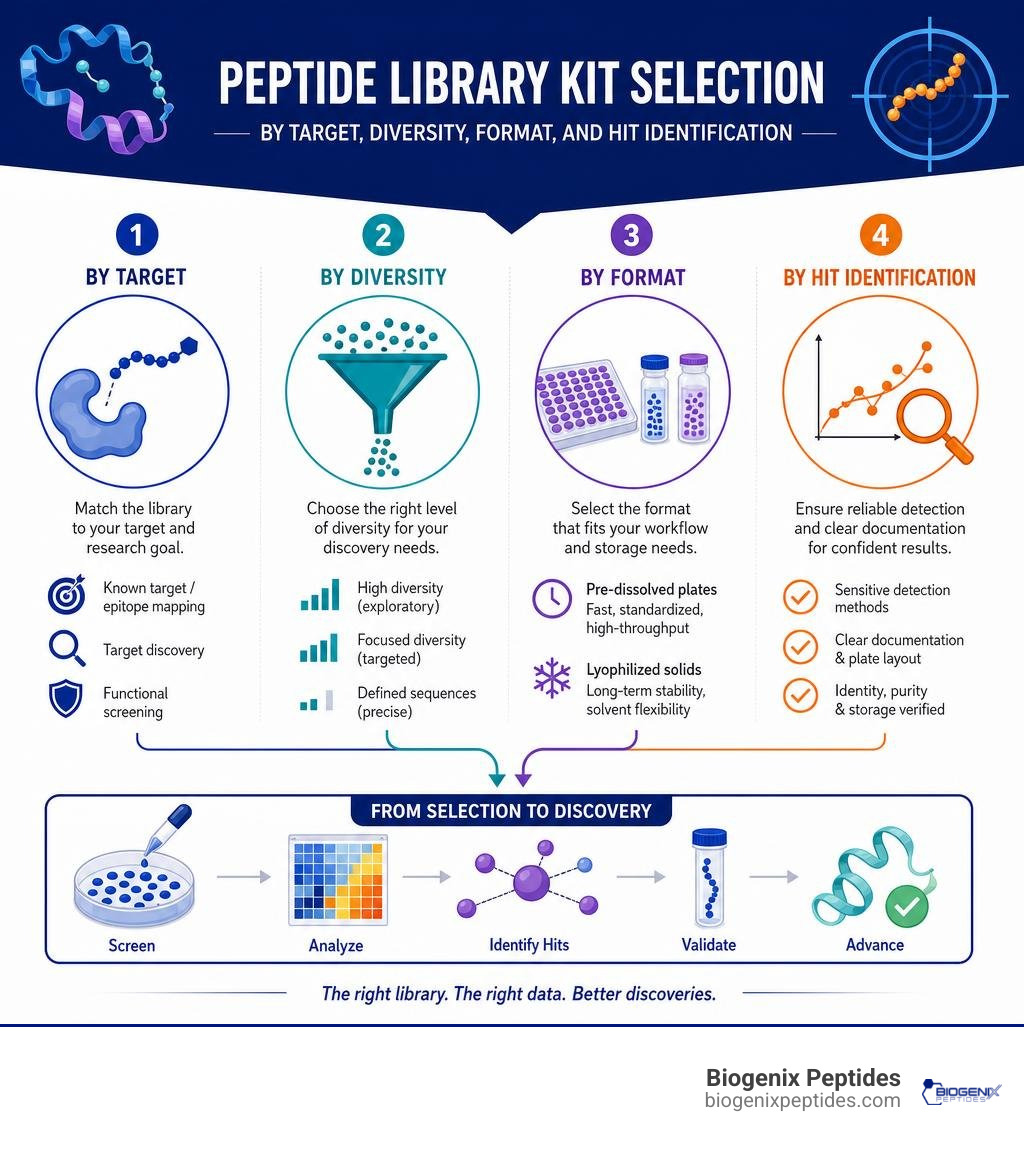
Choose peptide library screening kits by matching the platform to your target, assay, and hit-readout method:
- Choose phage or acellular display when you need very high diversity and iterative selection.
- Choose synthetic peptide arrays or overlapping pools when you need defined sequences for epitope mapping, T-cell research, or target verification.
- Choose pre-dissolved plates for faster, standardized high-throughput work, or lyophilized solids when long-term storage and solvent flexibility matter most.
- Confirm that the kit includes clear identity, purity, storage, and plate-layout documentation before starting a screen.
The right library is not always the largest one. A focused, well-controlled library can be a better fit when you already know the target class, binding region, or sequence space you want to test. For broad discovery, biological libraries can reach billions of variants, while defined chemical libraries make hit confirmation and follow-up studies more direct.
I am Jay Daniel, Founder and CEO of BioGenix Peptides, with hands-on experience in peptide sourcing, quality control, purity validation, and research-focused peptide development. In this guide to peptide library screening kits, I will help you compare the practical choices that support reliable, reproducible research.
Core Platforms in Commercial Peptide Library Screening Kits
Peptide therapeutics represent a rapidly growing domain in preclinical discovery. Over 80 peptide-based therapeutics have reached global approval for conditions spanning oncology, metabolic dysfunction, and viral pathogenesis. As the market value of therapeutic peptides surpassed $45 billion, high-throughput screening technologies have evolved into essential exploratory engines. In nature, over 7,000 native peptides have been mapped, providing an expansive baseline of functional scaffolds.
When evaluating screening platforms, kits generally divide into two operational architectures: biological display systems and synthetic chemical arrays. Each architecture relies on distinct construction principles, spatial constraints, and detection readouts.
Chemical peptide libraries are built via solid-phase or solution-phase synthetic pathways. To understand the fundamental building blocks behind these collections, reviewing our peptide synthesis complete guide provides actionable insight into how solid supports, protecting groups, and coupling reagents dictate the physical purity of combinatorial variants.
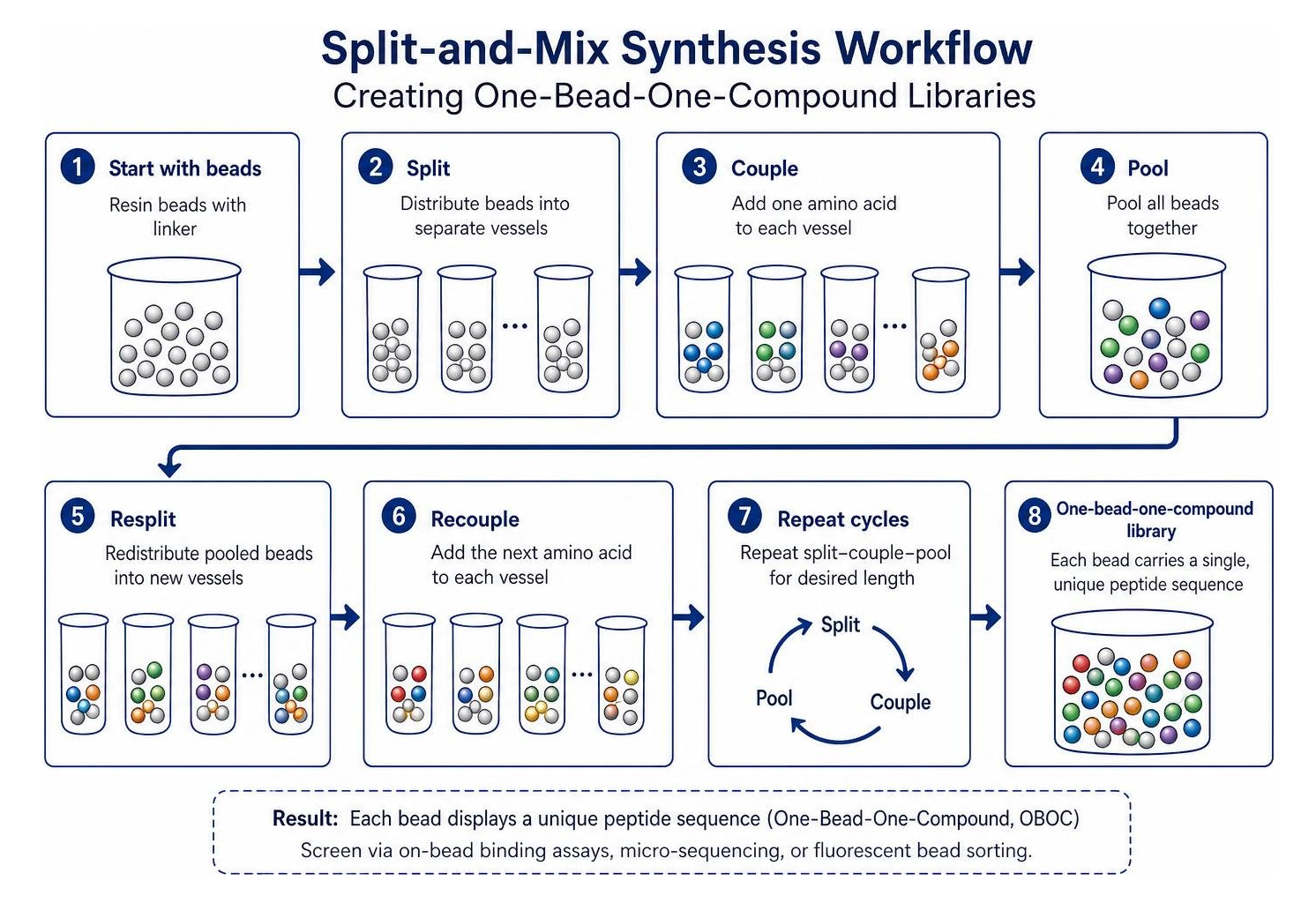
A primary chemical approach is the split-and-mix methodology, which enables one-bead-one-compound (OBOC) libraries. In an OBOC setup, thousands to millions of resin micro-beads are distributed into separate reaction vessels, coupled with single amino acid building blocks, pooled together, randomized, and redistributed. By iteratively repeating these coupling cycles, each resin bead displays an isolated, homogenous peptide sequence. OBOC screening relies on on-bead binding assays followed by micro-sequencing or fluorescent bead sorting to isolate valid binding partners. For broader context on how combinatorial chemistry underpins modern library design, researchers can review established literature on the topic.
Biological Display Formats for High-Complexity Discovery
Biological display platforms rely on an intimate genotype-to-phenotype linkage to evaluate massive combinatorial sequence variations simultaneously. Filamentous bacteriophage systems (such as M13) fuse randomized peptide oligonucleotides directly to minor coat proteins (pIII) or major coat proteins (pVIII).
Commercial solutions featuring randomized 7-mer and 12-mer phage display libraries offer ready-to-use platforms featuring roughly 1 billion unique electroporated sequences. These kits allow researchers to interrogate billions of variants in a single microtiter well without requiring helper phage for amplification.
Beyond standard phage platforms, higher-order display formats expand discovery capabilities:
- Bacterial and Yeast Surface Display: Display scaffolds linked to outer-membrane proteins enable quantitative sorting using Fluorescence-Activated Cell Sorting (FACS), matching library complexities of 10 million to 1 billion clones.
- Ribosome and mRNA Display (Acellular): Entirely cell-free in vitro translation frameworks eliminate transformation efficiency bottlenecks. These acellular platforms achieve extraordinary sequence diversities reaching up to 100 trillion to 1 quadrillion individual molecules, making them premier tools for unbiased de novo hit generation against complex targets.
Synthetic Chemical Arrays and Epitope Overlapping Pools
Synthetic chemical formats prioritize sequence precision, defined stoichiometry, and broad structural diversity over sheer library volume. By leveraging targeted synthesis, researchers can incorporate D-amino acids, non-canonical side chains, and targeted backbone staples.
When designing customized screening workflows, understanding the nuances between solid phase vs solution phase peptide synthesis clarifies why parallel solid-phase synthesis remains the benchmark for microtiter array generation.
Synthetic collections excel in targeted structural studies through systematic configurations:
- Overlapping Peptide Scans: Systematic fragmentation of a primary protein sequence into overlapping segments (typically 15-mers overlapping by 11 residues) to resolve linear binding epitopes.
- Alanine Scanning Arrays: Systematic replacement of native residues with alanine across a known lead peptide to determine critical binding hot spots.
- Defined Epitope Pools: Standardized peptide pools deliver focused, HLA-independent collections of synthetic 15-mers. These specialized pools allow standardized in vitro T-cell stimulation, antigen mapping, and immune monitoring assays without the sequence bias seen in uncharacterized biological mixtures.
Evaluating DNA-Encoded vs. Peptide-Encoded Library Technologies
The evolution of combinatorial discovery has created two powerful affinity selection platforms: DNA-encoded libraries (DELs) and peptide-encoded libraries (PELs). Both platforms pool massive numbers of tagged compounds into a single screening vessel, yet their underlying chemistries and readout methods differ fundamentally.
| Feature / Metric | DNA-Encoded Libraries (DEL) | Peptide-Encoded Libraries (PEL) | Phage Display Kits |
|---|---|---|---|
| Diversity Capacity | 1 million to over 10 billion compounds | 10,000 to 100,000 compounds | 1 billion to 100 billion clones |
| Encoding Material | Synthetic DNA oligonucleotides | Mass-differentiated peptide tags | Viral genome inside capsid |
| Synthetic Chemistry Scope | Aqueous, biocompatible reactions | Broad organic, metal-catalyzed | In vivo ribosomal translation |
| Target Compatibility | Protein targets excluding DNA-binders | Broad; ideal for DNA-binding targets | Soluble & cell-surface proteins |
| Readout Technology | PCR amplification + NGS | High-resolution LC-MS/MS | Plaque sequencing / NGS |
| Detection Threshold | Picomolar to femtomolar | Low nanomolar (~1 nM) | Single-virion recovery |
DNA-encoded libraries append unique, readable DNA barcodes to synthetic small molecules or peptidomimetic cores. DELs achieve astronomical diversity because enzymatic ligation builds extensive split-and-pool networks. However, because harsh synthetic reagents degrade DNA chains, DEL synthesis must stay strictly within DNA-compatible, aqueous reaction parameters. Furthermore, DEL selections often yield background artifacts when panning against nucleic-acid-binding targets like transcription factors or polymerases.
Conversely, peptide-encoded libraries replace vulnerable DNA tags with distinct, mass-differentiated peptide sequence tags. Because peptide tags withstand organic solvents and metal-catalyzed couplings, PELs unlock broader chemical reactions during synthesis. After affinity selections, binders are decoded via bottom-up tandem mass spectrometry (LC-MS/MS) proteomics rather than PCR.
While PEL diversities are capped around 100,000 members due to mass spectrometry sensitivity limits (~1 nM per member), their chemical resilience makes them valuable tools for focused optimization campaigns.
Decoding Chemical Space with Peptide Library Screening Kits
Linear biological peptides are naturally vulnerable to rapid proteolytic cleavage by serum endopeptidases and exopeptidases. In target discovery assays, unmodified linear peptides often show poor half-lives and floppy conformational states that increase entropic penalties upon binding.
Modern peptide screening kits resolve these limitations by engineering structural constraints into their combinatorial designs:
- Macrocyclization: Head-to-tail, side-chain-to-side-chain, and disulfide cyclization lock the peptide backbone into a rigid conformation, boosting binding affinity by minimizing entropic loss.
- Non-Canonical Amino Acids: Incorporating D-enantiomers, beta-amino acids, and N-methylated residues blocks systemic proteolytic degradation while presenting novel interaction surfaces.
- Flexible In Vitro Translation (RaPID System): Systems like the Random Non-standard Peptides Integrated Discovery (RaPID) platform employ engineered ribozymes (flexizymes) to charge tRNAs with unnatural amino acids, enabling cell-free mRNA display of millions of macrocyclic, drug-like peptidomimetics.
Researchers assessing variability across screened hits should examine what makes one peptide 10x more effective than another even with the same name to see how subtle changes in chiral centers, counter-ion choices, and conformational restraints dramatically alter target binding kinetics.
Key Screening Modalities and Hit Deconvolution Methods
Isolating high-affinity binding candidates from a library screen requires pairing the library format with an appropriate deconvolution method.
Modern discovery pipelines apply several validated separation and identification workflows:
- Biopanning Selections: Used in phage and acellular kits, target proteins are immobilized on solid surfaces or magnetic beads. The library is incubated with the target, non-binders are washed away, and high-affinity variants are eluted for iterative amplification rounds.
- Fluorescence-Activated Cell Sorting (FACS): For yeast and bacterial display, target engagement is paired with a fluorescent reporter, allowing multi-parameter, high-speed sorting based on affinity and expression levels.
- Positional Scanning Deconvolution: In synthetic array pools, systematic sub-libraries fix specific positions with one of the 20 amino acids while randomizing remaining positions. Analyzing functional response curves across these pools identifies optimal residues at each site.
- Next-Generation Sequencing (NGS): Rather than laboriously picking and Sanger-sequencing 50 to 100 individual clones after multiple panning cycles, deep NGS sequences millions of enriched variants after single selection rounds. Quantitative enrichment algorithms track copy-number expansion, identifying high-affinity hits that might be outcompeted during conventional culture growth steps.
Downstream hit characterization requires robust chromatographic purification. Learning how to develop robust HPLC methods for peptides ensures that candidate hits isolated from complex screens are properly separated, validated, and quantified before expanding into secondary assays.
Selecting the Right Formulation for Peptide Library Screening Kits
Commercial peptide library screening kits are typically packaged in one of two delivery formats: pre-dissolved solution plates or lyophilized dry solids. Choosing the appropriate format directly affects assay reliability, storage conditions, and bench stability.
Pre-dissolved libraries are commonly supplied in DMSO at standardized concentrations (such as 10 mM) in 96-well or 384-well microplate footprints. These plates integrate smoothly into automated liquid handlers, minimizing manual pipetting steps during high-throughput screens.
However, DMSO is highly hygroscopic; repeated plate thaws draw ambient moisture into the wells, accelerating hydrolysis of sensitive bonds and causing hydrophobic peptides to precipitate. To mitigate these risks:
- Store master stock plates strictly at -80°C under desiccated conditions.
- Prepare single-use daughter plates to prevent repeated freeze-thaw cycles.
- Leave outer border wells empty or filled with pure buffer to minimize plate edge effects caused by thermal differences and peripheral evaporation during extended incubation assays.
Lyophilized solid libraries offer superior long-term chemical stability. Unreconstituted dry powders resist hydrolytic degradation and can be stored reliably at -20°C or -80°C for years. This format allows researchers to tailor the reconstitution solvent (adjusting acetonitrile, water, or aqueous buffers) to match the specific physical solubility profile of each peptide family.
Quality Control Standards for Hit Confirmation and Resynthesis
Once an initial screen reveals potential binding hits, validating those candidate sequences with freshly synthesized, high-purity single peptides is critical to rule out assay artifacts and false positives.
Screening library pools often contain minor truncated sequences, deletion fragments, or incomplete deprotection products generated during parallel synthesis. Confirming true target engagement requires independently resynthesizing the identified hits at high purity (typically >95%) and confirming their structure via rigorous analytical methods.
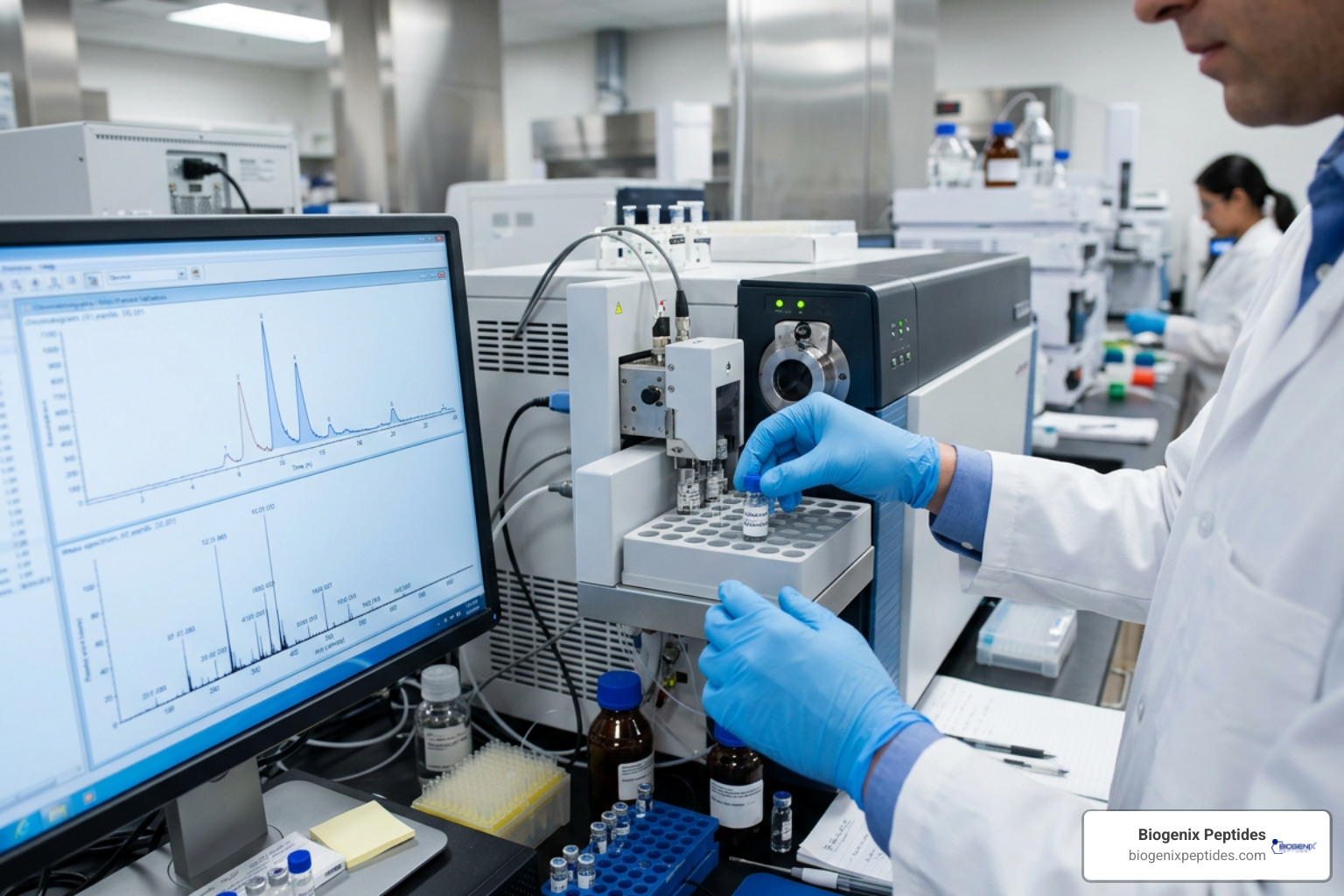
Before ordering or resynthesizing candidate hits, mastering how to read a peptide COA provides the skills needed to verify analytical documentation. Two orthogonal analytical tools remain the industry gold standard:
- Analytical Reversed-Phase HPLC (RP-HPLC): Determines chromatographic purity and verifies the absence of early-eluting deletion sequences or hydrophobic contaminants.
- High-Resolution Mass Spectrometry (HR-MS / ESI-MS): Confirms exact molecular weight and isotopic distribution, ensuring proper amino acid assembly and complete protecting-group removal.
For an in-depth review of how these analytical instruments operate together to confirm compound identity, review our reference on HPLC and mass spectrometry in peptide analysis. Familiarizing your lab team with the terminology covered in research peptides terms demystified will also help prevent common misinterpretations of peptide content, counter-ion mass, and net purity calculations.
Frequently Asked Questions About Peptide Screening
What is the difference between biological phage display and synthetic chemical peptide libraries?
Biological phage display links a peptide directly to the viral genome of an M13 bacteriophage, generating vast diversity (1 billion to 100 billion clones) that can be iteratively amplified in host bacteria. However, it is largely limited to the 20 standard L-amino acids.
Synthetic chemical peptide libraries are manufactured through parallel chemical synthesis in microplates or on resin beads. While their diversity is lower (100 to 100,000 compounds), chemical libraries can freely incorporate non-natural amino acids, D-stereocenters, backbone modifications, and macrocyclic crosslinks.
How should reconstituted peptide screening plates be stored to maintain integrity?
Reconstituted peptide screening plates should be sub-aliquoted into single-use daughter plates and stored at -80°C in airtight, moisture-sealed containers with desiccants.
Avoid repeated freeze-thaw cycles, which accelerate peptide aggregation and hydrolytic degradation. Ensure the DMSO or reconstitution buffer used remains dry and free of oxidizing contaminants.
Why are DNA-encoded libraries larger than peptide-encoded libraries?
DNA-encoded libraries (DELs) can reach diversities beyond 10 billion compounds because DNA tags can be exponentially amplified via PCR, enabling the detection of single, femtomolar-level binders using Next-Generation Sequencing.
Peptide-encoded libraries (PELs) rely on tandem mass spectrometry for tag decoding. Because mass spectrometers require compound concentrations around 1 nM for clear detection without amplification, PEL sizes are practically limited to 10,000 to 100,000 members.
Conclusion: Selecting the Optimal Screening Solution for Your Pipeline
Selecting the right screening system requires aligning your biological target, required chemical space, and analytical resources. For unbiased discovery across vast sequence permutations, biological display kits provide exceptional diversity. When your project demands non-natural modifications, rigid macrocycles, or precise epitope mapping, synthetic peptide arrays deliver reliable resolution.
High-throughput discovery requires unwavering material quality at every validation phase. Whether screening initial libraries or resynthesizing top hits for secondary binding assays, every peptide must meet rigorous analytical standards for identity, purity, and stability.
To support your lab’s discovery efforts, source high-purity research materials and explore specialized catalog offerings at the Biogenix Peptides shop.
Research Citations
Bozovičar K, Bratkovič T. “Evolving a Peptide: Library Platforms and Diversification Strategies..” International journal of molecular sciences, 2019. PMCID PMC6981544.