GHK-Cu (Copper Peptide): The Cellular “Repair Foreman” That Helps Coordinate Healing
Deep Dive • Mechanism • Research Review
Disclaimer: The information provided on this website, including articles, blogs, graphics, and other educational materials, is intended solely for informational and educational purposes within a scientific research context. This content is not medical advice and should not be interpreted as such.
BioGenix Peptides™ products are sold for research use only. They are not intended for human or veterinary use, are not approved by the FDA, and are not intended to diagnose, treat, cure, or prevent any disease.
Statements regarding molecular mechanisms, biological activity, or potential applications are based on publicly available scientific literature and preclinical research models. Results observed in laboratory, in vitro, or animal studies may not translate to outcomes in humans.
By accessing this website and purchasing products from BioGenix Peptides™, you acknowledge that you are a qualified researcher and agree to use these materials in compliance with all applicable laws and regulations.
Introduction
A science-forward, analogy-rich exploration of a naturally occurring copper-binding peptide studied for tissue remodeling, skin integrity, and wound repair signaling. Research-Only Notice:
This content is provided for educational and informational purposes only and is intended for scientific discussion in a research context. It is not medical advice and is not intended to diagnose, treat, cure, or prevent any disease. BioGenix Peptides™ products are sold for research use only and are not for human or veterinary use. Table of Contents
- What is GHK-Cu?
- Why copper matters (and why GHK is special)
- Mechanism #1: Gene expression modulation
- Mechanism #2: Skin & extracellular matrix remodeling
- Mechanism #3: Inflammation & oxidative balance
- Mechanism #4: Wound repair signaling in models
- Why it’s discussed in aging research
- Key takeaways
- Peer-reviewed references (Vancouver style)
What is GHK-Cu?
GHK-Cu is a naturally occurring copper-binding tripeptide complex: Glycyl-L-histidyl-L-lysine (GHK) bound to a copper ion (Cu2+). It has been identified in human fluids (including plasma) and has been studied for roles in tissue remodeling and repair signaling. [1,6]
Importantly, GHK-Cu is often discussed as a signaling peptide—not as a blunt “on switch,” but as a messenger that can influence repair pathways in cells and tissues.
In simple terms:
GHK-Cu is a tiny “message molecule” that carries copper in a controlled way and can help cells behave more like they’re in repair mode.
Why copper matters (and why GHK is special)
Copper is an essential trace element used in multiple biological processes—especially those tied to tissue structure and antioxidant defense. But “free” copper can be reactive, which is one reason biology typically prefers copper to be bound and escorted.
GHK acts like a precision escort, binding copper and potentially supporting targeted delivery/signaling behavior seen in research models.
Analogy:
Free copper is like tossing tools into a running engine. GHK-Cu is like a mechanic carrying the tool to the exact bolt that needs it.
In simple terms:
Copper is useful, but it needs “handling.” GHK is a natural way copper can be carried and used more safely/strategically in biology.
Mechanism #1: Gene expression modulation (the “reset” conversation)
One of the most discussed features of GHK-Cu in modern reviews is its potential to influence gene expression patterns related to repair, inflammation balance, and tissue integrity. [2,6]
In practice, this means researchers evaluate whether exposure to GHK/GHK-Cu shifts the “instructions” cells follow—nudging pathways associated with rebuilding extracellular matrix components and regulating inflammatory signaling. [2,6]
In simple terms:
Instead of “forcing growth,” GHK-Cu is discussed as helping cells read from a more repair-friendly playbook.
Mechanism #2: Skin & extracellular matrix remodeling (collagen, GAGs, proteoglycans)
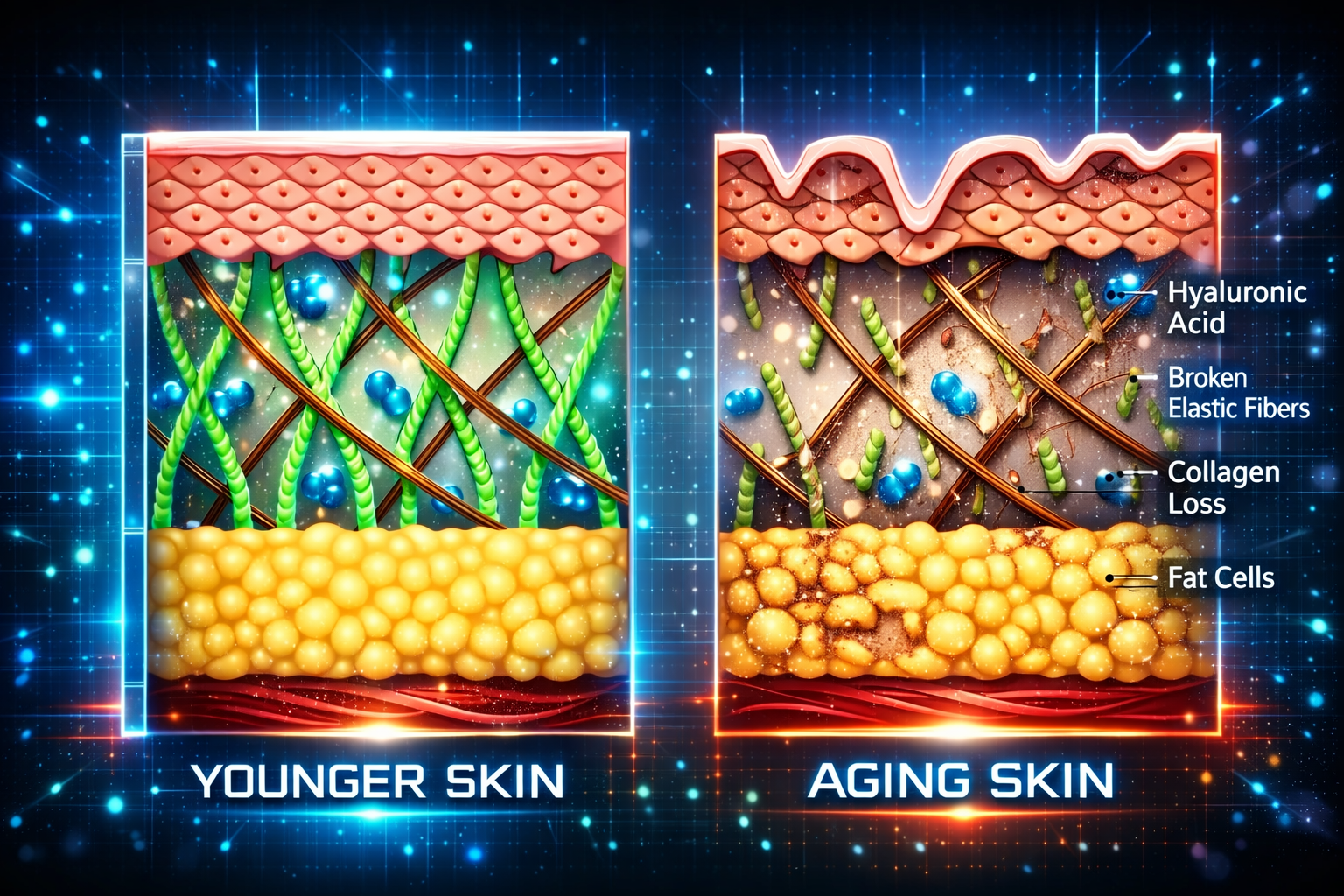
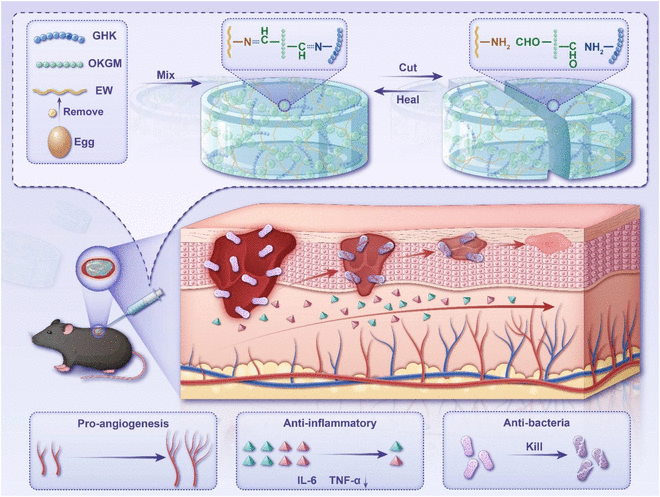
In tissue repair and skin biology, a huge part of the story is the extracellular matrix (ECM)—the structural scaffold made from collagen, glycosaminoglycans (GAGs), and proteoglycans that gives tissue its thickness, elasticity, and resilience.
Research in wound and fibroblast models has explored GHK-Cu’s effects on ECM-related outputs including glycosaminoglycans and small proteoglycans, as well as broader remodeling behavior during healing. [3,4,6]
Analogy:
If your skin is a mattress, collagen is the springs and GAGs/proteoglycans are the padding that keeps it plump. GHK-Cu is studied like a “materials coordinator” helping restock the right supplies during repair.
In simple terms:
GHK-Cu shows up in research around the building blocks that keep tissue firm, hydrated, and resilient—especially during wound repair.
Mechanism #3: Inflammation & oxidative balance (turning the “volume knob”)
Repair is not just “build new tissue.” It also requires controlling inflammatory signals and oxidative stress so the environment is suitable for remodeling. Reviews frequently discuss GHK-Cu in the context of anti-inflammatory and protective signaling across multiple pathways. [2,6]
Analogy:
Inflammation is like a controlled burn used to clear debris. Too little and the job doesn’t get done—too much and the whole forest catches. GHK-Cu is studied like a thermostat that helps keep the burn controlled.
In simple terms:
Healing needs inflammation, but not chaos. GHK-Cu is discussed as supporting a more balanced repair environment.
Mechanism #4: Wound repair signaling in models
Animal and wound-model research has investigated GHK-Cu’s influence on tissue accumulation and wound remodeling, including work using experimental wound systems. [4,6]
The key theme across this literature is that GHK-Cu is repeatedly positioned as a remodeling coordinator—helping orchestrate how tissue rebuilds, rather than acting as a single-target “switch.”
In simple terms:
In multiple wound-related studies, GHK-Cu is examined for how it may help tissues rebuild more effectively.
Why it’s discussed in aging research
A recurring idea in the GHK literature is that levels of GHK in the body may decline with age, and that this decline could relate to slower tissue repair signaling. Modern reviews and mechanistic papers often frame GHK/GHK-Cu as part of a broader “repair messaging” network. [2,6]
Analogy:
Aging isn’t only “wear and tear.” It can be “lost communication.” If repair messages get quieter over time, tissues may rebuild more slowly.
In simple terms:
Some scientists view GHK-Cu as one of the body’s natural repair signals—worth studying because repair tends to slow with age.
Key takeaways
- GHK-Cu is a naturally occurring copper-peptide complex studied for tissue remodeling and repair signaling. [2,6]
- It’s frequently discussed as a multi-pathway coordinator (gene expression, ECM remodeling, inflammatory balance). [2,3,4,6]
- Many findings come from cell culture and animal wound models—important context for interpretation. [3,4]
Peer-reviewed references (Vancouver style)
- Pickart L, Thaler MM. Tripeptide in human serum which prolongs survival of normal liver cells and stimulates growth in neoplastic liver. Nat New Biol. 1973;243(124):85–87. PubMed.
- Pickart L, Margolina A. Regenerative and Protective Actions of the GHK-Cu Peptide in the Light of the New Gene Data. Int J Mol Sci. 2018;19(7):1987. doi:10.3390/ijms19071987. PubMed | Full text (PMC) | DOI.
- Siméon A, Wegrowski Y, Bontemps Y, Maquart FX. Expression of glycosaminoglycans and small proteoglycans in wounds: modulation by the tripeptide-copper complex glycyl-L-histidyl-L-lysine-Cu(2+). J Invest Dermatol. 2000. PMID:11121126. PubMed.
- Maquart FX, Bellon G, Chaqour B, et al. In vivo stimulation of connective tissue accumulation by the tripeptide-copper complex glycyl-L-histidyl-L-lysine-Cu2+ in rat experimental wounds. J Clin Invest. 1993;92:2368–2376. doi:10.1172/JCI116842. PubMed | DOI.
- Pickart L, Vasquez-Soltero JM, Margolina A. GHK Peptide as a Natural Modulator of Multiple Cellular Pathways in Skin Regeneration. Biomed Res Int. 2015;2015:648108. doi:10.1155/2015/648108. PubMed | Full text (PMC) | DOI.
- Pickart L. The human tri-peptide GHK and tissue remodeling. J Biomater Sci Polym Ed. 2008;19(8):969–988. doi:10.1163/156856208784909435. PubMed | DOI.
Reminder: This article is for educational scientific discussion only. BioGenix Peptides™ products are sold for research use only and are not for human or veterinary use.
GHK-Cu 100mg
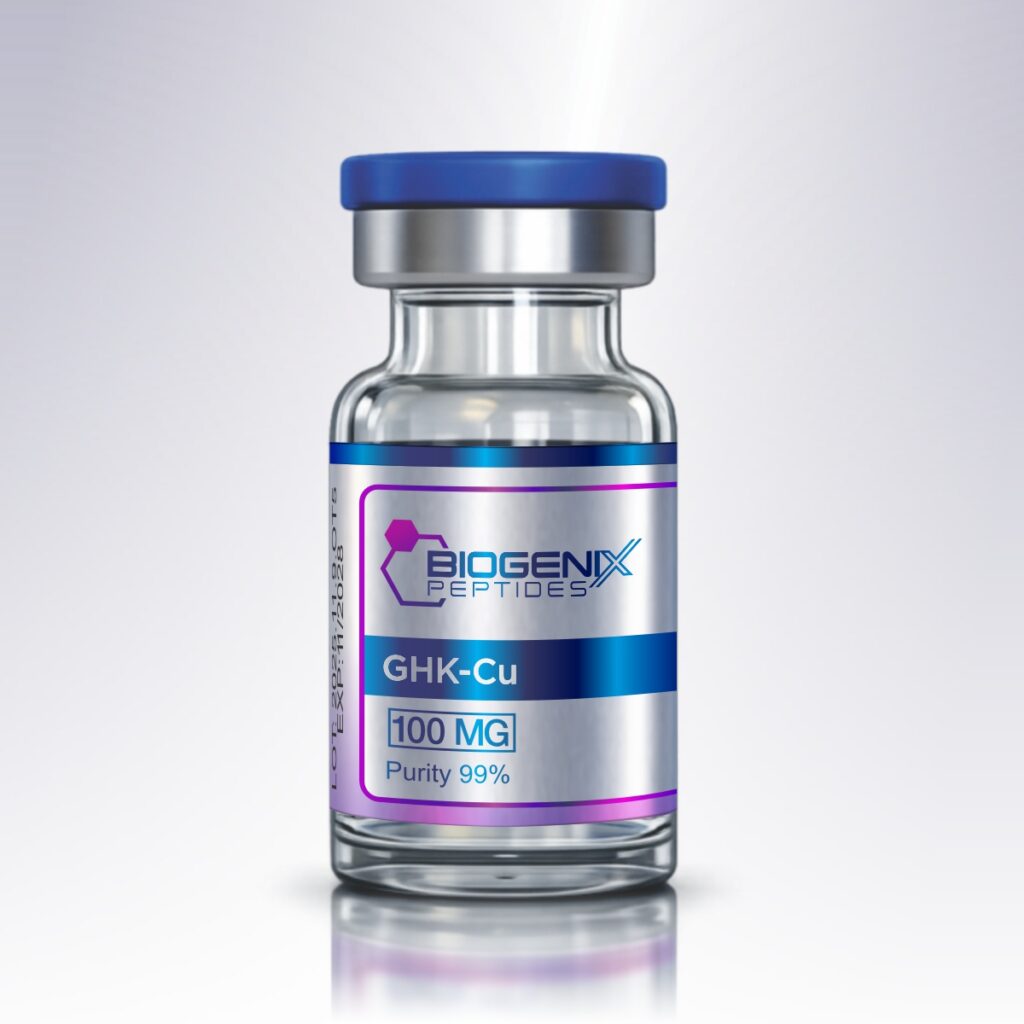
GHK-Cu is a naturally occurring copper-binding tripeptide composed of glycyl-L-histidyl-L-lysine chelated to copper (II). It is present in plasma and is released at injury sites, where it is proposed to influence extracellular matrix synthesis and tissue repair. Reported circulating concentrations decline with age (e.g., ~200 ng/mL at ~20 years to ~80 ng/mL by ~60 years). In vitro and in vivo studies have explored GHK (with and without copper) for roles spanning collagen dynamics, antioxidant defenses, wound healing, gene expression modulation, and anti-inflammatory pathways.
Out of stock