
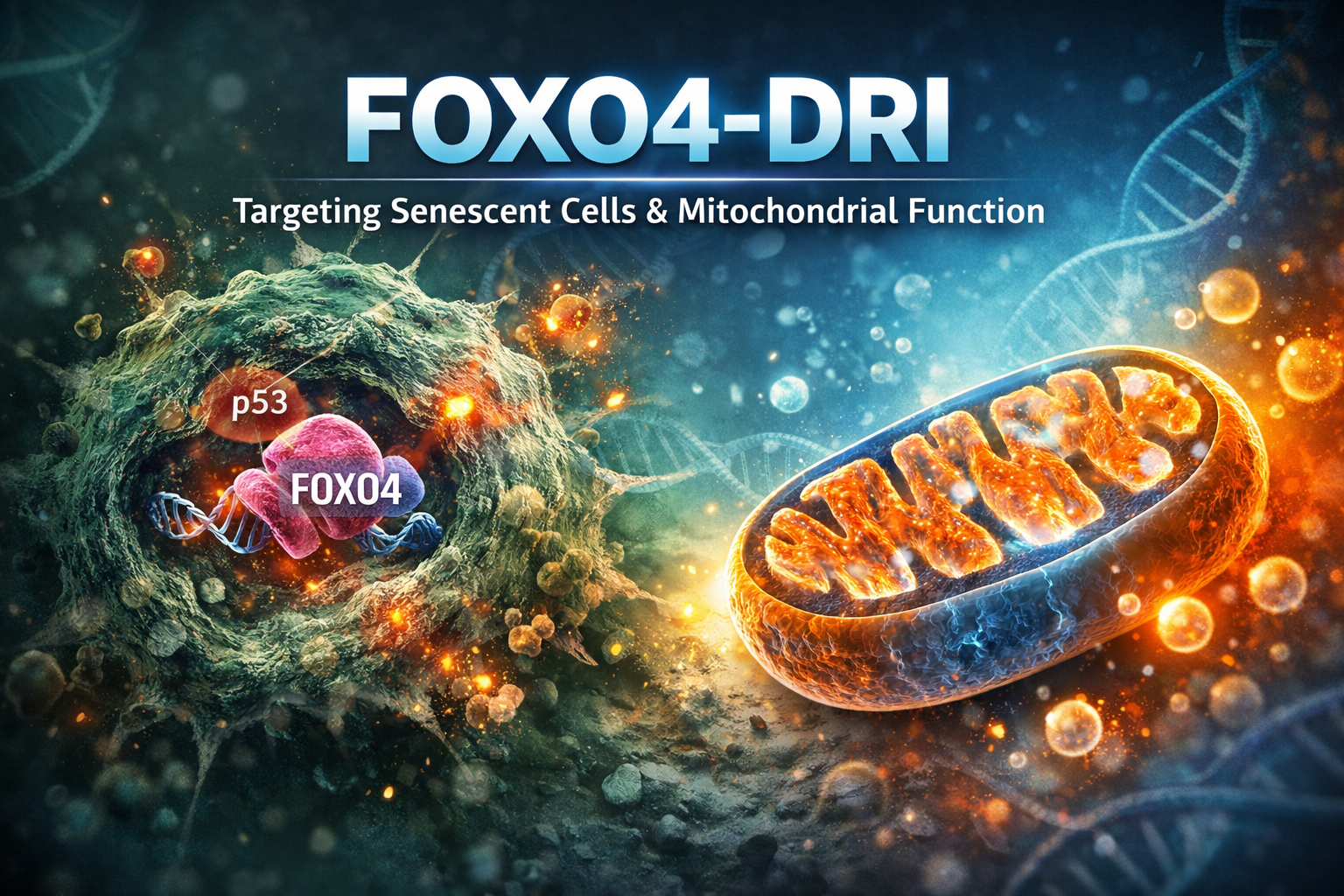
FOXO4-DRI: Targeting Senescent Cells and the Downstream Effects on Mitochondrial Function
Research Use Only Disclaimer
FOXO4-DRI and related compounds referenced on this page are offered strictly for laboratory and analytical research purposes only. They are not approved by the FDA or any regulatory authority for human or veterinary use.
These materials are not drugs, dietary supplements, cosmetics, or medical devices. They are not intended to diagnose, treat, cure, or prevent any disease. Any discussion of mechanisms, biological pathways, or preclinical findings is provided solely for educational review of published research.
BioGenix Peptides does not provide medical advice, dosing guidance, administration instructions, or recommendations for personal use. Purchasers are responsible for ensuring compliance with all applicable laws and regulations regarding research materials.
Introduction
A deep research overview of the FOXO4–p53 pathway, senescent cell signaling (SASP), and how clearing senescent burden may improve tissue energetics and mitochondrial health in preclinical models.
Category: Research EducationTopic: Senescence • Mitochondria • InflammationReading time: Long-form
The Emerging Science of Cellular “Housekeeping”
Longevity research is increasingly focused on the biology of cellular senescence—a state in which cells stop dividing, resist programmed cell death, and begin secreting inflammatory signals that can impair nearby tissues. FOXO4-DRI is studied as a targeted approach intended to disrupt a key survival interaction in senescent cells, thereby promoting their clearance in preclinical models.
While FOXO4-DRI is often discussed in the context of “senolytics” (agents studied for senescent cell clearance), the more interesting downstream story for many researchers is mitochondrial: senescent cells tend to harbor dysfunctional mitochondria, generate excessive oxidative stress, and amplify inflammatory cascades that further degrade tissue energetics. When senescent burden is reduced in animal models, markers of mitochondrial function and tissue resilience frequently improve.
Simple Terms Summary
Some older, damaged cells don’t “shut down” when they should. Instead, they hang around and release signals that irritate surrounding tissue. These problem cells often have malfunctioning mitochondria (the cell’s power system) that leak stress signals. FOXO4-DRI is studied as a way to push certain senescent cells toward a normal shutdown process, which may reduce inflammation and allow healthier cells—and their mitochondria—to function better.
What Are Senescent Cells?
Cellular senescence is commonly triggered by DNA damage, telomere shortening, oncogenic stress, or other cellular injury. Senescent cells typically exhibit a stable growth arrest, altered gene expression, and changes in metabolism. Importantly, they can remain alive for long periods, resisting apoptosis under conditions where damaged cells would normally be removed.
A central feature of senescence is the senescence-associated secretory phenotype (SASP)—a mix of cytokines, chemokines, proteases, and growth factors that can reshape the tissue environment. SASP signaling is not “all bad” in every context; it may be helpful in wound healing or tumor suppression in the short term. The issue arises when senescent cells accumulate and SASP becomes chronic, contributing to persistent inflammation and functional decline across tissues.
Common characteristics observed in senescent cells
- Increased inflammatory signaling (SASP factors such as IL-6, IL-1β, TNF-α in many models)
- Elevated oxidative stress and reactive oxygen species (ROS)
- Impaired mitochondrial dynamics (often more fragmented or dysfunctional networks)
- Reduced regenerative capacity in local tissue microenvironments
FOXO4-DRI Mechanism: Disrupting FOXO4–p53 Binding
FOXO4 (Forkhead box O4) is a transcription factor that, among other roles, participates in stress response pathways. In senescent cells, FOXO4 is implicated in maintaining cell survival by interacting with p53, a key regulator of cell cycle arrest and apoptosis. In certain senescent contexts, FOXO4 can help keep p53 activity biased away from apoptosis, allowing senescent cells to persist.
FOXO4-DRI is engineered as a D-retro-inverso peptide that mimics a portion of FOXO4’s interaction surface. In the foundational preclinical work, this construct was designed to compete with endogenous FOXO4 for p53 binding. By disrupting the FOXO4–p53 interaction, the hypothesis is that p53 can more readily engage apoptosis pathways in senescent cells, promoting selective clearance while sparing many non-senescent cells in those models.
Simple Terms Summary
Think of p53 as a “quality control” system that can shut down badly damaged cells. Some senescent cells use FOXO4 like a “shield” to avoid being shut down. FOXO4-DRI is studied as a molecule that gets in the way of that shield, letting the shutdown process happen in those senescent cells.
Why Mitochondria Are Central to the Senescence Story
Mitochondria are more than ATP generators; they are major regulators of redox signaling, innate immune activation, and programmed cell fate. Many senescent cells show mitochondrial abnormalities, including impaired electron transport chain function, altered membrane potential, disrupted fusion/fission dynamics, and increased mitochondrial-derived ROS. This matters because ROS and mitochondrial stress signals can amplify inflammatory cascades and reinforce senescence signaling both within the cell and across tissue neighborhoods.
Researchers have proposed a reinforcing loop in which mitochondrial dysfunction contributes to senescence (and SASP), while SASP and chronic inflammation further damages mitochondrial function in nearby cells. In this framework, senescent burden is not only a symptom of aging but a driver of declining tissue energetics.
The SASP–Mitochondria feedback loop
In many models, SASP factors contribute to chronic inflammation and can impair cellular housekeeping processes that normally keep mitochondria healthy, such as autophagy/mitophagy and balanced mitochondrial biogenesis. Meanwhile, stressed mitochondria can activate inflammatory pathways, increasing the production of SASP components. The result can be a self-sustaining environment where tissue function slowly degrades over time.
Simple Terms Summary
When mitochondria struggle, cells leak stress signals and “noise” that irritate the surrounding area. Senescent cells do this a lot. That irritation can damage other cells’ mitochondria too, spreading dysfunction. Clearing senescent cells is studied as a way to remove a major source of that stress so the tissue environment can stabilize.
Does FOXO4-DRI “Repair” Mitochondria?
FOXO4-DRI is not generally described in the literature as a direct mitochondrial repair agent. Instead, the mitochondrial relevance comes from what happens after senescent cells are reduced in preclinical models: inflammation markers tend to decline, oxidative stress can drop, and tissue function sometimes improves. In many senolytic studies (including those not specific to FOXO4-DRI), researchers observe improved mitochondrial signaling or structure as the tissue environment becomes less inflammatory and less oxidative.
The distinction is important. Compounds like SS-31 (elamipretide) are studied for more direct interactions with mitochondrial membranes and electron transport stabilization, while FOXO4-DRI is studied for a more upstream “environmental cleanup” approach by targeting senescent cell survival mechanisms.
What Preclinical Research Suggests
The initial FOXO4-DRI research demonstrated selective targeting of senescent cells in mouse models, with reported improvements in certain functional readouts and tissue markers. While those outcomes are not equivalent to proving clinical benefit in humans, they have fueled broader interest in senescence as a lever for improving tissue resilience.
Beyond FOXO4-DRI specifically, the senolytic field has accumulated evidence that reducing senescent burden can improve physiological function in multiple organ systems in animal models and, in early human pilot studies with other senolytics, has been explored in limited clinical contexts. Across this broader literature, mitochondrial-related endpoints (oxidative stress, energetic capacity, mitochondrial quality control) appear repeatedly as downstream signals that may improve when chronic senescence-associated inflammation is reduced.
Why “selective” matters
Senescence is not universally harmful in every context. Short-lived senescence can support tumor suppression and wound healing, and senescent signaling can be part of normal tissue remodeling. The research challenge is developing approaches that reduce harmful, persistent senescent burden without disrupting beneficial, transient senescence responses. Selectivity, timing, and tissue context are therefore recurring themes in senolytic research discussions.
Research Status Note
Human data on FOXO4-DRI specifically is limited. Most mechanistic and functional claims come from preclinical studies and broader senescence research. Translating senolytic strategies into safe, reliable human applications remains an active area of investigation.
How This Differs from “Energy” or “Mitochondria” Peptides
Mitochondrial-targeted peptides and signaling peptides are often studied for more direct support of mitochondrial function—stabilizing membranes, improving electron flow, or modulating metabolic signaling. FOXO4-DRI is studied differently: it targets a survival pathway in senescent cells, with mitochondrial improvements framed as downstream effects of reducing senescent burden and chronic SASP signaling.
A useful way to conceptualize the distinction is: direct mitochondrial peptides aim to improve the performance of the “engine,” whereas senolytic strategies aim to remove persistent sources of “toxic exhaust” that degrade the whole system over time.
Limitations, Unknowns, and Why This Field Is Still Early
Even with exciting preclinical signals, senolytic research faces practical and scientific uncertainties. Key open questions include optimal dosing schedules (intermittent vs. continuous), tissue selectivity, biomarkers for senescent burden in living organisms, and how to balance beneficial versus harmful roles of senescence across different contexts.
Another major limitation is heterogeneity: “senescent cells” are not one uniform thing. Different tissues, triggers, and species can produce senescent phenotypes that vary significantly. This means a strategy that appears selective in one model may not behave identically elsewhere. The complexity is exactly why researchers continue to emphasize careful interpretation and controlled investigation.
Simple Terms Summary
The idea is promising, but the science is still evolving. “Old cells” can be different depending on tissue and stress type, and clearing them safely is complicated. Most FOXO4-DRI evidence is from animal research, so it’s best viewed as a research concept—not a finished, proven human solution.
Peer-Reviewed References
- Baar MP, Brandt RMC, Putavet DA, Klein JDD, Derks KWJ, Bourgeois BRM, et al. Targeted apoptosis of senescent cells restores tissue homeostasis in response to chemotoxicity and aging. Cell. 2017;169(1):132–147.e16.
- Childs BG, Durik M, Baker DJ, van Deursen JM. Cellular senescence in aging and age-related disease. Nat Med. 2015;21(12):1424–1435.
- Kirkland JL, Tchkonia T. Cellular senescence: A translational perspective. EBioMedicine. 2017;21:21–28.
- Correia-Melo C, Passos JF. Mitochondria: Are they causal players in cellular senescence? Biochim Biophys Acta. 2015;1847(11):1373–1379.
- Wiley CD, Campisi J. From ancient pathways to aging cells—connecting metabolism and cellular senescence. Cell Metab. 2016;23(6):1013–1021.
- Justice JN, Nambiar AM, Tchkonia T, LeBrasseur NK, Pascual R, Hashmi SK, et al. Senolytics in idiopathic pulmonary fibrosis: Results from a first-in-human, open-label pilot study. EBioMedicine. 2019;40:554–563.