
ARA-290 (Cibinetide): Deep Science on a Selective Tissue-Protective Peptide
Research Use Only Disclaimer
The information provided on this website is for educational and informational purposes only. All products referenced are research compounds intended solely for in vitro laboratory research and development.
These materials are not intended for human or veterinary use, are not approved by the FDA, and are not intended to diagnose, treat, cure, or prevent any disease. No statements on this site have been evaluated by the Food and Drug Administration.
The content on this website should not be construed as medical advice, dosing guidance, or a substitute for consultation with a qualified healthcare professional.
By accessing this website, you acknowledge that you are a qualified researcher and agree to use all products in compliance with applicable laws and regulations.
Mechanism, receptor biology, and what human trials actually show — with “in simple terms” summaries and peer-reviewed references.
- What ARA-290 is
- The Innate Repair Receptor (IRR): the key target
- Downstream signaling: how “repair mode” is switched on
- Human evidence: what trials found
- Why it’s different from standard symptom-only approaches
- Safety and open questions
- References (Vancouver)
1) What ARA-290 is
ARA-290 (also called cibinetide) is a short synthetic peptide designed from a region of the erythropoietin (EPO) molecule that is associated with tissue protection rather than red-blood-cell production. The central goal: capture EPO-like cytoprotective / anti-inflammatory signaling while avoiding EPO’s hematopoietic (blood-forming) effects. [5]
In simple terms: ARA-290 is built to trigger the body’s repair signaling without turning on the “make more blood cells” pathway.
2) The Innate Repair Receptor (IRR): the key target
EPO can signal through different receptor configurations. ARA-290 is best known for selectively activating the Innate Repair Receptor (IRR), described as a heteromeric complex involving the EPO receptor (EPOR) and the β common receptor (CD131). This receptor is upregulated in tissues under stress or injury and is associated with anti-inflammatory and tissue-protective programs rather than erythropoiesis. [5]
Classic EPO signaling (simplified)
Primarily drives red blood cell production (desired in anemia, but can be risky in other contexts).
IRR signaling (ARA-290’s lane)
Biases toward anti-inflammation, cytoprotection, microvascular support, and repair responses after injury/metabolic stress.
In simple terms: ARA-290 is like a “selective key” that fits the body’s repair receptor more than the blood-production receptor.
3) Downstream signaling: how “repair mode” gets switched on
When IRR signaling is activated, multiple downstream cascades associated with cell survival and inflammation control can be modulated. In the neuropathy literature, a recurring theme is that ARA-290 appears to shift tissues away from a chronic pro-inflammatory state and toward a program that supports healing and functional recovery. [5]
What that can mean biologically
- Immune “dampening” without full shutdown: Cibinetide has been reported to dampen certain innate immune cell functions in experimental settings. [4]
- Neurovascular + small-fiber relevance: Small fiber neuropathy involves injury to thin sensory/autonomic fibers and often microvascular and inflammatory contributors.
- “Disease-modifying” hypothesis: ARA-290 has been framed as potentially more than symptomatic relief if it improves objective small fiber measures (e.g., corneal nerve fiber density). [3]
In simple terms: Instead of just “muting pain,” the goal is to calm the inflammatory environment that keeps nerves irritated — and help the tissue recover.
4) Human evidence: what trials found (and what they didn’t)
A) Sarcoidosis-associated small fiber neuropathy
In a clinical study involving patients with sarcoidosis-associated small fiber neuropathy, ARA-290 was reported to improve symptoms and increase corneal nerve fiber density (a non-invasive biomarker of small fiber integrity). [3]
In simple terms: Some participants didn’t just report feeling better — measurements suggested small nerve fibers may have improved.
B) Type 2 diabetes with neuropathic symptoms
In Molecular Medicine, Brines and colleagues reported that ARA-290 improved neuropathic symptoms and showed improvements in metabolic control in patients with type 2 diabetes. [1]
In simple terms: In addition to neuropathy symptom measures, some metabolic markers improved — suggesting broader stress-repair signaling may be involved.
Reality check:
The most interesting findings in this area often come from relatively small or phase-2 style studies. The field still needs larger, longer trials to confirm durability, identify best responders, and understand how outcomes translate across different neuropathy causes. [5]
Related trial registrations and results postings exist (useful for study design details, endpoints, and timelines). [6] [7]
5) Why ARA-290 is different from symptom-only strategies
Many neuropathic pain approaches are primarily symptom modulators. ARA-290’s research rationale is different: it aims at an injury-response / repair receptor and is discussed as a potential disease-modifying approach if structural small fiber metrics improve. [5]
| Question | Typical symptom-focused meds | ARA-290 research intent |
|---|---|---|
| Does it target pain signaling? | Often yes | Indirectly (via inflammation/repair milieu) |
| Does it target underlying inflammation? | Varies / limited | Core hypothesis [5] |
| Any objective small-fiber improvement? | Rare | Reported in corneal fiber outcomes in sarcoidosis SFN [3] |
In simple terms: The big idea is “change the environment so nerves can recover,” not just “turn down the volume on pain.”
6) Safety and open questions
ARA-290 is engineered to avoid EPO’s erythropoietic effects, and the neuropathy literature emphasizes a favorable safety profile in the studied settings. [5] That said, as with many investigational therapies, important questions remain.
- Durability: How long do benefits persist after stopping treatment? [5]
- Responder biology: Which neuropathy subtypes respond best (inflammatory vs metabolic vs idiopathic)?
- Optimal endpoints: Symptom scores are important, but objective fiber measures (e.g., corneal confocal microscopy) can clarify disease modification. [3]
- Broader indications: IRR signaling is being explored in other injury/repair contexts, but translation is indication-specific.
References (peer-reviewed)
- Brines M, Dunne AN, van Velzen M, et al. ARA 290, a nonerythropoietic peptide engineered from erythropoietin, improves metabolic control and neuropathic symptoms in patients with type 2 diabetes. Mol Med. 2015;20(1):658-666. doi:10.2119/molmed.2014.00215. PubMed · Journal page
- van Velzen M, Dahan A. ARA 290 for treatment of small fiber neuropathy in sarcoidosis. Expert Opin Investig Drugs. 2014. (Review of phase II data and rationale). PubMed
- Dahan A, et al. ARA 290 improves symptoms in patients with sarcoidosis-associated small nerve fiber loss and increases corneal nerve fiber density. Mol Med. 2013;19:334-345. Full text (PMC)
- Nairz M, et al. Cibinetide dampens innate immune cell functions thus ameliorating tissue injury. Sci Rep. 2017. Nature / Scientific Reports
- Dahan A, et al. Targeting the innate repair receptor to treat neuropathy. Pain Rep. 2016. Full text (PMC)
- ClinicalTrials.gov. Study of efficacy of ARA-290 on corneal nerve fiber density and neuropathic symptoms (sarcoidosis SFN). NCT02039687
- EU Clinical Trials Register. Double-blind, placebo-controlled phase 2 dose-ranging study of ARA-290 in sarcoidosis (results posting). EudraCT 2013-003016-45
- Culver DA, et al. Cibinetide improves corneal nerve fiber abundance in patients with sarcoidosis-associated small nerve fiber loss and neuropathic pain. Invest Ophthalmol Vis Sci. 2017;58:BIO52-BIO60. doi:10.1167/iovs.16-21291. IOVS
Last updated: Feb 4, 2026.
If you want, I can also format this into an Elementor-friendly section layout (containers + headings + icon boxes), or generate a shorter “product page” version while keeping the same citations.

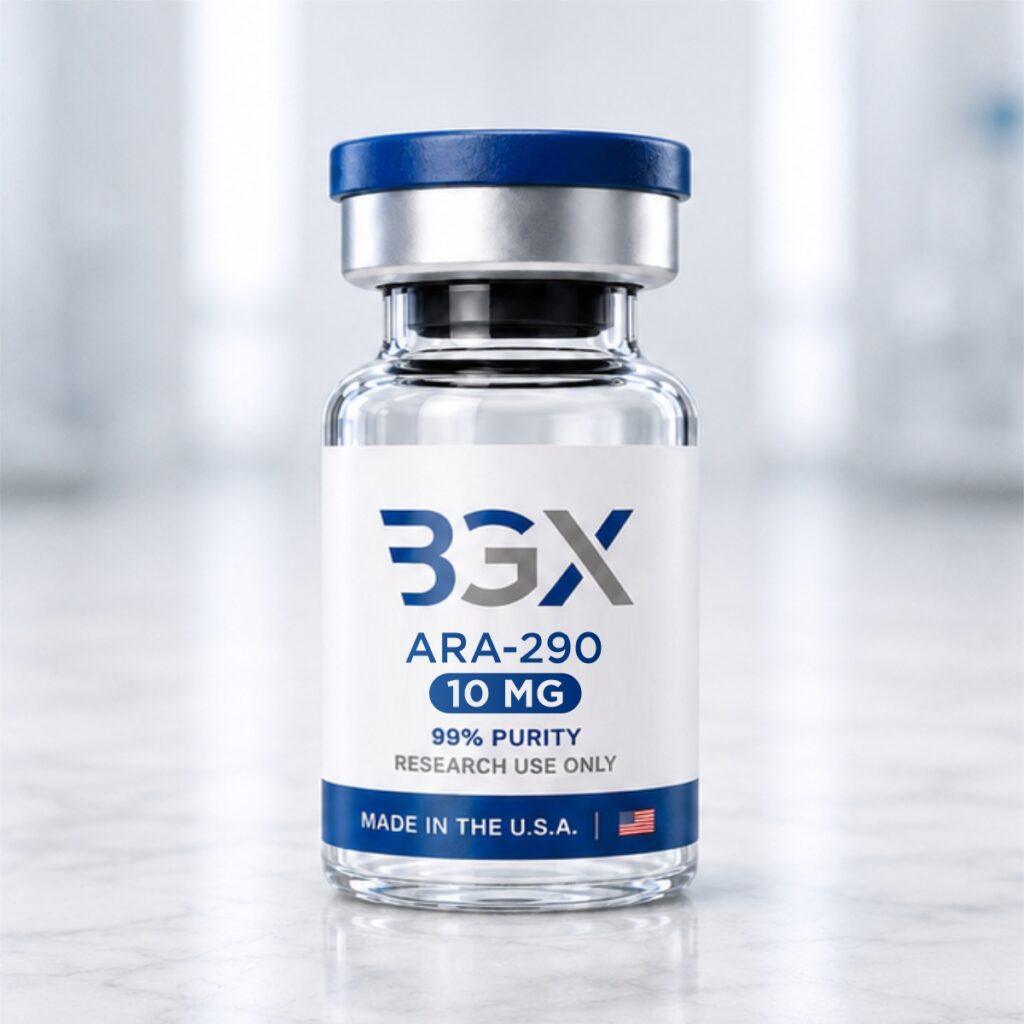
ARA-290 10mg
ARA-290 (Cibinetide) is a synthetic peptide designed to support the body’s natural repair and anti-inflammatory pathways. It is based on a small portion of the erythropoietin (EPO) molecule but engineered to avoid the blood-building effects associated with full EPO. Instead, ARA-290 activates a specific “repair receptor” involved in calming inflammation and protecting tissues.Because of this targeted action, ARA-290 is widely studied for its potential roles in inflammation control, nerve protection, microvascular repair, and immune system balance—all without increasing red-blood-cell levels…