The Science of Making Peptides Heatproof
The Science of Making Peptides Heatproof
Why Enhancing Peptide Thermal Stability Matters for Research and Therapeutics
Enhancing peptide thermal stability is one of the most critical challenges in peptide science today. Here’s a quick overview of the most effective approaches:
Top methods for improving peptide heat resistance:
- Counterion selection – Use Na⁺ or Ca²⁺ at pH 7, or Cl⁻ at pH 2 to reinforce nanofiber backbone integrity at elevated temperatures
- Hydrocarbon stapling – Cross-link peptide chains at i,i+4 or i,i+7 positions to enforce α-helical structure and resist unfolding
- D-amino acid substitution – Replace L-amino acids with D-forms to block protease recognition and cleavage
- Encapsulation – Use liposomes, hydrogels, or polymeric nanoparticles to shield peptides from thermal and enzymatic stress
- pH and buffer optimization – Maintain pH between 3–5 using acetate or citrate buffers to minimize hydrolysis and deamidation
- Amphiphilic peptide surfactants – Peptides like Ac-I5K2-CONH2 can raise the melting temperature of sensitive proteins by several degrees
Peptides are remarkable molecules. They sit in a unique molecular weight range — between small-molecule drugs and large biologics — and they offer high specificity and low toxicity. Around 120 therapeutic peptides have already been approved by the USFDA, with over 140 more in clinical trials.
But there’s a serious problem.
Peptides are fragile. Heat is one of their biggest enemies. Even modest temperature increases can break apart the hydrogen bonds and self-assembled structures that give peptides their function. Once a peptide unfolds or its nanofiber disintegrates, it often cannot do its job — whether that’s delivering a drug, supporting cell adhesion, or harvesting solar energy.
The stakes are high in research settings too. A peptide that degrades on the bench, in storage, or inside the body before reaching its target is a wasted resource — and potentially a failed experiment.
This guide walks through exactly how heat destabilizes peptides at the molecular level, and what you can do about it — from smart counterion choices and structural engineering to advanced delivery systems.
I’m Jay Daniel, Founder and CEO of BioGenix Peptides, with years of hands-on experience in peptide development, quality control, and research innovation. My work in enhancing peptide thermal stability spans formulation strategy, sourcing protocols, and tracking the latest advances in structural peptide engineering — all to help researchers get reliable, reproducible results with high-quality peptides.
Molecular Mechanisms of Peptide Nanofiber Disintegration
When we look at peptides through the lens of bionanomedicine, we often see them organized into complex shapes like nanofibers. These structures are held together by a delicate balance of non-covalent forces. To understand how to make them “heatproof,” we first have to understand why they fall apart.
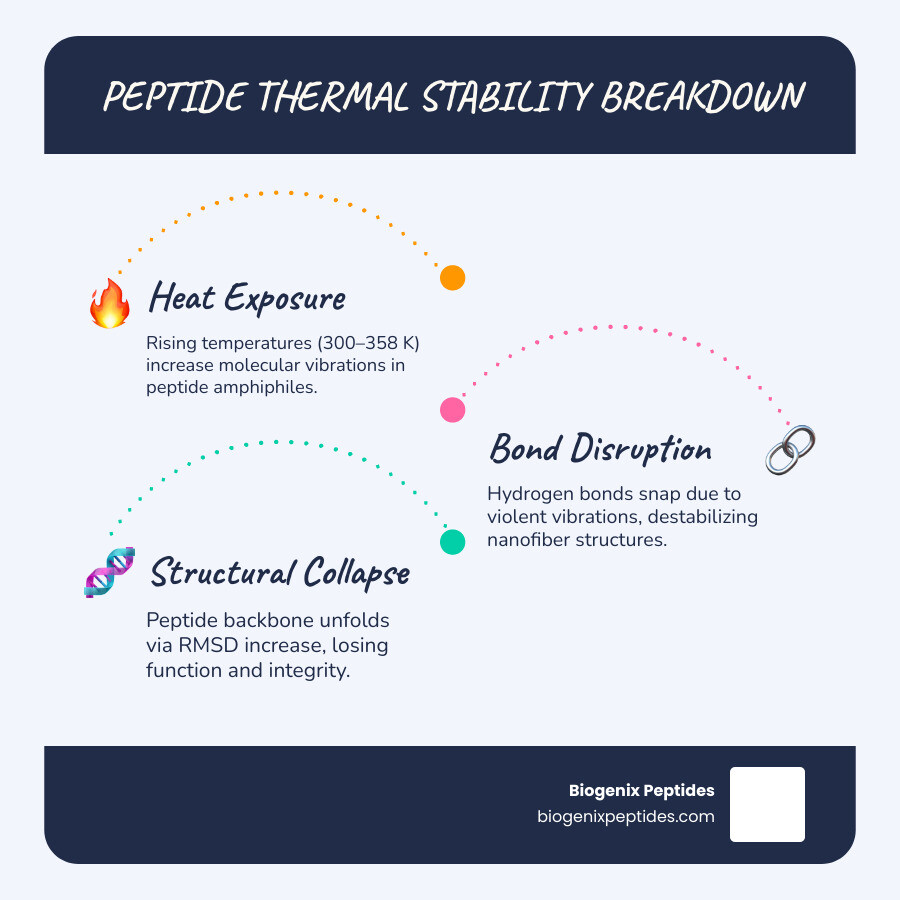
Scientists use a technique called united-atom molecular dynamics (MD) simulation to watch this disintegration in real-time. In these simulations, we can observe how increasing temperature (specifically in the range of 300–358 K) affects the peptide backbone. The primary culprit in structural failure is the loss of hydrogen bonding. As kinetic energy rises, the vibrations within the peptide amphiphiles become so violent that the hydrogen bonds—the “velcro” holding the nanofiber together—begin to snap.
Researchers use RMSD analysis (Root Mean Square Deviation) to measure how much the atoms in a peptide deviate from their original, stable positions. High RMSD values at elevated temperatures indicate that the backbone integrity is failing. We’ve seen that as the temperature climbs toward 358 K, the self-assembly of these nanofibers begins to loosen, leading to total disintegration if the environment isn’t perfectly optimized.
This is exactly why research peptides are typically lyophilized and how this benefits research. By removing water and storing the peptide in a “freeze-dried” state, we effectively hit the pause button on these molecular vibrations, preventing the disintegration that would otherwise happen in a liquid state at room temperature. For more technical insights into these protective mechanisms, you can explore this Scientific research on peptide stability strategies.
Environmental Variables Enhancing Peptide Thermal Stability
One of the coolest (pun intended) findings in recent years is that the environment surrounding a peptide can act as a thermal shield. It’s not just about the peptide itself; it’s about the “soup” it lives in.
pH Sensitivity and Counterion Identity The charge of a peptide changes based on the pH of the solution. At a neutral pH of 7, many peptide amphiphiles carry a negative charge. To keep them stable, we introduce positive counterions like Sodium (Na+) or Calcium (Ca2+). These ions act like molecular glue, neutralizing the repulsive charges between peptide molecules and reinforcing the nanofiber backbone.
If the environment is acidic (pH 2), the peptide might become positively charged, requiring a negative counterion like Chloride (Cl−) for stability. Our research shows that enhancing peptide thermal stability is highly dependent on matching the right ion to the right pH. For example, at higher temperatures, nanofibers formed with specific ions remain intact far longer than those without them.
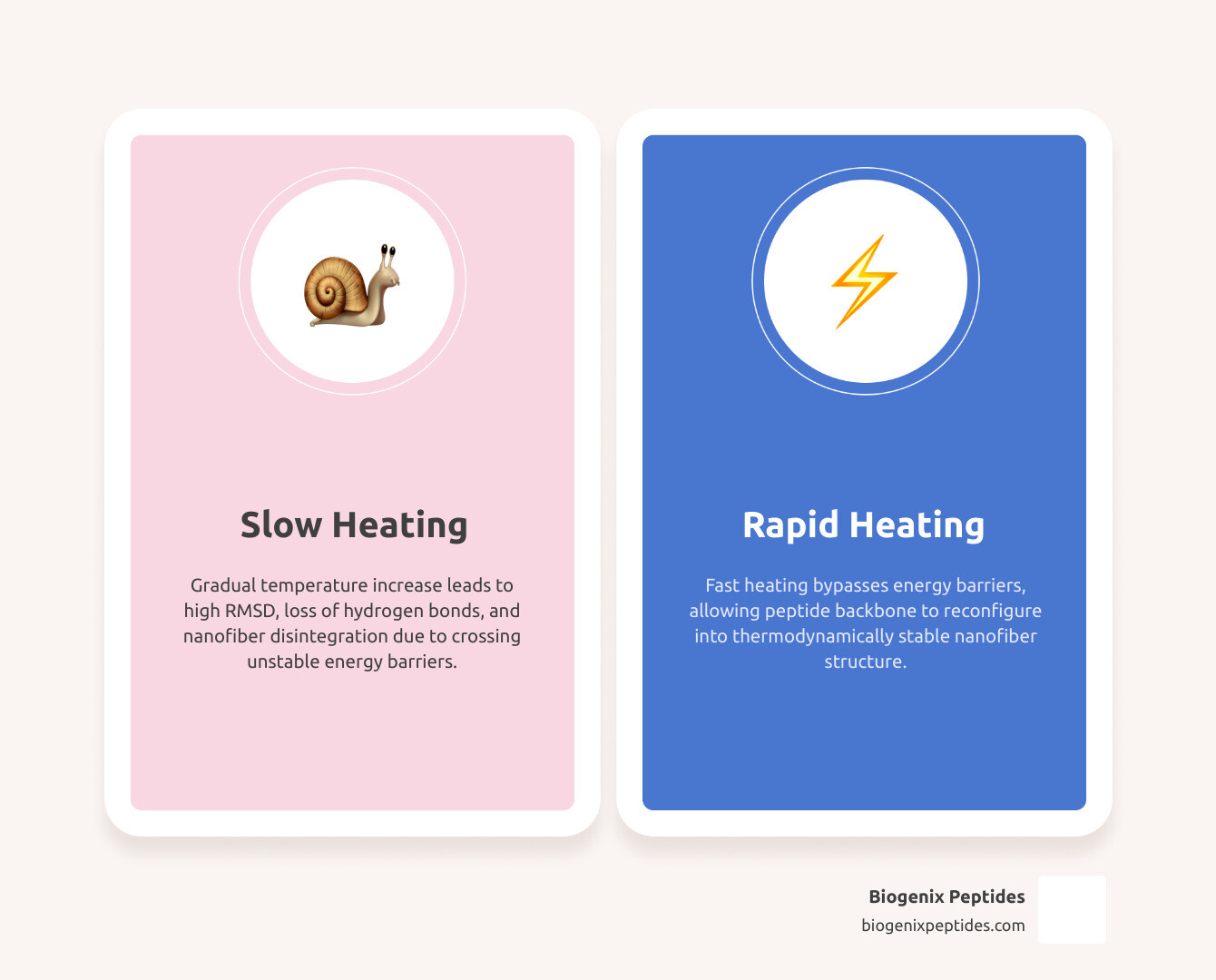
The Rapid Heating Anomaly Here’s a head-scratcher: sometimes, heating a peptide faster actually makes it more stable. In certain simulations, rapid heating to high temperatures allowed the peptide backbone to reestablish its integrity. Why? It seems the peptide can bypass an intermediate “energy barrier” to reach a more thermodynamically stable configuration that it couldn’t access through slow, gradual heating. It’s a bit like jumping over a puddle instead of trying to wade through it.
To ensure your samples stay within these optimal windows, we recommend following our peptide storage & stability guidelines to manage these environmental variables effectively.
Structural Engineering: Stapling and Substitution Strategies
If the environment is the shield, then structural engineering is the armor. We can physically modify a peptide to make it inherently more resistant to heat and enzymes.
Hydrocarbon Stapling and “Stitched” Peptides Imagine a spiral staircase. If the wind blows hard enough, the staircase might wobble or collapse. Now, imagine welding steel bars between the steps. That is hydrocarbon stapling. By using ruthenium-catalyzed metathesis, we can create a covalent bridge (a “staple”) between two parts of the peptide’s alpha-helix.
- Single-stapling: Increases the half-life of a peptide significantly. For instance, a stapled HCV inhibitor showed a 200-minute half-life compared to just 10 minutes for the linear version.
- Double-stapling: Takes it further. Double-stapled analogs have shown half-lives of up to 335 minutes against aggressive enzymes like chymotrypsin.
- Stitched Peptides: This is the “gold standard.” These involve spiro-linked staples that create a continuous, reinforced structure. In tests, stitched peptides remained 94% intact after exposure to trypsin, while unmodified peptides were completely destroyed.
D-amino Acid Substitution Most natural peptides are made of L-amino acids. However, enzymes in the body (and heat-induced stress) target these specific shapes. By substituting L-amino acids with their mirror-image D-amino acids, we can effectively “hide” the peptide from degradation. This modification doesn’t just improve thermal resilience; it makes the peptide nearly invisible to the proteases that would otherwise chew it up. We are also seeing that new enzyme-based chemistry is making peptides more stable by allowing for more precise modifications.
Improving Helicity for Enhancing Peptide Thermal Stability
The alpha-helix is the most common secondary structure in proteins, but in short peptides, it’s often unstable. Enhancing peptide thermal stability often boils down to “enforcing” this helicity.
By placing staples at the i,i+4 or i,i+7 positions, we can lock the peptide into a rigid helical shape. This does two things:
- It maximizes the internal hydrogen bonding, making the structure harder to melt.
- It shields the amide bonds—the vulnerable “neck” of the peptide—inside the helical core where heat and enzymes can’t reach them.
A famous example is the SAH-p53 analog. By stapling this peptide, researchers increased its helicity from a measly 11% to as high as 59%. This didn’t just make it more heat-stable; it increased its binding affinity to its target by three orders of magnitude!
Advanced Delivery Systems for Thermal Protection
Sometimes, the best way to protect a peptide is to put it in a “delivery van.” Advanced delivery systems act as physical barriers against the outside world.
Cell-Penetrating Peptides (CPPs) CPPs like the TAT sequence (from HIV-1) or Penetratin are masters of movement. They can carry cargo directly into cells. Because they often rely on arginine-rich domains, they create strong interactions with membranes that can help stabilize the payload during transit. Interestingly, research shows that some CPPs like Penetratin have 87.5 times the corneal permeability of standard small-molecule drugs, making them excellent candidates for stable ocular therapies.
Liposomes and Hydrogels Encapsulating a peptide in a liposome (a tiny fat bubble) or a hydrogel matrix provides a controlled microenvironment. These systems can be engineered to be stimuli-responsive, meaning they only release the peptide when they hit a certain pH or temperature. This prevents the peptide from being exposed to harsh conditions prematurely. You can find more about these strategies in this Research on improving peptide stability and delivery.
Utilizing Liposomes and Hydrogels for Enhancing Peptide Thermal Stability
We’ve seen incredible results using these systems for specific antimicrobial peptides (AMPs).
- Gramicidin S: When encapsulated in liposomes, this peptide maintains its activity while its toxic side effects are reduced. The liposome acts as a thermal buffer, keeping the peptide functional even if the ambient temperature fluctuates.
- Polymyxin B: This peptide is often used in hydrogel matrices for wound healing. The hydrogel doesn’t just keep the wound moist; it creates a nanofiber network that protects the Polymyxin B from thermal degradation, ensuring a sustained release over several days.
Using these systems correctly requires following best practices for peptide handling to ensure the delivery vehicle itself doesn’t break down before it reaches the target.
Frequently Asked Questions about Peptide Heat Resistance
Why does rapid heating sometimes reestablish peptide nanofiber integrity?
It sounds counterintuitive, but it’s all about thermodynamic stability. Slow heating often leads a peptide down a path of gradual unfolding and aggregation. However, rapid heating can provide enough energy all at once to help the peptide “jump” over a high energy barrier. This allows it to snap into a more thermodynamically stable configuration—a “reconfiguration” of the backbone—that is actually more resistant to heat than its original state.
How does hydrocarbon stapling affect a peptide’s half-life?
It has a massive impact. By creating a covalent cross-link, you aren’t just making the peptide stiffer; you are physically blocking enzymes from reaching the cleavage sites. While a standard linear peptide might have a half-life of 10 minutes, a double-stapled version can last over 335 minutes in the presence of chymotrypsin. This protease resistance is a direct result of the enforced alpha-helical structure.
Which counterions provide the best thermal protection for peptide amphiphiles?
It depends on your pH, but generally, Sodium (Na+) and Calcium (Ca2+) are the heavy hitters for neutral environments (pH 7). They provide the best nanofiber backbone reinforcement by neutralizing the negative charges on the peptide “heads.” If you are working in highly acidic conditions (pH 2), Chloride (Cl−) ions are often the better choice to provide thermal protection.
Conclusion
At Biogenix Peptides, we believe that understanding the science of enhancing peptide thermal stability is the key to unlocking the next generation of bionanomedicine. Whether it’s designing thermophilic enzymes for industrial use or creating biomimetic solar harvesting devices that use Photosystem-I (PS-I) stabilized by peptide surfactants, heat resistance is the foundation of success.
Future research is moving toward “designer” peptides like Ac-I5K2-CONH2, which can raise the melting temperature of proteins by 5°C or more. By combining computational design (like the SEQOPT method) with smart chemical modifications and advanced delivery systems, we are making peptides that aren’t just functional—they’re tough.
For more information on how to keep your research materials in peak condition, be sure to check our peptide storage & stability guidelines. Together, we can push the boundaries of what these “fragile” molecules can achieve.