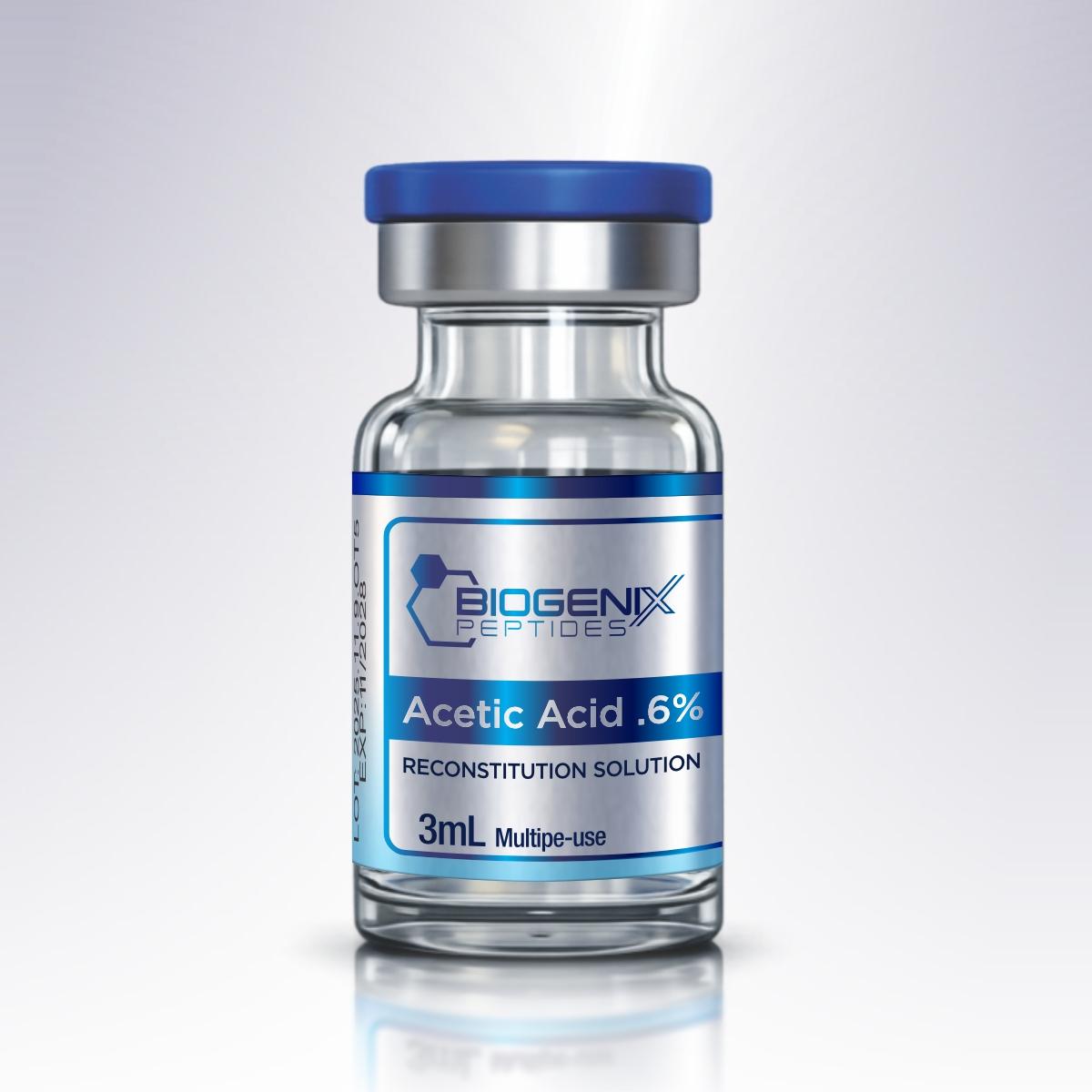
Acetic Acid (Reconstitution Solution) 3mL
$9.00
Acetic Acid 0.6% is a research-grade reconstitution solution designed for peptides that may exhibit solubility challenges. Unlike standard bacteriostatic water, the mild acidic environment can help reduce clumping, cloudiness, aggregation, and incomplete dissolution. It is commonly used during the reconstitution of difficult peptides such as AOD-9604, Tesamorelin, MOTS-C, Kisspeptin-10, and certain CJC-1295 formulations before dilution to final research concentrations.
Out of stock
Acetic Acid 0.6%
Background and Application
Acetic Acid 0.6% is commonly utilized in laboratory research as a specialized solvent and reconstitution aid for peptides and proteins that exhibit poor solubility in water alone. Certain research compounds possess hydrophobic regions or complex tertiary structures that can lead to aggregation, precipitation, gel formation, or incomplete dissolution when reconstituted solely with bacteriostatic water or sterile water.
The addition of a mild acetic acid solution can help improve peptide solubility by temporarily altering pH conditions, reducing intermolecular interactions, and promoting complete dissolution. Acetic Acid 0.6% is frequently employed during the initial stages of reconstitution before further dilution with bacteriostatic water or other research-grade diluents.
Chemical Characteristics
| Compound | Type | Molecular Formula | Molecular Weight |
|---|---|---|---|
| Acetic Acid | Weak Organic Acid | C₂H₄O₂ | 60.05 g/mol |
| Water | Solvent | H₂O | 18.02 g/mol |
Concentration: 0.6% Acetic Acid in Sterile Water
Research and Laboratory Use
1. Reconstitution of Difficult-to-Dissolve Peptides
– Commonly used for peptides that demonstrate poor aqueous solubility or a tendency to aggregate.
– Frequently utilized during the reconstitution of compounds such as AOD-9604, Tesamorelin, CJC-1295, MOTS-C, Kisspeptin-10, and other peptides known to occasionally exhibit solubility challenges.
– May help reduce clumping, floating particles, and incomplete dissolution observed with water-only reconstitution.
2. Prevention of Aggregation and Gel Formation
– Certain peptides can form visible strands, cloudiness, gels, or precipitates after reconstitution.
– The mild acidic environment created by Acetic Acid 0.6% may improve solution stability by reducing peptide-to-peptide interactions that contribute to aggregation.
– Researchers often use a small volume of Acetic Acid 0.6% initially, followed by dilution with bacteriostatic water to achieve the desired final concentration.
3. Improved Long-Term Solution Stability
– Some peptides remain stable in solution for longer periods when initially reconstituted under mildly acidic conditions.
– Stability characteristics vary significantly among compounds and should be evaluated according to specific research protocols.
– Refrigeration is generally recommended following reconstitution.
4. Research Protocol Flexibility
– Can be used alone or in conjunction with bacteriostatic water depending on the peptide being studied.
– Researchers frequently employ Acetic Acid 0.6% as a preliminary solvent before dilution to final working concentrations.
– Experimental protocols should be optimized based on the physicochemical properties of the compound under investigation.
General Specifications (Research Grade)
Composition: Sterile Water containing 0.6% Acetic Acid
Form: Multi-use laboratory vial
Primary Use: Solvent and reconstitution aid for peptides and proteins with solubility challenges
Appearance: Clear, colorless solution
Storage: Store at controlled room temperature. Refrigerate reconstituted compounds as dictated by research protocols.
Important Research Considerations
– Acetic Acid 0.6% is not required for the reconstitution of most peptides.
– It is generally reserved for compounds that demonstrate poor solubility, clumping, precipitation, cloudiness, or gel formation.
– Excessive acidification may affect the stability of certain compounds; therefore, researchers should utilize only the amount necessary to achieve complete dissolution.
– Researchers should consult available literature and protocol-specific guidance when determining appropriate reconstitution procedures.
Compliance Notice
Acetic Acid 0.6% is supplied strictly for laboratory and research applications. It is not intended for human or veterinary therapeutic use. Researchers are responsible for following proper laboratory procedures, aseptic technique, institutional protocols, and all applicable laws, regulations, and safety guidelines.
No certificate available for this product.

Out of stock