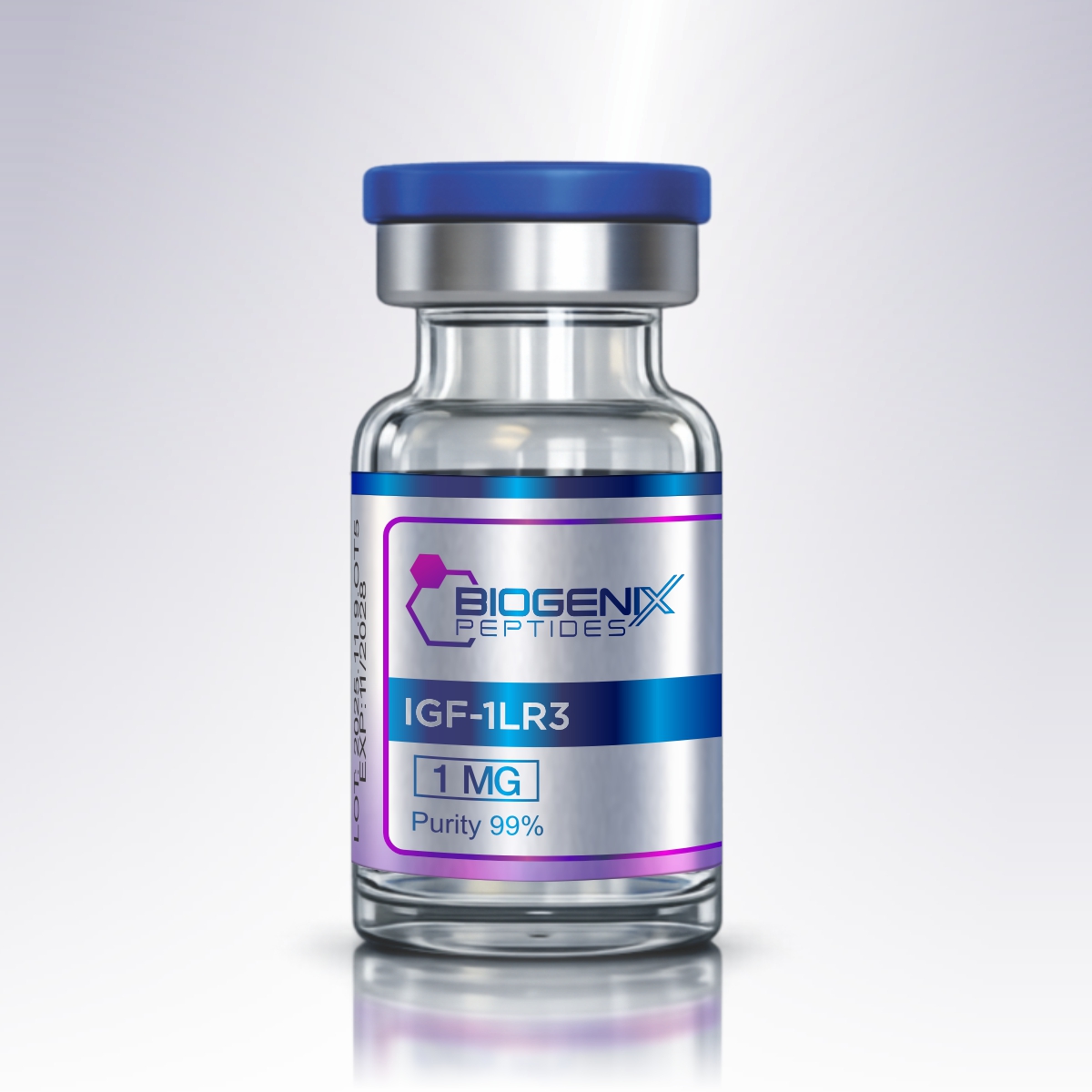
IGF-1LR3 1mg
$120.00
Insulin-like Growth Factor-1 Long Arg3 (IGF-1 LR3) is a synthetic analog of human IGF-1 designed with a modified amino acid sequence to improve stability and extend half-life. It differs from native IGF-1 by the substitution of arginine for glutamic acid at position 3, along with an additional 13-amino-acid extension at the N-terminus. These modifications reduce binding affinity to IGF-binding proteins (IGFBPs), which normally sequester circulating IGF-1, thereby increasing bioavailability in experimental models.
In Stock
IGF-1 LR3 (Long Arg3 IGF-1)
Insulin-like Growth Factor-1 Long Arg3 (IGF-1 LR3) is a synthetic analog of human IGF-1 designed with a modified amino acid sequence to improve stability and extend half-life. It differs from native IGF-1 by the substitution of arginine for glutamic acid at position 3, along with an additional 13-amino-acid extension at the N-terminus. These modifications reduce binding affinity to IGF-binding proteins (IGFBPs), which normally sequester circulating IGF-1, thereby increasing bioavailability in experimental models.
Overview
Native IGF-1 is a 70 amino acid peptide hormone primarily secreted by the liver in response to growth hormone (GH). It plays a central role in mediating many anabolic and growth-related actions of GH, including protein synthesis, muscle cell differentiation, and tissue regeneration. IGF-1 LR3 was engineered to overcome IGF-1’s short half-life and rapid inactivation, resulting in:- Extended half-life (20–30 hours vs. 20–30 minutes for native IGF-1)- Reduced binding to IGFBPs, leading to greater receptor activation- Enhanced potency in in vitro and in vivo models of cell growth and metabolism
Chemical Characteristics
| Compound | Type | Molecular Formula | Molecular Weight |
| IGF-1 LR3 | Long arginine-3 insulin-like growth factor 1 (extended analog) | C400H625N111O115S9 | 9117.60 g/mol |
Research and Clinical Studies
IGF-1 LR3 and Muscle Growth
Experimental studies suggest IGF-1 LR3 may stimulate proliferation and differentiation of myoblasts, potentially supporting muscle fiber hypertrophy and repair. By binding to IGF-1 receptors (IGF-1R), the peptide activates the PI3K/Akt/mTOR pathway, which is strongly associated with protein synthesis and muscle anabolism [1].
IGF-1 LR3 and Metabolic Function
Research models indicate IGF-1 LR3 may enhance glucose uptake in muscle cells and improve lipid metabolism, suggesting possible utility in metabolic research. Unlike insulin, its activity appears to be less prone to inducing hypoglycemia [2].
IGF-1 LR3 and Neuroprotection
Animal models have shown IGF-1 analogs may support neuronal survival, synaptic plasticity, and neurogenesis, with possible implications for neurodegenerative disease research [3].
IGF-1 LR3 vs. Native IGF-1
Whereas native IGF-1 binds strongly to IGFBPs, limiting its receptor activity, IGF-1 LR3’s modifications yield significantly higher free circulating levels. This allows for prolonged receptor activation and potentially more pronounced anabolic and regenerative effects [4].
Lyophilized Peptide Form
IGF-1 LR3 is provided as a lyophilized powder for laboratory stability. It should be reconstituted with sterile solvent (e.g., bacteriostatic water) prior to experimental use. For best preservation, aliquots are typically stored at 2 – 8 °C .
IGF-1 LR3 — References
- Francis, G. L. Albumin and insulin-like growth factor binding proteins act as the principal serum transport proteins for IGF-I and IGF-II. Molecular and Cellular Endocrinology. 1992;88(1-3):1-8.https://doi.org/10.1016/0303-7207(92)90046-D
- Francis, G. L., Upton, F. M., Ballard, F. J., McNeil, K. A., Wallace, J. C. Insulin-like growth factors 1 and 2 in bovine colostrum: sequences and biological activities compared with those of a potent truncated form of IGF-I (des(1–3)IGF-I). Biochemical Journal. 1988;251(1):95–103.https://doi.org/10.1042/bj2510095
- Francis, G. L., Ross, M., Ballard, F. J., Wallace, J. C. Modification of the B-domain of IGF-I increases its biological potency. Journal of Endocrinology. 1991;128(1):107–115.https://doi.org/10.1677/joe.0.1280107
- Francis, G. L., Ballard, F. J., Milner, S. J., McNeil, K. A., Wallace, J. C. Enhanced biological potency of human IGF-I analogues with modified B-domains designed to resist IGF binding proteins. Biochemical and Biophysical Research Communications. 1990;168(3):1139–1145.https://doi.org/10.1016/0006-291X(90)91165-V
- Ballard, F. J., Francis, G. L., Ross, M., Wallace, J. C. Des(1-3)IGF-I and Long R3 IGF-I: analogues of IGF-I with reduced binding to IGF-binding proteins and increased potency. Growth Regulation. 1996;6(1):1-8.https://pubmed.ncbi.nlm.nih.gov/8734477/
- Ross, M., Francis, G. L., Ballard, F. J., Wallace, J. C. Biological activity of IGF-I analogues in vitro and in vivo. Journal of Endocrinology. 1991;131(3):395–400.https://doi.org/10.1677/joe.0.1310395
- Cheetham, T. D., Holly, J. M., Baxter, R. C., Wallace, J. C., Ballard, F. J., Francis, G. L. Long R3 IGF-I stimulates growth of human osteosarcoma cells through the IGF-I receptor. Journal of Endocrinology. 1998;156(1):21–29.https://doi.org/10.1677/joe.0.1560021
- Francis, G. L. Long R3 IGF-I: a potent IGF-I analogue designed to circumvent binding proteins. Molecular Pathology. 1999;52(5):270–277.https://www.ncbi.nlm.nih.gov/pmc/articles/PMC395452/
NOTICE OF COMPLIANCE
The mission of BioGenix Peptides™ is to provide researchers with the highest-quality, Ultra-Pure Series™ compounds to help unlock the full potential of this evolving field. With precision, purity, and scientific integrity at the core of our operations, BioGenix Peptides™ is dedicated to supporting responsible exploration and discovery
Products from BioGenix Peptides™ are not intended for human consumption. They are supplied exclusively for in-vitro and pre-clinical research purposes.
By purchasing or using these products, the Customer accepts full responsibility for their handling and use, and agrees to indemnify and hold BioGenix Peptides™ harmless from any claims resulting from misuse.
Having trouble viewing? Use the buttons below to download or open the certificate.
Related products

In Stock