
PPAR-δ Activation & Exercise-Mimetic Signaling
Research-focused overview of endurance signaling, metabolic flexibility, and mitochondrial programming
Research Disclaimer
This article is provided for educational and informational purposes only. It discusses theoretical, mechanistic, and preclinical research related to metabolic signaling pathways and “exercise-mimetic” concepts. It does not constitute medical advice. All compounds and mechanisms referenced are discussed strictly in a research context and are not intended for human or animal use.
What Is PPAR-δ?
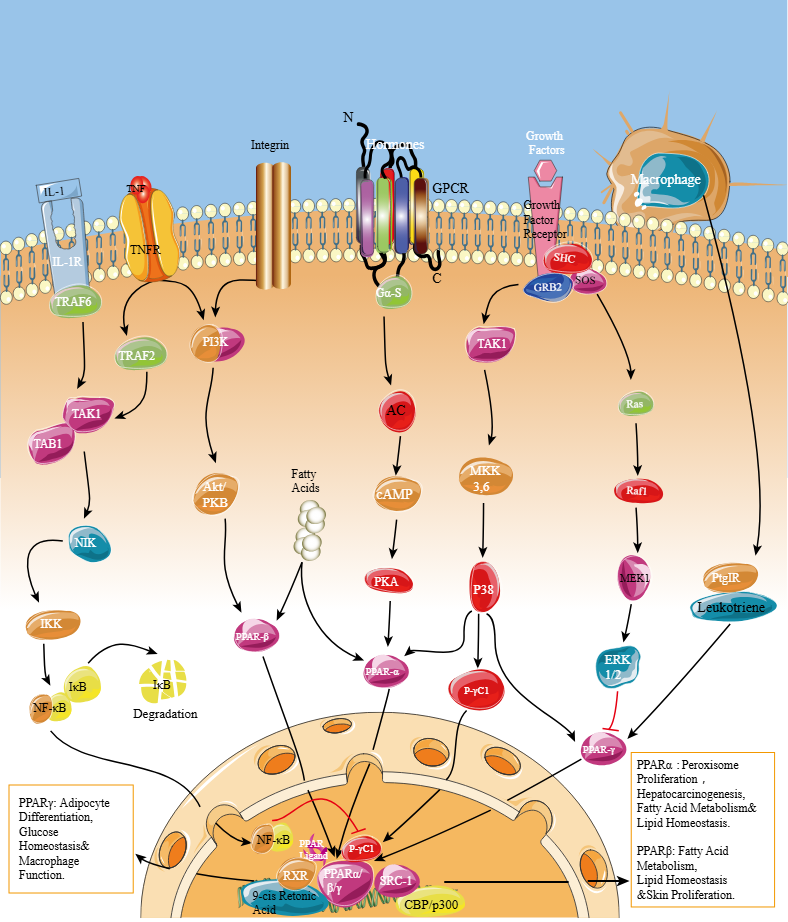
Peroxisome Proliferator-Activated Receptor Delta (PPAR-δ) (also written PPARβ/δ) is a nuclear receptor expressed in tissues with high energy demand—especially skeletal muscle, heart, and certain adipose depots. Unlike receptors that trigger rapid “on/off” signaling at the cell surface, nuclear receptors shape physiology through gene transcription programs.
In simplified terms, PPAR-δ activation pushes cellular metabolism toward an oxidative, fat-utilizing profile. The pathway is often discussed in endurance biology because it aligns with hallmark adaptations observed after repeated aerobic training:
- Greater capacity for fatty acid uptake and transport
- Upregulated β-oxidation machinery
- Enhanced mitochondrial oxidative metabolism
- Bias toward oxidative (endurance-type) muscle fiber characteristics
Exercise Is a Molecular Signal (Not Just “Calorie Burn”)
Endurance exercise doesn’t only increase energy expenditure in the moment—it triggers a network of stress-adaptive signaling that instructs cells to become more efficient at producing ATP under sustained demand.
Common nodes in this network include:
- AMPK (energy stress sensing; “low fuel” signaling)
- PGC-1α (mitochondrial biogenesis and oxidative gene co-activation)
- Sirtuins (e.g., SIRT1) and NAD+-linked sensing pathways
- PPAR-δ (longer-term fuel selection and oxidative gene regulation)
Think of PPAR-δ as part of the cell’s durable transcriptional memory of repeated energetic demand: it helps “lock in” an endurance-leaning metabolic architecture.
What “Exercise-Mimetic” Means (and What It Doesn’t)
The term exercise-mimetic is used in research to describe interventions that reproduce some molecular signatures of exercise without mechanical work. In the PPAR-δ context, the emphasis is typically on metabolic remodeling (fuel use and oxidative gene expression), not skill, strength, or tissue loading.
Important boundary: mimicking a subset of endurance-associated signaling is not equivalent to exercise.
- It does not replicate the mechanical stimulus required for tendon/ligament/bone adaptation.
- It does not reproduce cardiovascular conditioning or neuromuscular coordination.
- It does not provide the broad systemic effects of training across all organs and time scales.
In other words: “exercise-mimetic signaling” is best viewed as a mechanism-first research concept, not a replacement for physical training.
Fuel Switching: Fat Oxidation vs. Glucose Reliance
One of the most studied outcomes linked to PPAR-δ signaling is a shift toward fatty acid utilization, especially in skeletal muscle. This aligns with a broader endurance phenotype: improved ability to sustain energy production through oxidative phosphorylation rather than relying heavily on rapid glycolysis.
In mechanistic terms, PPAR-δ is associated with increased transcription of genes involved in:
- Fatty acid transport and uptake (often discussed alongside CD36)
- Mitochondrial import and β-oxidation (often discussed alongside CPT1-linked control points)
- Oxidative metabolism and mitochondrial enzyme systems
This is frequently framed as improved metabolic flexibility—the capacity to transition between fuels (lipids vs. carbohydrates) depending on demand, substrate availability, and energetic state.
PPAR-δ, AMPK, and PGC-1α: A Common Endurance Axis
PPAR-δ is often discussed as part of a coordinated endurance axis: AMPK → PGC-1α → oxidative transcription programs.
- AMPK is activated when cellular energy is stressed (higher AMP/ATP signaling).
- PGC-1α supports mitochondrial biogenesis and amplifies oxidative transcription.
- PPAR-δ contributes to longer-term oxidative/fat-leaning programming, reinforcing endurance-like outputs.
In research discussions, this creates a plausible “feed-forward” logic: repeated energy stress signals increase oxidative capacity, and increased oxidative capacity reduces future energetic strain at similar workloads.
Why Researchers Care About This Pathway
PPAR-δ signaling sits at an intersection of several high-interest research areas:
- Endurance physiology (oxidative muscle remodeling)
- Metabolic disease biology (fuel partitioning and lipid handling)
- Mitochondrial biology (efficiency and oxidative capacity)
- Aging research (mitochondrial decline and metabolic resilience)
A key theme is that PPAR-δ is not about a quick “boost.” It is typically framed as a slow structural reprogrammer—a transcriptional lever with durable consequences for how tissues prefer to generate ATP.
Common Misconceptions & Practical Interpretation (Research Lens)
- “Exercise-mimetic” is partial. It refers to certain molecular signatures, not the full training stimulus.
- Metabolism ≠ performance. Oxidative remodeling may relate to endurance capacity in models, but performance is multi-system.
- Context matters. Effects vary by tissue type, baseline fitness/energetic status, and experimental design.
- Translation is non-trivial. Findings in cell/animal systems do not automatically map to humans.
FAQ
Is PPAR-δ the same as AMPK?
No. AMPK is an energy stress sensor (signaling state), while PPAR-δ is a transcriptional regulator (programming state). They can intersect in endurance-related signaling, but they are distinct nodes.
Does PPAR-δ activation “replace cardio”?
Not as a biological equivalent. In research terms, PPAR-δ is associated with a subset of endurance-like metabolic adaptations, but it does not replicate the mechanical, cardiovascular, neuromuscular, and connective tissue training stimulus.
Why is mitochondrial density mentioned so often?
Endurance adaptations are strongly linked to mitochondrial quantity and function because mitochondria enable sustained ATP generation via oxidative phosphorylation—especially when relying more heavily on lipid fuels.
Key Takeaways
- PPAR-δ is a nuclear receptor that helps program tissues toward an oxidative, endurance-leaning metabolic profile.
- Exercise-mimetic signaling refers to reproducing some molecular signatures of training—especially oxidative gene expression—without mechanical work.
- PPAR-δ intersects with AMPK and PGC-1α in common endurance research frameworks tied to metabolic flexibility and mitochondrial remodeling.
- “Mimetic” is not “replacement.” It’s a mechanistic model, not a substitute for whole-body exercise adaptation.
Peer Reviewed References
- Wang YX, Zhang CL, Yu RT, Cho HK, Nelson MC, Bayuga-Ocampo CR, et al. Regulation of muscle fiber type and running endurance by PPARδ. PLoS Biol. 2004;2(10):e294. Link PMC
- Narkar VA, Downes M, Yu RT, Embler E, Wang YX, Banayo E, et al. AMPK and PPARδ agonists are exercise mimetics. Cell. 2008;134(3):405-415. PubMed Full text (Cell)
- Fan W, Evans RM. Exercise mimetics: impact on health and performance. Cold Spring Harb Perspect Med. 2017;7(10):a029819. PubMed PMC
- de Lange P, Lombardi A, Silvestri E, Goglia F, Lanni A, Moreno M. Peroxisome proliferator-activated receptor delta: a conserved director of lipid homeostasis through regulation of mitochondrial function. PPAR Res. 2008;2008:172676. PMC
- Neels JG, Grimaldi PA. Physiological functions of peroxisome proliferator-activated receptor β/δ. Physiol Rev. 2014;94(3):795-858. Full text
- Zizola C, Schulze PC. Activation of PPARδ signaling improves skeletal muscle oxidative capacity and endurance in models of impaired exercise tolerance. (Open-access article). PMC