

How to outrun your limits with the right peptide blends
Why Peptide Blends Are Changing the Way Researchers Study Endurance Training
Disclaimer: The information provided in this article is for educational and informational purposes only. It is not intended as medical advice, diagnosisled, or treatment. Products and compounds referenced are for research use only and are not approved for human or veterinary consumption. Always consult a qualified professional regarding health or medical decisions.
Disclaimer: The information provided in this article is for educational and informational purposes only. It is not intended as medical advice, diagnosis, or treatment. Products and compounds referenced are for research use only and are not approved for human or veterinary consumption. Always consult a qualified professional regarding health or medical decisions.

Peptide blends endurance training research is one of the fastest-moving areas in sports science right now. If you’re looking for a quick overview before diving deeper, here’s what the current research shows:
Top peptide blends studied in endurance research contexts:
| Peptide Blend | Primary Research Focus | Key Findings |
|---|---|---|
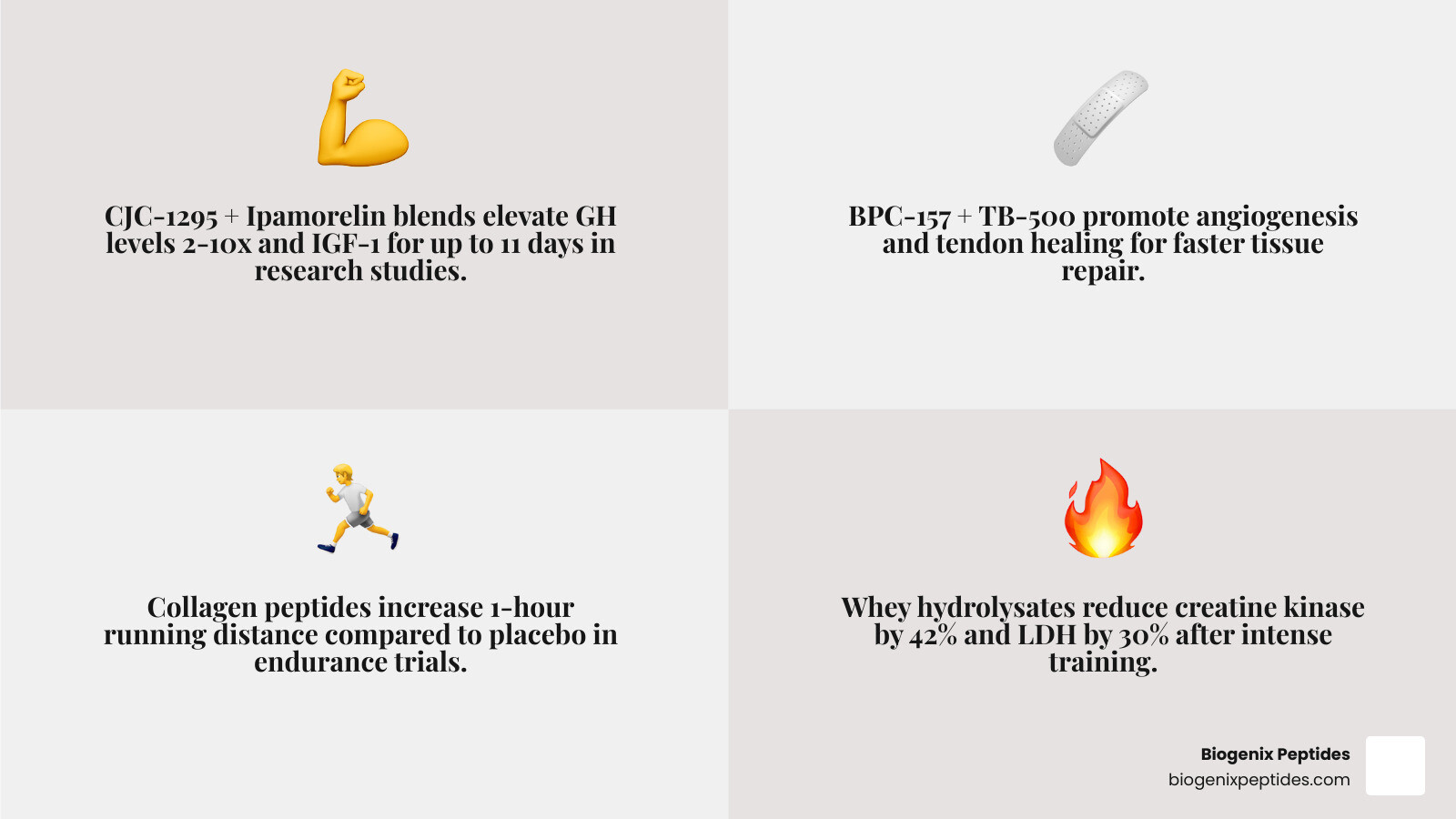
| CJC-1295 + Ipamorelin | GH secretion, recovery | 2-10x GH increase; IGF-1 elevated up to 11 days |
| BPC-157 + TB-500 | Tissue repair, inflammation | Angiogenesis, tendon healing, anti-inflammatory signaling |
| Collagen peptides | Endurance, connective tissue | Improved 1-hour running distance vs. placebo |
| Whey hydrolysates | Muscle damage recovery | CK reduced by 42%, LDH by 30% over 12 weeks |
| Tesamorelin | Fat metabolism, body composition | 18% visceral fat reduction in clinical trials |
Endurance athletes push their bodies hard. Training for marathons, triathlons, or long-distance cycling creates a constant cycle of stress, damage, and recovery. The body needs to repair tissue, manage inflammation, and sustain energy output — all at the same time.
That’s a big ask.
Traditional supplements like carbohydrates, caffeine, and beta-alanine help. But researchers are now studying something more targeted: peptides — short chains of amino acids that act as biological messengers, signaling specific processes inside cells.
Unlike broad-spectrum supplements, peptides interact with precise receptors. They don’t flood the entire system. They send specific instructions. That’s what makes combinations of peptides — or blends — particularly interesting from a research standpoint. When two or more peptides are studied together, they can target multiple pathways at once: GH secretion, tissue repair, fat metabolism, and inflammation control, all in parallel.
The science is still developing. But early findings from clinical trials, animal studies, and peer-reviewed reviews are pointing toward real and measurable effects on endurance-related markers.
I’m Jay Daniel, Founder and CEO of BioGenix Peptides, with years of hands-on experience in peptide research, quality control, and laboratory science. My work in peptide blends endurance training research has given me a detailed view of both the promise and the limitations of what these compounds can tell us. In the sections ahead, we’ll break down the specific blends being studied, what the data actually shows, and what researchers need to know before drawing conclusions.
Understanding Peptide Blends for Endurance Training
To understand the role of peptide blends endurance training in a laboratory setting, we first have to define what these molecules actually are. Peptides are short chains of amino acids, typically consisting of 2 to 50 units. While proteins are the “workhorses” of the body, peptides act more like building blocks of proteins that function as signaling messengers.
A common point of confusion in athletic circles is the distinction between peptides and anabolic steroids. It is crucial to note that peptides and steroids are fundamentally different. Steroids are synthetic versions of hormones like testosterone that have broad, systemic effects on the body, often accompanied by significant side effects. Peptides, conversely, are highly specific. Their power lies in their ability to bind to specific receptors on cell surfaces, triggering a targeted biological response without overriding the body’s natural feedback loops in the same way steroids do.
In endurance research, “blends” are used to simulate complex physiological environments. By combining different messengers, researchers can observe how the body manages the simultaneous demands of high-intensity aerobic work and the subsequent need for rapid cellular repair.

Synergistic Growth Hormone Secretagogues in Research
Growth Hormone Secretagogues (GHS) are a primary focus for those investigating peptide blends endurance training. These compounds stimulate the production and release of the body’s own human growth hormone (HGH).
Two of the most frequently studied GHS are CJC-1295 and Ipamorelin. Research into prolonged stimulation of growth hormone (GH) and insulin-like growth factor I secretion by CJC-1295 has shown that this peptide can increase plasma GH levels by 2 to 10 times the baseline for several days. When paired with Ipamorelin, which provides a more immediate “pulse” of GH without significantly increasing cortisol or prolactin, the synergy is remarkable.
This elevation in GH leads to a corresponding rise in Insulin-like Growth Factor-1 (IGF-1). This is vital for endurance models because IGF-1 stimulates muscle protein synthesis and supports the preservation of lean tissue during high-volume training blocks.
| Analog Type | Specific Peptide | Primary Mechanism | Research Duration |
|---|---|---|---|
| GHRH Analog | CJC-1295 | Mimics GHRH; sustained GH release | Long-acting (days) |
| GHRP Analog | Ipamorelin | Mimics Ghrelin; selective GH pulse | Short-acting (hours) |
| GHRH Analog | Sermorelin | Stimulates pituitary GH production | Short-acting |
Optimizing peptide blends endurance training for metabolic efficiency
Endurance isn’t just about muscle; it’s about how efficiently the body uses fuel. Peptides like AOD-9604 are designed specifically to support fat loss by mimicking the fat-burning region of the HGH molecule. In a study of 300 obese subjects, a 1 mg daily amount of AOD-9604 led to weight loss more than three times greater than the placebo group over 12 weeks.
For endurance athletes, reducing non-functional mass while preserving muscle is a key performance indicator. Tesamorelin is another peptide showing promise in this area. Research into the effects of tesamorelin, a growth hormone-releasing factor, in HIV-infected patients demonstrated an 18% decrease in visceral fat. By improving lipid profiles and visceral fat metabolism, these compounds may help researchers understand how to optimize an athlete’s power-to-weight ratio and overall stamina.
The role of peptide blends endurance training in inflammation management
Perhaps the most exciting area of peptide blends endurance training research is the use of “recovery-focused” blends like BPC-157 and TB-500. BPC-157 (Body Protecting Compound 157) is a peptide naturally found in human gastric juice that has shown remarkable healing and regenerative properties.
Research indicates that BPC-157 promotes angiogenesis—the formation of new blood vessels—which is critical for delivering oxygen and nutrients to damaged tissues. Furthermore, studies show that pentadecapeptide BPC 157 enhances the growth hormone receptor expression in tendon fibroblasts, potentially making the body’s natural GH more effective at repairing connective tissue. When combined with TB-500, which supports cellular migration and wound healing, these blends represent a multi-pathway approach to managing the chronic inflammation associated with endurance sports.
Advanced Recovery Protocols and Tissue Support
Endurance training often leads to micro-trauma in muscle fibers and connective tissues. To study how to mitigate this, researchers look at Thymosin Beta-4 (TB-4). This peptide plays a vital role in tissue repair by facilitating new blood vessel formation and the migration of progenitor cells to injury sites. In clinical trials, patients receiving TB-4 experienced a significant increase in walking distance capacity, suggesting improved cardiac and skeletal muscle function.
Beyond synthetic peptides, “bioactive” peptides derived from food sources are also under the microscope. You might have heard everything you should know about collagen peptides, but in an endurance context, they do more than just support skin health. One study found that 12 weeks of concurrent training with collagen peptides significantly improved running distance during a one-hour time trial compared to a placebo group.
Similarly, whey hydrolysates—pre-digested proteins broken down into peptides—have shown a powerful ability to reduce markers of muscle damage. Research into the bioactivity of food peptides found that whey hydrolysate reduced creatine kinase (a marker of muscle damage) by 42% and lactate dehydrogenase by 30% during intense training interventions.
Scientific findings on peptide blends endurance training and body composition
The impact of peptides on body composition is well-documented in clinical literature. For instance, collagen peptide supplementation in combination with resistance training improves body composition by increasing fat-free mass and muscle strength while reducing fat mass.
In endurance models, the goal is often muscle preservation rather than massive hypertrophy. The action of GH on skeletal muscle function involves complex molecular mechanisms that prevent muscle wasting (catabolism) during periods of high-volume aerobic stress. By maintaining a favorable hormonal environment, peptide blends may help researchers identify ways to prevent the “sarcopenia-like” muscle loss sometimes seen in overtrained endurance athletes.
Safety, Compliance, and Research Limitations
While the data is promising, the use of peptide blends endurance training comes with significant regulatory and safety considerations. Most of these compounds (with the exception of collagen peptides) are prohibited by the World Anti-Doping Agency (WADA) for use in competitive sports. Athletes in tested environments must be extremely cautious, as many of these substances are banned both in and out of competition.
From a clinical perspective, there are also immunogenicity risks. This refers to the potential for the body to develop an immune response against the therapeutic peptide. The FDA has provided guidance for industry: Immunogenicity assessment to help researchers monitor for the formation of anti-drug antibodies, which can neutralize the peptide’s effects or cause adverse reactions.
Furthermore, the FDA has identified certain bulk drug substances for use in compounding that may present significant safety risks. This highlights the importance of sourcing pharmaceutical-grade materials from reputable sources rather than “research-grade” chemicals that may contain contaminants.
Frequently Asked Questions about Endurance Peptides
How do peptides compare to traditional supplements like beta-alanine?
Traditional supplements like beta-alanine work primarily by buffering lactic acid in the muscle, which is a localized, acute effect. Peptides operate on a systemic, hormonal, and cellular signaling level. While beta-alanine might help you push through the final 400 meters of a race, peptide blends are being researched for their ability to fundamentally alter the body’s recovery rate, tissue integrity, and metabolic efficiency over a full training cycle.
What are the potential risks of immunogenicity in research?
Immunogenicity is the tendency of a substance to trigger an immune response. In peptide research, this can lead to the formation of antibodies that “attack” the peptide, rendering it useless or potentially causing allergic reactions. Researchers follow the guideline on immunogenicity assessment of therapeutic proteins to ensure that the long-term safety profile of these compounds is understood before any human applications are considered.
Are these compounds permitted in competitive sports?
Generally, no. Most growth hormone secretagogues, BPC-157, and TB-500 are on the WADA prohibited list. Collagen peptides and basic protein hydrolysates are currently the only exceptions. It is the responsibility of the athlete and the researcher to stay updated on anti-doping education to avoid accidental violations.
Conclusion
At Biogenix Peptides, we believe that the future of endurance science lies in a deeper understanding of cellular signaling. The research into peptide blends endurance training is opening new doors for how we might one day manage recovery, optimize metabolism, and protect the human body from the rigors of elite performance.
While many of these compounds remain strictly in the realm of research, the data we already have—from 18% fat reduction to 42% decreases in muscle damage markers—is too significant to ignore. As laboratory techniques improve and clinical trials continue, the line between “outrunning your limits” and “redefining them” will continue to blur.
Biogenix Peptides: Leading the way in high-purity research compounds for the next generation of endurance science.