
A Practical Guide to Stopping Peptide Denaturation in Its Tracks
Why Thermal Denaturation Peptide Prevention Matters for Your Research
Thermal denaturation peptide prevention is the practice of protecting peptides and proteins from heat-induced structural breakdown — and getting it wrong can silently ruin your research or therapeutic formulation.
Here’s a quick answer if you need it fast:
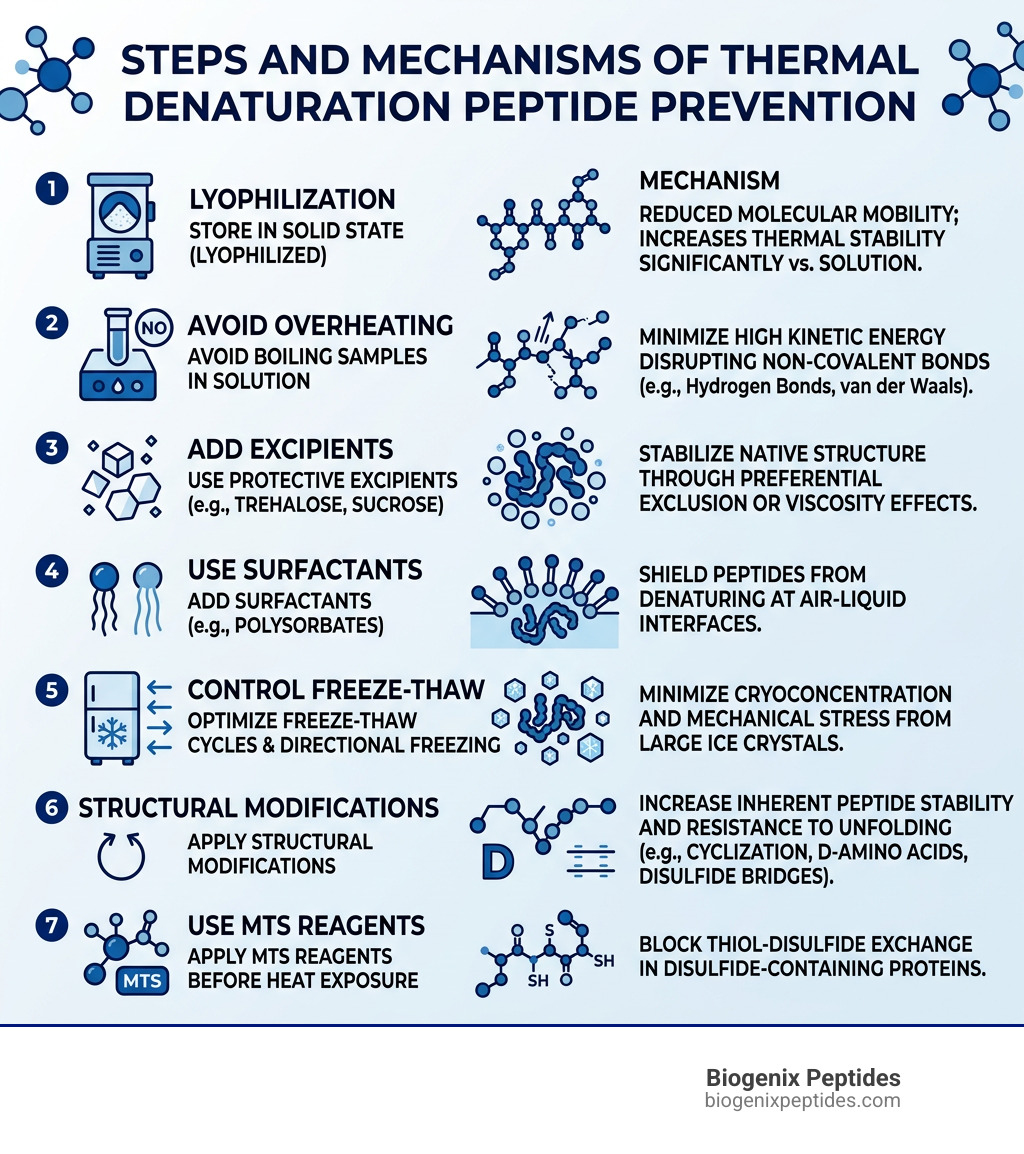
How to prevent thermal denaturation of peptides:
- Store peptides in lyophilized (freeze-dried) solid form — solid-state proteins are stable up to 130–185°C vs. 40–80°C in solution
- Avoid boiling samples dissolved in lysis buffer for proteomic workflows
- Add excipients like trehalose or sucrose to protect structure during processing
- Use surfactants (e.g., polysorbates, poloxamers) to shield peptides from air-liquid interfaces
- Control freeze-thaw cycles with directional freezing to minimize cryoconcentration
- Apply structural modifications (cyclization, D-amino acids, disulfide bridges) to increase inherent thermal resistance
- Use MTS reagents to block thiol-disulfide exchange in disulfide-containing proteins before heat exposure
Peptides are remarkably precise molecules. Their biological activity depends entirely on maintaining the right three-dimensional shape. When heat disrupts that shape, the result isn’t just a slightly less effective molecule — it can be a completely inactive one, or worse, one that aggregates into a form that’s difficult to detect, analyze, or safely administer.
This problem shows up everywhere: in proteomics labs where boiling samples in lysis buffer silently degrades mass spectrometry results, in drug delivery pipelines where processing temperatures destroy therapeutic potency, and in storage conditions that seem harmless but slowly unravel peptide structure.
The consequences are measurable. Research shows that heating proteins at 100°C in lysis buffer produces increasingly polydisperse bands on electrophoresis gels, with MASCOT scores, matched peptides, and sequence coverage all declining as heating time increases. That’s not a minor inconvenience — it’s compromised data.
I’m Jay Daniel, Founder and CEO of BioGenix Peptides, and I’ve spent years working directly with peptide formulation, quality control, and stability protocols to understand exactly where thermal denaturation peptide prevention breaks down in real laboratory and manufacturing settings. In this guide, I’ll walk you through the science and the practical steps so you can protect peptide integrity at every stage — from sample prep to long-term storage.
Understanding Thermal Denaturation and Its Impact on Peptide Integrity
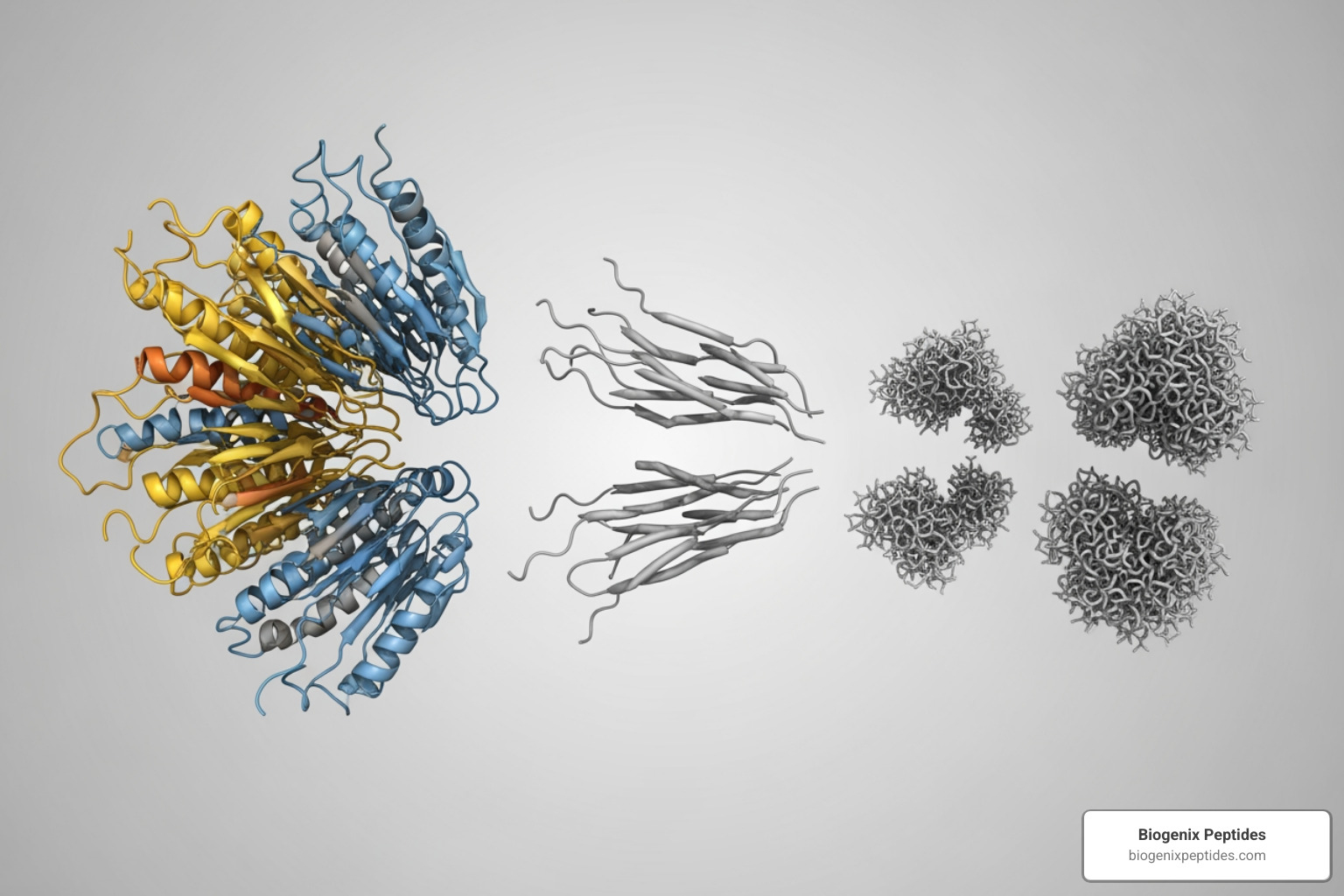
To stop denaturation, we first have to understand what’s actually happening when things get too hot. Think of a peptide like a complex piece of origami. Its function comes from its specific folds. Thermal denaturation peptide prevention is essentially the art of keeping that origami from unfolding and turning into a tangled mess of wet paper.
At the molecular level, heat provides kinetic energy that disrupts the delicate non-covalent bonds—like hydrogen bonds and van der Waals forces—that hold a peptide in its native secondary and tertiary structures. As these bonds break, the peptide “unfolds,” exposing its hydrophobic (water-fearing) interior to the surrounding aqueous environment.
This exposure is a recipe for disaster. Because those hydrophobic sections don’t want to be near water, they find each other instead, leading to aggregation. Once peptides clump together, they often become irreversibly inactivated. In proteomic analysis, this results in “artifacts”—basically, fake data or missing signals that don’t represent the actual biological state of your sample.
Consequences for Proteomic Analysis and Mass Spectrometry
If you’re working in a lab, thermal denaturation is often the “hidden ghost” in your machine. When proteins or peptides denature due to excessive heat during preparation, the downstream effects on Mass Spectrometry (MS) are devastating.
Research has shown that thermal denaturation interferes with trypsin cleavage efficiency. Trypsin is the “scissors” we use to cut proteins into manageable peptides for identification. If the protein is misfolded or aggregated due to heat, those scissors can’t reach the right spots. This leads to:
- Lower MASCOT scores (the statistical confidence in your protein identification).
- Reduced sequence coverage (you only see a fraction of the protein).
- Higher GRAVY (Grand Average of Hydropathicity) values, indicating that the peptides being identified are skewed toward being more hydrophobic, which can mess with your LC-MS/MS results.
For a deeper dive into how this affects your mapping, check out Thermal Denaturation: A Useful Technique in Peptide Mass Mapping.
Challenges in Drug Delivery Systems
In therapeutics, thermal denaturation peptide prevention is a matter of safety and efficacy. If a peptide drug denatures during manufacturing—say, during melt extrusion or spray drying—it loses its bioactivity.
Even worse, denatured or aggregated peptides can become immunogenic. This means the patient’s immune system might recognize the “misfolded” peptide as a foreign invader, leading to dangerous allergic reactions or the production of antibodies that neutralize the medicine. Controlled-release systems, which often require heat or organic solvents during setup, are particularly risky.
For more on these hurdles, see Innovative Strategies In Peptide Therapeutics: Stability Challenges And Advanced Analytical Methods.
Biological and Chemical Strategies for Thermal Denaturation Peptide Prevention
Nature has its own high-tech solution for heat stress: Molecular Chaperones. Specifically, the Hsp60 (chaperonin) family is a rockstar in mitochondrial protection.
As demonstrated in classic studies, Hsp60 doesn’t just wait for a protein to break; it actively binds to polypeptides as they begin to denature. It forms a protective complex that prevents the “sticky” hydrophobic parts from clumping together. Then, using ATP-dependent refolding, it literally pushes the protein back into its correct shape even while the heat is still on. This mechanism is so effective it can protect enzymes like DHFR (dihydrofolate reductase) from permanent inactivation.
You can read the foundational 1992 Science paper on this here: Prevention of Protein Denaturation Under Heat Stress by the Chaperonin Hsp60.
Structural Modifications for Thermal Denaturation Peptide Prevention
We can’t always put Hsp60 in a vial, so we use chemistry to build “tougher” peptides. Some of our favorite strategies include:
- Cyclization: By “tying” the ends of the peptide together, we reduce its flexibility. Less flexibility means it’s harder for the heat to wiggle the bonds apart.
- D-amino acids: Using the “mirror image” versions of amino acids can make the peptide backbone more resistant to both heat and enzymatic breakdown.
- Hydrocarbon Staples: These act like internal “braces” for alpha-helices, locking the structure in place.
- The SEQOPT Method: This is a computational approach used to optimize amino acid sequences to maximize helical content and thermal stability using only natural building blocks.
Learn more about these designs in Design of Stable α-Helical Peptides and Thermostable Proteins in Biotechnology and Biomedicine.
Chemical Stabilization via Aromatic Stacking
Another “cool” trick involves π–π interactions. By conjugating peptides with synthetic aromatic groups like NDI (naphthalene diimide), we can create a “shield” of aromatic stacking. This provides steric hindrance, physically blocking heat and enzymes from reaching the peptide’s core.
These can even be designed as redox-responsive systems, where the peptide stays “locked” and stable in the vial but releases its active form once it enters the reducing environment of a cell. This is a game-changer for therapeutic delivery.
Details on this stacking strategy can be found in Stabilization of peptides against proteolysis through disulfide-bridged conjugation with synthetic aromatics.
Optimizing Formulations to Resist Heat-Induced Degradation
When we talk about thermal denaturation peptide prevention in the real world, the “secret sauce” is usually in the formulation. The goal is to surround the peptide with molecules that act as a safety net.
Key Stabilizers Include:
- Sugars (Trehalose and Sucrose): These are non-reducing disaccharides that stay in an “amorphous” (glass-like) state. They replace the hydrogen bonds of water, essentially “freezing” the peptide in its native shape.
- PEGylation: Attaching Polyethylene Glycol (PEG) increases the molecular weight and provides a “water cloud” around the peptide, protecting it from heat and clearance.
- Surfactants: Poloxamers or polysorbates are essential for preventing peptides from sticking to the air-liquid interface (the surface of the liquid in the vial), where denaturation often starts.
For more on these protocols, see our Peptide Storage & Stability Guidelines.
Comparison: Solution-State vs. Solid-State Stability
One of the most important facts we share with researchers is the massive difference between liquid and solid stability.
| State | Typical Unfolding Temp | Risk Factors |
|---|---|---|
| Solution (Liquid) | 40°C – 80°C | Hydrolysis, Aggregation, Oxidation |
| Solid (Lyophilized) | 130°C – 185°C | Residual Moisture, Improper Sealing |
This is why we almost always recommend lyophilization for long-term storage.
Preventing Irreversible Inactivation
Sometimes, heat causes more than just unfolding; it causes “scrambling.” In proteins with disulfide bonds, heat can trigger disulfide-thiol exchange. This is where the bonds break and reform in the wrong places, like buttoning your shirt starting with the wrong hole.
To prevent this, we use MTS (methanethiosulphonate) reagents. These chemicals rapidly block free thiols, stopping the “scrambling” before it starts. Combined with glycinamide, which prevents deamination (another heat-induced chemical change), you can significantly improve the chances of a protein refolding correctly after it cools down.
Explore this chemical blocking in Evaluation of irreversible protein thermal inactivation caused by breakage of disulphide bonds using methanethiosulphonate.
Best Practices for Processing and Sample Preparation
We’ve seen many brilliant experiments fail because of a simple 5-minute boiling step. In modern proteomics, thermal denaturation peptide prevention often means avoiding the heat altogether.
Our Lab Recommendations:
- Ditch the Boiling: If your proteins are dissolved in a modern lysis buffer, you often don’t need to heat them to 100°C for SDS-PAGE. Traditional Laemmli buffer protocols are being replaced by room-temperature markers that remain stable without the stove-top treatment.
- Use Lysis Buffer Directly: Research shows that proteins dissolved in lysis buffer without heating produce much clearer, more distinct bands on 1-DE and 2-DE gels.
- Room Temp Markers: You can create stable protein markers by dissolving standards directly in lysis buffer (without BSA). These can often be stored at room temperature for convenience.
For a complete list of handling tips, visit our Best Practices for Peptide Storage & Handling.
Advanced Techniques for Thermal Denaturation Peptide Prevention in the Lab
When processing peptides at scale, we use advanced engineering to bypass heat:
- Cryoconcentration Management: Slow freezing is dangerous because it concentrates the peptides into small pockets of liquid, leading to collisions and aggregation. We use directional freezing and rapid cooling to minimize this.
- Spray Drying: Interestingly, even though spray dryers use hot air (>100°C), the actual peptide droplet usually stays at the “wet bulb temperature” (around 40°C) due to evaporative cooling. It’s a “flash” process that protects the structure.
- Melt Extrusion: By processing peptides in the solid state rather than liquid, we can use the 130°C+ stability threshold to incorporate them into polymers without losing activity.
Learn why we prefer these methods in Why Research Peptides Are Typically Lyophilized (And How This Benefits Research).
Minimizing Interface and Shear Stress
It’s not just the temperature; it’s the “roughness” of the environment. Agitation (shaking), shear stress (pumping), and air-liquid interfaces (bubbles) can all trigger thermal-like denaturation.
- Sonication Caution: Probe sonication is the most damaging, followed by homogenization. Vortexing is generally the safest high-energy agitation.
- Solvent Selection: If you must use organic solvents, ethyl acetate is often less denaturing than dichloromethane (DCM).
- Surfactant Shielding: Adding a tiny amount of surfactant can prevent the peptide from “unzipping” at the surface of a bubble.
Find more strategy comparisons in Improving peptide stability: Strategies and applications.
Frequently Asked Questions about Peptide Stability
How does thermal denaturation interfere with mass spectrometry results?
Thermal denaturation is a “data killer” in the MS lab. When you heat proteins in lysis buffer at 100°C, you create degenerative proteins. These lead to:
- Reduced Trypsin Efficiency: The enzyme can’t “find” its targets in a misfolded clump.
- Redundant Peptides: Heat can cause random modifications, creating a “noisy” background of modified peptides that confuse the software.
- Lower Sequence Coverage: You might only identify 40% of a protein that should have 80% coverage.
- Polydisperse Bands: On a gel, this looks like a “smear” rather than a clean line, making it impossible to cut out specific spots for analysis.
For the data behind this, see Thermal denaturation produced degenerative proteins and interfered with MS for proteins dissolved in lysis buffer in proteomic analysis.
Can denatured peptides be refolded using chaperones?
Yes, but it’s complicated. In a living cell, Hsp60 uses ATP to act like a “folding machine,” grabbing denatured proteins and forcing them back into shape. In the lab, this is much harder to replicate. While we can use chaperones in some in vitro assays to prevent aggregation, once a peptide has formed “hard” insoluble aggregates (like amyloid fibrils), it is almost impossible to refold. Prevention is always better than the cure.
What is the safest way to reconstitute and store peptides?
The “Golden Rules” of reconstitution are:
- Let it reach room temp: Never open a cold vial; condensation will introduce moisture, which leads to degradation.
- Use the right buffer: Check the pH. Some peptides are only stable in slightly acidic or basic conditions.
- Avoid “Bubbling”: Don’t shake the vial. Gently swirl or vortex.
- Aliquot: Divide the reconstituted peptide into small “one-time use” tubes to avoid repeated freeze-thaw cycles.
Follow our Reconstituting Lyophilized Peptides: Step-by-Step guide for the perfect protocol.
Conclusion
At BioGenix Peptides, we believe that thermal denaturation peptide prevention shouldn’t be a mystery. By understanding the physics of unfolding—and using the right biological chaperones, chemical stabilizers, and lab techniques—we can ensure that your research is built on a foundation of structural integrity.
Whether you’re designing a new therapeutic or running a high-stakes proteomic screen, the ” origami” of your peptides is in your hands. Keep it solid, keep it cool, and use the right “braces” to keep those folds exactly where they belong.
For more information on keeping your samples safe, check out our Peptide Storage & Stability Guidelines 2.