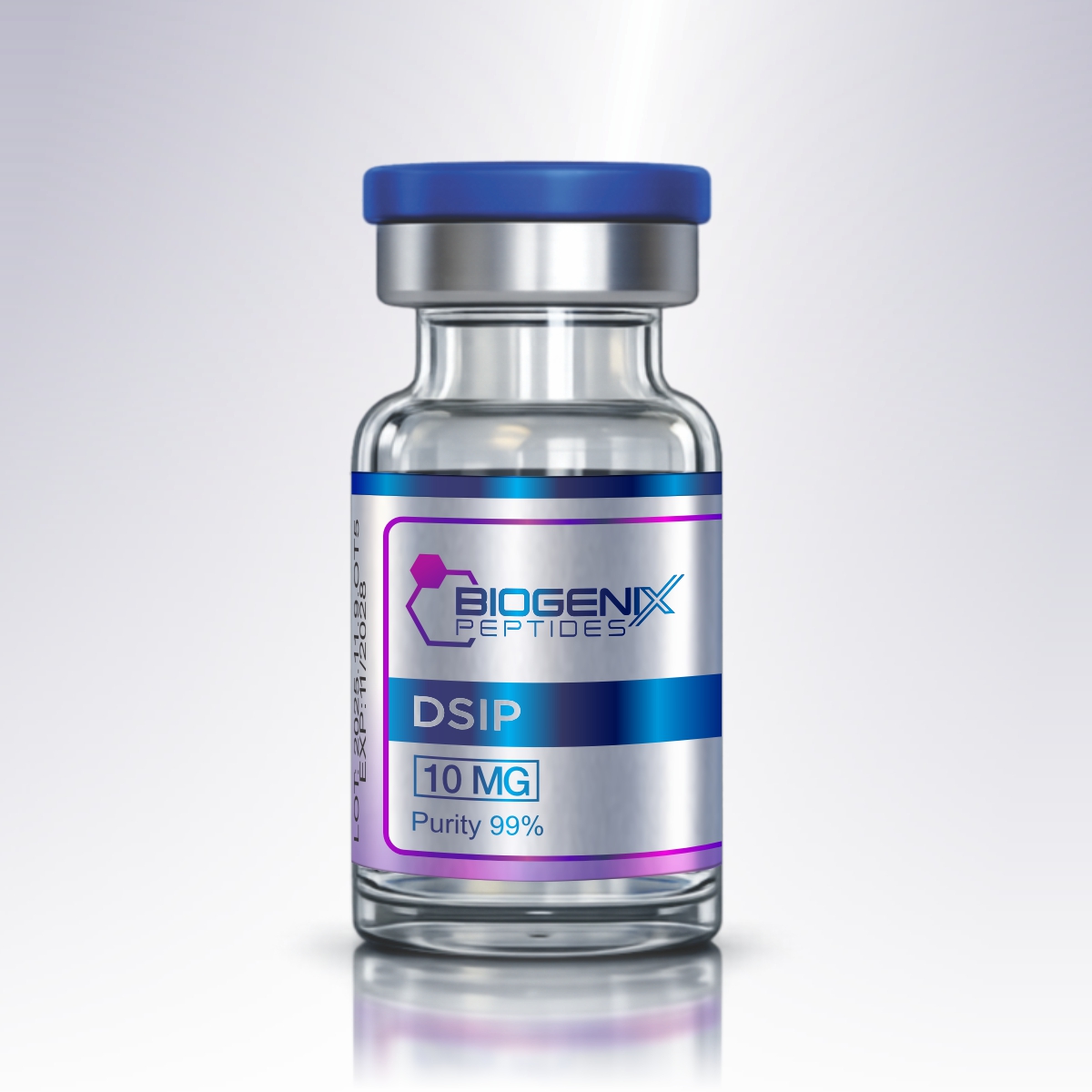
DSIP 10mg
$65.00
Delta Sleep-Inducing Peptide (DSIP) is a small, naturally occurring peptide made of nine amino acids. It was first discovered in the brain during early studies on deep, slow-wave sleep. Although its name comes from its link to “delta sleep,” researchers now study DSIP for much more than sleep alone.
In research settings, DSIP has been explored for its potential to help support healthy sleep patterns, balance certain hormones, improve how the body responds to stress, and influence energy and metabolism. Some studies also look at how DSIP may affect pain perception and overall cellular resilience over time.
In Stock
DSIP (Delta Sleep-Inducing Peptide) — Research Overview
Introduction
Delta Sleep-Inducing Peptide (DSIP) is a naturally occurring nonapeptide (nine amino acids) originally isolated from the central nervous system during studies of electrically induced sleep. DSIP is named for its association with delta sleep, or slow-wave sleep, but has since been studied for broader roles in regulating neuroendocrine activity, stress response, and metabolic processes. First described between 1963 and 1977, DSIP has been examined in animal and human research models for its potential effects on sleep cycles, hormonal balance, pain perception, stress tolerance, and even cellular longevity.
Mechanisms of Action
DSIP is hypothesized to modulate sleep and stress by interacting with multiple receptor systems and signaling pathways:- GABA and NMDA Receptors: DSIP may enhance inhibitory neurotransmission through GABA, while reducing excitatory activity at NMDA (glutamate-linked) receptors. This dual action may shorten sleep onset and promote deep (slow-wave) sleep.- Opioid Receptors: Research suggests DSIP influences opioid signaling, potentially contributing to its reported roles in sleep regulation, pain modulation, and alleviation of withdrawal symptoms.- Alpha 1-Adrenergic Receptor: Found in the pineal gland, this receptor may link DSIP to circadian rhythm regulation and stress tolerance.- Endocrine Effects: Studies suggest DSIP may influence luteinizing hormone (LH), growth hormone (GH), and other hormones typically secreted during sleep, connecting the peptide to neuroendocrine regulation.
Chemical Characteristics
| CAS #: 62568-57-4 Molecular Formula: C35H48N10O15 Molecular Weight: 848.824 g/mol |
Other Titles: DSIP Nonapeptide, Emideltide
Research Applications
1. Sleep Regulation
– In feline models, DSIP increased total sleep and slow-wave sleep within one hour of administration, maintaining effects for up to seven hours.- Human studies have suggested increased sleep efficiency, shortened sleep onset, and greater overall restfulness.
2. Endocrine Function
– DSIP has been observed to elevate luteinizing hormone (LH) without affecting follicle-stimulating hormone (FSH).- Evidence suggests it may stimulate GH release via hypothalamic and pituitary pathways, potentially linking DSIP’s sleep-inducing role to natural GH surges during slow-wave sleep.
3. Stress Response
– Animal studies indicate DSIP influences markers such as substance P, beta-endorphin, and corticosterone, suggesting it may buffer stress responses and modulate the opioidergic system.- Notably, corticosterone levels dropped shortly after DSIP exposure, aligning with stress-protective actions.
4. Longevity and Oxidative Stress
– DSIP has been associated with extended lifespan in animal models, reduced chromosomal damage, and lower incidence of malignancies.- Proposed antioxidant mechanisms include reduced lipid peroxidation and increased activity of endogenous defense systems (superoxide dismutase, catalase, ceruloplasmin).
Conclusion
DSIP remains an experimental peptide of interest for its proposed influence on sleep architecture, stress adaptation, hormonal regulation, and cellular protection. While mechanisms are still under study, research points toward DSIP’s multifaceted role in neuroendocrine and metabolic systems.
DSIP (Delta Sleep-Inducing Peptide) — References
- Schoenenberger, G. A., Monnier, M., Zahnd, G. R. Delta sleep-inducing peptide (DSIP): A hypothalamic sleep-promoting substance. Archives of Physiology and Biochemistry. 1977;85(2):307–309. https://doi.org/10.3109/13813457709069861
- Schoenenberger, G. A., Monnier, M., Zahnd, G. R. Delta sleep-inducing peptide (DSIP): characterization and biological activity in rabbits and rats. European Journal of Pharmacology. 1977;45(3):367–371. https://doi.org/10.1016/0014-2999(77)90137-6
- Kastin, A. J., Schally, A. V., Ehrensing, R. H., Anderson, M. S., Hackler, R. Delta sleep-inducing peptide (DSIP): Induction of spindle activity in sleep of cats and rabbits. Science. 1977;196(4288):1228–1230. https://doi.org/10.1126/science.404479
- Plytycz, B., Bigaj, J., Malecki, A., Pytka, A. DSIP modulation of sleep phases and EEG in rats. Neuropeptides. 1982;3(1):39–50. https://doi.org/10.1016/0143-4179(82)90023-9
- Chazov, E. I., Mjasoedov, N. F., Kamenskij, A. A., Ashmarin, I. P. The delta sleep-inducing peptide: its structure and biological activity. FEBS Letters. 1977;82(2):353–356. https://doi.org/10.1016/0014-5793(77)81253-1
- Graf, M. V., Kastin, A. J., Zadina, J. E. DSIP and its effects on the endocrine system: Modulation of ACTH and cortisol rhythms. Peptides. 1984;5(2):293–297. https://doi.org/10.1016/0196-9781(84)90102-4
- Sudakov, K. V., Alekseeva, E. V., Sudakova, I. G. Effects of delta sleep-inducing peptide on stress reactions and sleep phases in rats. Neuroscience and Behavioral Physiology. 1995;25(5):420–425. https://doi.org/10.1007/BF02360247
- Graf, M. V., Kastin, A. J. Delta sleep-inducing peptide in neuroendocrine regulation. Peptides. 1986;7(6):1097–1104. https://doi.org/10.1016/0196-9781(86)90131-0
- Inoue, S., Honda, K. Identification of delta sleep-inducing peptide and its relationship to slow-wave sleep in rats. Sleep. 1981;4(3):263–273. https://doi.org/10.1093/sleep/4.3.263
- Mjasoedov, N. F., Kamensky, A. A., Dobretsov, G. E. Peptide regulation of sleep: Delta sleep-inducing peptide (DSIP) and its analogs. Annals of the New York Academy of Sciences. 1988;525(1):245–259. https://doi.org/10.1111/j.1749-6632.1988.tb38507.x
NOTICE OF COMPLIANCE
The mission of BioGenix Peptides™ is to provide researchers with the highest-quality, Ultra-Pure Series™ compounds to help unlock the full potential of this evolving field. With precision, purity, and scientific integrity at the core of our operations, BioGenix Peptides™ is dedicated to supporting responsible exploration and discovery
Products from BioGenix Peptides™ are not intended for human consumption. They are supplied exclusively for in-vitro and pre-clinical research purposes.
By purchasing or using these products, the Customer accepts full responsibility for their handling and use, and agrees to indemnify and hold BioGenix Peptides™ harmless from any claims resulting from misuse
Having trouble viewing? Use the buttons below to download or open the certificate.

In Stock