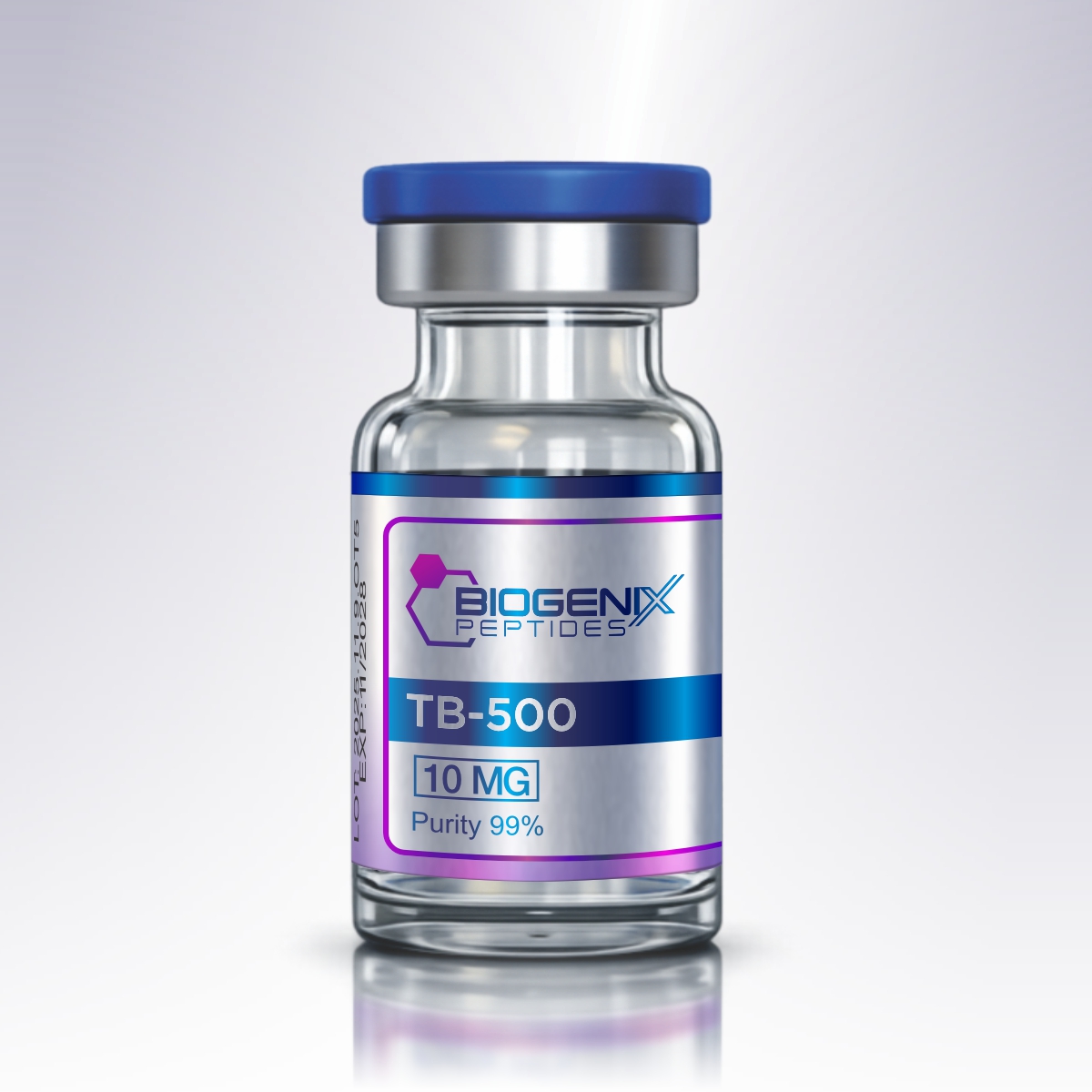
TB-500 10mg
$64.00
TB-500 is a synthetic version of Thymosin Beta-4, a naturally occurring protein found in many tissues throughout the body. Researchers study TB-500 for its potential role in supporting healthy tissue repair, circulation, and recovery following physical stress or injury.
In research models, TB-500 has been examined for its ability to promote cell movement, improve blood flow, and aid the body’s natural healing response in muscles, tendons, and other soft tissues. Its stability and ease of use make it a popular tool for studying repair and regeneration processes.
In Stock
TB-500 — Research Overview
Introduction
TB-500 peptide, also known as synthetic Thymosin Beta 4 (Tβ4), is the synthetic version of the naturally occurring protein Thymosin beta 4. Thymosin beta 4 is encoded by the TMSB4X gene and found within thymus cells. TB-500 has been investigated for potential mechanisms such as inducing angiogenesis, promoting wound healing, supporting cardiac regeneration, influencing inflammatory pathways, and stimulating hair follicle growth. As a 43-amino acid peptide abundant in wound fluid, TB-500 may interact with actin and impact cellular migration and cytoskeletal remodeling.
Chemical Characteristics
| Compound | Type | Molecular Formula | Molecular Weight |
| TB-500 | Synthetic peptide fragment of Thymosin Beta-4 | C₂₁₂H₃₅₀N₅₆O₇₈S | 4963.44 g/mol |
Other Known Titles: Thymosin Beta 4.
Research Applications
1. Inflammation
– TB-500 may elevate microRNA-146a (miR-146a), downregulating inflammatory pathways involving IRAK1 and TRAF6, suggesting potential anti-inflammatory action [4].
2. Acute Wounds
– In wounded murine models, TB-500 exposure increased re-epithelialization by ~41% after 4 days and enhanced wound contraction by 11% compared to saline controls [5].
3. Chronic Wounds
– Studies across diabetic, aged, and steroid-treated animals indicated accelerated wound healing with TB-500. Clinical trials in stasis and pressure ulcers suggested accelerated closure by up to one month [6].
4. Heart Cells
– In pulmonary hypertension models, TB-500 influenced the Notch3-Col3A-CTGF axis, reducing right ventricular hypertrophy [7].
– Research suggests TB-500 promotes cardiac cell survival, angiogenesis, and migration, with enhanced integrin-linked kinase and Akt activation [8,9].
5. Hair Follicle Growth
– Murine models exposed to TB-500 demonstrated increased hair shafts and follicles, with elevated mRNA and protein expression linked to hair growth [10].
6. Angiogenesis and Blood Vessel Formation
– TB-500 has been shown to promote angiogenesis in HUVEC and murine CLI models, elevating VEGFA, Ang2, Notch, and NF-κB pathway markers [13].
7. Corneal Tissues
– In corneal wound models, TB-500 modulated cytokine expression (IL-1β, IL-6) and reduced neutrophil infiltration, suggesting wound healing and anti-inflammatory potential [14].
Conclusion
TB-500 (synthetic Thymosin Beta 4) is a 43-amino acid peptide with potential biological roles in wound healing, inflammation modulation, cardiac repair, angiogenesis, hair follicle induction, and corneal regeneration. While preclinical and early clinical studies suggest promising therapeutic avenues, TB-500 remains restricted to controlled laboratory research use.
TB-500 — References
- Kleinman, H. K., & Sosne, G. Thymosin β4 Promotes Dermal Healing. Vitamins & Hormones. 2016;102:251–275.https://doi.org/10.1016/bs.vh.2016.04.005
- Ho, E. N., Kwok, W. H., Lau, M. Y., Wong, A. S., Wan, T. S., Lam, K. K., Schiff, P. J., Stewart, B. D. Doping control analysis of TB-500, a synthetic version of an active region of thymosin β4, in equine urine and plasma by liquid chromatography–mass spectrometry. Journal of Chromatography A. 2012;1265:57–69.https://doi.org/10.1016/j.chroma.2012.09.043
- Gurtner, G. C., Werner, S., Barrandon, Y., & Longaker, M. T. Wound repair and regeneration. Nature. 2008;453(7193):314–321.https://doi.org/10.1038/nature07039
- Santra, M., Zhang, Z. G., Yang, J., Santra, S., Santra, S., Chopp, M., & Morris, D. C. Thymosin β4 up-regulation of microRNA-146a promotes oligodendrocyte differentiation and suppression of the Toll-like proinflammatory pathway. Journal of Biological Chemistry. 2014;289(28):19508–19518.https://doi.org/10.1074/jbc.M113.529966
- Malinda, K. M., Goldstein, A. L., & Kleinman, H. K. Thymosin β4 accelerates wound healing. Journal of Investigative Dermatology. 1999;113(3):364–368.https://doi.org/10.1046/j.1523-1747.1999.00703.x
- Treadwell, T., Kleinman, H. K., Crockford, D., Hardy, M. A., Guarnera, G. T., Goldstein, A. L. The regenerative peptide thymosin β4 accelerates the rate of dermal healing in preclinical animal models and in patients. Annals of the New York Academy of Sciences. 2012;1270(1):66–72.https://doi.org/10.1111/j.1749-6632.2012.06696.x
- Wei, C., Kim, I. K., Li, L., Wu, L., Gupta, S. Thymosin Beta-4 protects mice from monocrotaline-induced pulmonary hypertension and right ventricular hypertrophy. PLoS ONE. 2014;9(11):e110598.https://doi.org/10.1371/journal.pone.0110598
- Srivastava, D., Ieda, M., Fu, J., & Qian, L. Cardiac repair with thymosin β4 and cardiac reprogramming factors. Annals of the New York Academy of Sciences. 2012;1270:66–72.https://doi.org/10.1111/j.1749-6632.2012.06696.x
- Bock-Marquette, I., Saxena, A., White, M. D., Dimaio, J. M., & Srivastava, D. Thymosin beta4 activates integrin-linked kinase and promotes cardiac cell migration, survival and cardiac repair. Nature. 2004;432(7016):466–472.https://doi.org/10.1038/nature03000
- Gao, X. Y., Hou, F., Zhang, Z. P., et al. Role of thymosin beta 4 in hair growth. Molecular Genetics and Genomics. 2016;291:1639–1646.https://doi.org/10.1007/s00438-016-1217-8
- Huff, T., Müller, C. S., Otto, A. M., Netzker, R., & Hannappel, E. β-Thymosins, small acidic peptides with multiple functions. The International Journal of Biochemistry & Cell Biology. 2001;33(3):205–220.https://doi.org/10.1016/S1357-2725(00)00087-X
- Freeman, K. W., Bowman, B. R., & Zetter, B. R. Regenerative protein thymosin beta-4 is a novel regulator of purinergic signaling. FASEB Journal. 2011;25(3):907–915.https://doi.org/10.1096/fj.10-169417
- Lv, S., Cai, H., Xu, Y., Dai, J., Rong, X., & Zheng, L. Thymosin-β4 induces angiogenesis in critical limb ischemia mice via regulating Notch/NF-κB pathway. International Journal of Molecular Medicine. 2020;46(4):1347–1358.https://doi.org/10.3892/ijmm.2020.4701
- Sosne, G., Qiu, P., & Kurpakus-Wheater, M. Thymosin beta 4: A novel corneal wound healing and anti-inflammatory agent. Clinical Ophthalmology. 2007;1(3):201–207.https://www.ncbi.nlm.nih.gov/pmc/articles/PMC2705838/
NOTICE OF COMPLIANCE
The mission of BioGenix Peptides™ is to provide researchers with the highest-quality, Ultra-Pure Series™ compounds to help unlock the full potential of this evolving field. With precision, purity, and scientific integrity at the core of our operations, BioGenix Peptides™ is dedicated to supporting responsible exploration and discovery
Products from BioGenix Peptides™ are not intended for human consumption. They are supplied exclusively for in-vitro and pre-clinical research purposes.
By purchasing or using these products, the Customer accepts full responsibility for their handling and use, and agrees to indemnify and hold BioGenix Peptides™ harmless from any claims resulting from misuse.
Having trouble viewing? Use the buttons below to download or open the certificate.
Related products

In Stock