
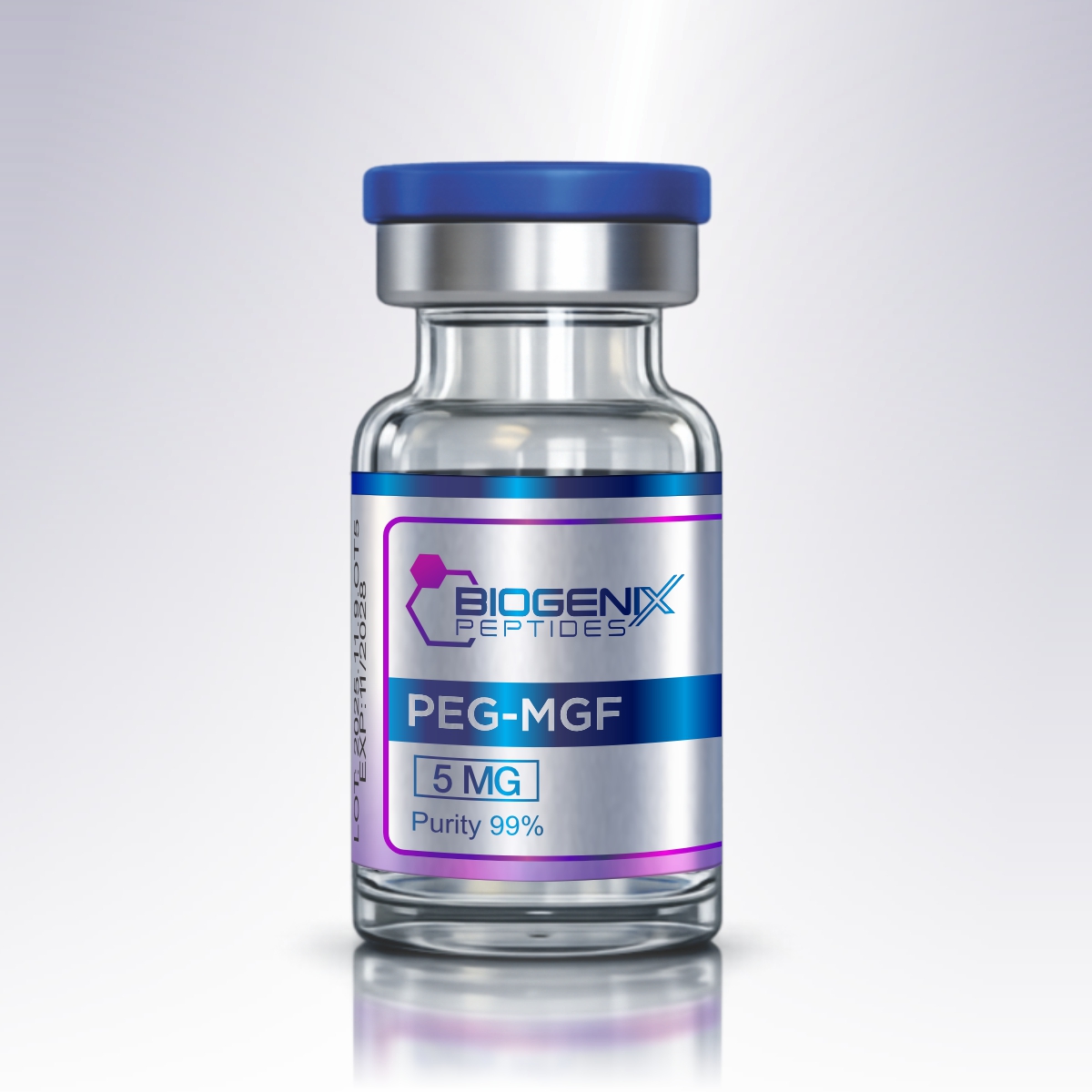
PEG-MGF 5mg
$60.00
PEG-MGF (Pegylated Mechano Growth Factor)
PEG-MGF is a pegylated research peptide derived from Mechano Growth Factor (MGF), an IGF-1 splice variant observed in muscle tissue after mechanical stress in preclinical models. Adding a PEG (polyethylene glycol) group helps stabilize the peptide and allows it to remain intact longer in laboratory settings compared with non-pegylated MGF.
Researchers use PEG-MGF to study early muscle signaling, regeneration pathways, and growth-factor timing in controlled in-vitro and pre-clinical research models where prolonged peptide presence is desired.
For research use only. Not for human or animal consumption.
In Stock
PEG-MGF (Pegylated Mechano Growth Factor) — Research Overview
Introduction
PEG-MGF (Pegylated Mechano Growth Factor) is a synthetic, pegylated peptide derived from the E-domain of Mechano Growth Factor (MGF), an alternative splice variant of insulin-like growth factor-1 (IGF-1 Ec). MGF is transiently expressed in skeletal muscle tissue in response to mechanical overload, stretch, or injury, where it is believed to initiate early regenerative and adaptive signaling events in preclinical models.
Unlike mature IGF-1, which is primarily associated with systemic endocrine signaling and later-stage hypertrophic effects, MGF is considered a locally acting growth factor involved in early tissue-repair processes. Native MGF peptides exhibit extremely short functional persistence due to rapid proteolytic degradation. Pegylation of the MGF E-domain is employed to enhance molecular stability and extend signaling exposure in experimental systems.
As a result, PEG-MGF is widely used as a research tool compound for investigating sustained MGF-related signaling, temporal differences among IGF-1 splice variants, and early muscle-adaptive pathways without the pharmacokinetic limitations of the native peptide.
Chemical Characteristics
- CAS #: N/A
- Molecular Formula: C121H200N42O39
- Molecular Weight: N/A
- Peptide Length (Core): 24 amino acids (MGF E-domain)
- Modification: PEGylation (representative PEG-2000 conjugate)
The molecular formula shown represents a reference composition for PEG-MGF. Due to PEG polydispersity and conjugation variability, PEG-MGF does not possess a single fixed molecular weight.
Mechanisms of Action (Research Context)
1. Modulation of Mechano-Responsive Growth Factor Signaling
MGF is produced locally in skeletal muscle following mechanical strain or injury. In experimental models, MGF-derived peptides have been associated with early signaling events distinct from those mediated by mature IGF-1, including localized autocrine and paracrine activity. PEG-MGF is utilized to explore how prolonged availability of MGF-related signaling influences these early adaptive responses.
2. Satellite Cell Activation and Myogenic Pathways
Preclinical research indicates that MGF-related signaling may play a role in:
- Activation of quiescent muscle satellite cells
- Early proliferative responses during muscle regeneration
- Coordination between mechanical stimuli and growth-factor signaling
Pegylation allows researchers to study whether extended MGF exposure alters satellite-cell behavior compared with the native, short-lived peptide.
3. Temporal Differentiation of IGF-1 Isoform Activity
IGF-1 exists in multiple splice variants with distinct biological functions. While mature IGF-1 is more closely associated with later-stage hypertrophy and anabolic signaling, MGF appears to act early following mechanical stress, locally within affected tissue, and over short physiological time windows. PEG-MGF serves as a research tool for examining time-dependent differences in IGF-1 isoform signaling, particularly the effects of sustained versus transient exposure.
4. Enhanced Stability and Protease Resistance
Native MGF peptides are rapidly degraded by proteolytic enzymes. Pegylation confers increased resistance to enzymatic breakdown, prolonged functional persistence in vitro and in vivo research models, and improved consistency in longer-duration experimental designs. These properties make PEG-MGF particularly suitable for studies requiring extended growth-factor exposure.
Research Applications
Within controlled laboratory and preclinical research settings, PEG-MGF is commonly employed to investigate:
- Muscle Regeneration and Repair — Early signaling following mechanical injury or overload
- Satellite Cell Biology — Activation, proliferation, and differentiation dynamics
- IGF-1 Splice Variant Research — Functional distinctions between MGF and mature IGF-1
- Peptide Stabilization Strategies — Effects of PEGylation on peptide persistence
- Growth-Factor Signaling Kinetics — Sustained versus transient exposure models
Summary
PEG-MGF is a pegylated derivative of the MGF E-domain designed to overcome the rapid degradation of native MGF peptides. By extending the functional persistence of MGF-related signaling, PEG-MGF enables researchers to investigate early muscle-adaptive pathways, satellite-cell activation, and the temporal dynamics of IGF-1 splice variant activity in preclinical models.
For research use only. Not for human or animal consumption.
No certificate available for this product.
Related products

In Stock