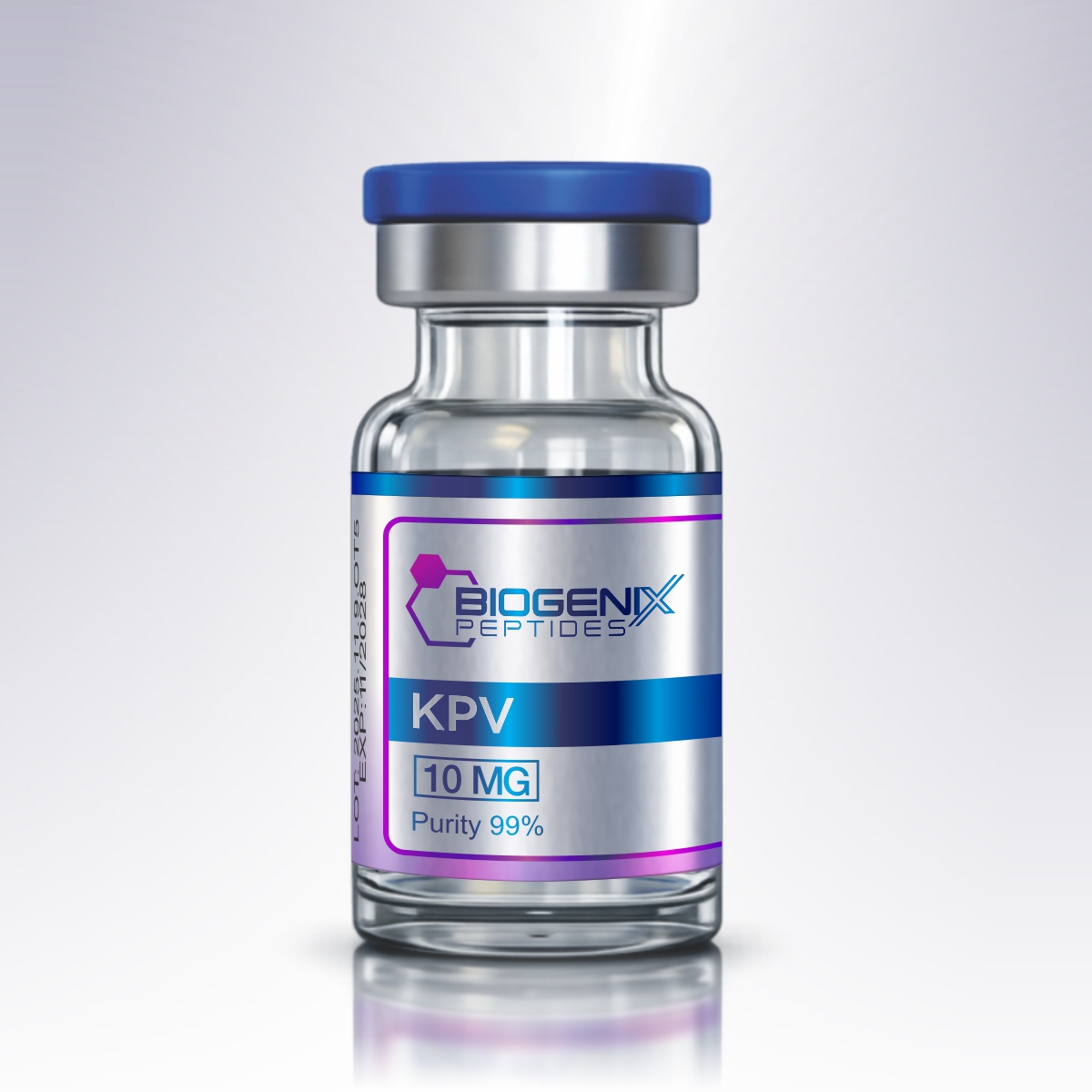
KPV 10mg
$48.00
KPV is a short, naturally occurring tripeptide made from the amino acids lysine, proline, and valine. It is a small fragment of the larger hormone α-MSH, and researchers study KPV because of its potential to help calm inflammation, support healthy tissue recovery, and protect the body’s natural barriers, such as the skin and gut lining.
In research settings, KPV has been shown to reduce inflammatory signals, support the repair of irritated or damaged tissue, and help maintain the strength and stability of the body’s protective surfaces. It has also been explored for its role in skin health, wound-healing models, and studies involving gut barrier function.
Because it is small, stable, and easy for cells to work with, KPV is often used as a simple model compound for understanding how the body manages inflammation and protects itself under stressful conditions.
In Stock
KPV (Lys–Pro–Val) — Overview & Chemical Characteristics
KPV is a naturally occurring tripeptide composed of lysine, proline, and valine (Lys–Pro–Val).
It represents the C-terminal fragment of the endogenous peptide hormone
α-melanocyte–stimulating hormone (α-MSH). Researchers are interested in KPV for its
anti-inflammatory, barrier-protective, and tissue-repair–related properties in a variety of preclinical models.
As a minimal melanocortin-derived motif, KPV retains significant biological activity while offering a short,
chemically stable structure that is straightforward to synthesize and formulate.
Chemical Identity
- Name: KPV (Lys–Pro–Val)
- Sequence: H–Lys–Pro–Val–OH
- CAS #: 112965-21-6
- Molecular Formula: C17H32N6O4
- Molecular Weight: 384.48 g/mol
- Peptide Length: 3 amino acids (tripeptide)
- Origin: C-terminal fragment of α-MSH (melanocortin-derived peptide)
Mechanistic Features (Research Context)
Anti-Inflammatory Activity
KPV has been widely studied as a small, melanocortin-derived peptide with broad anti-inflammatory potential.
In cell-based assays and animal models, KPV and related α-MSH fragments have been shown to:
- Reduce production of pro-inflammatory cytokines such as TNF-α, IL-1β, and IL-6.
- Attenuate activation of the transcription factor NF-κB in immune and epithelial cells.
- Down-regulate expression of pro-inflammatory enzymes, including inducible nitric oxide synthase (iNOS) and COX-2, in select models.
Collectively, these actions position KPV as a useful tool compound for studying inflammation control and
signaling pathways downstream of NF-κB and MAPK in controlled research settings.
Barrier and Mucosal Protection
KPV has been investigated extensively in models of intestinal inflammation and epithelial injury. In murine
colitis paradigms (such as DSS- or TNBS-induced colitis), KPV treatment has been reported to:
- Lower clinical and histologic indices of colitis severity.
- Reduce neutrophil infiltration and myeloperoxidase activity in the affected tissue.
- Preserve epithelial architecture and reduce ulceration and mucosal damage.
In vitro, KPV has been observed to help maintain tight-junction protein expression and reduce permeability in
intestinal epithelial monolayers exposed to inflammatory stimuli. These findings suggest that KPV may be
valuable for probing mechanisms of gut barrier integrity and mucosal healing.
Innate Immune Modulation & Antimicrobial Effects
Beyond its anti-inflammatory profile, KPV has been studied for direct and indirect effects on innate immunity:
- Modulation of macrophage and neutrophil activation in response to microbial products such as LPS.
- Potential direct antimicrobial activity against selected bacterial strains in vitro.
- Reduction of tissue damage in infection-associated inflammation models, consistent with dampened overactive immune responses.
These properties support KPV’s use in research examining host–pathogen interactions and regulation of innate immune signaling.
Melanocortin Lineage and PepT1-Mediated Transport
While full-length α-MSH signals primarily through melanocortin receptors (e.g., MC1R, MC3R, MC4R), KPV appears
to exert some of its effects through partially distinct mechanisms:
- KPV retains key structural elements of α-MSH, linking it to the melanocortin family and certain receptor-mediated effects.
- In intestinal models, KPV has been shown to utilize the peptide transporter 1 (PepT1) for uptake across the epithelial layer, supporting the feasibility of luminal/oral delivery in research paradigms.
This combination of melanocortin lineage and PepT1-mediated transport makes KPV an attractive tool for
studying how small peptides can modulate local inflammation and barrier function when delivered directly to
mucosal surfaces.
Wound-Healing and Tissue Repair
In cutaneous and mucosal wound models, topical or locally administered KPV has demonstrated:
- Acceleration of re-epithelialization and closure of experimental wounds.
- Reduction of inflammatory cell infiltrates at the wound site.
- Improved histologic organization of regenerating tissue compared with untreated controls.
These data are consistent with a dual role for KPV—both limiting excessive inflammation and supporting the
tissue repair processes that underlie healthy recovery.
Potential Research Applications
Within controlled laboratory settings, KPV is commonly employed to explore:
- Inflammation Control & NF-κB Signaling – Probing how small peptides can regulate cytokine output, transcriptional responses, and inflammatory cascades.
- Intestinal Barrier Integrity – Modeling epithelial permeability, tight-junction regulation, and mucosal protection in colitis and gut-injury models.
- Mucosal & Cutaneous Wound Healing – Evaluating epithelial repair, scar formation, and the balance between inflammation and regeneration.
- Innate Immune Responses to Microbes – Studying macrophage and neutrophil behavior, antimicrobial peptide synergy, and host defense mechanisms.
- Peptide Transport & Drug-Delivery Concepts – Using KPV as a probe for PepT1-mediated transport and epithelial uptake of small bioactive peptides.
Representative Studies (Selected)
- Preclinical studies demonstrating suppression of NF-κB activation and pro-inflammatory cytokine release by KPV and α-MSH fragments in immune and epithelial cells.
- Murine colitis models (DSS/TNBS) showing reduced disease severity, improved histology, and better barrier function with KPV treatment.
- Intestinal epithelial transport studies identifying PepT1 as a key route for KPV uptake from the luminal side.
- Cutaneous wound-healing experiments reporting accelerated re-epithelialization and reduced inflammatory infiltrate with topical KPV.
- Reviews of melanocortin-derived peptides highlighting KPV as a simplified, bioactive fragment with anti-inflammatory and tissue-protective properties.
For research use only. Not for human consumption.
NOTICE OF COMPLIANCE
The mission of BioGenix Peptides™ is to provide researchers with the
highest-quality, Ultra-Pure Series™ compounds to help unlock the full potential of
this evolving field. With precision, purity, and scientific integrity at the core of our operations,
BioGenix Peptides™ is dedicated to supporting responsible exploration and discovery.
Products from BioGenix Peptides™ are not intended for human consumption. They are
supplied exclusively for in-vitro and pre-clinical research purposes.
By purchasing or using these products, the Customer accepts full responsibility for their handling and use,
and agrees to indemnify and hold BioGenix Peptides™ harmless from any claims resulting
from misuse.
Having trouble viewing? Use the buttons below to download or open the certificate.
Related products

In Stock