
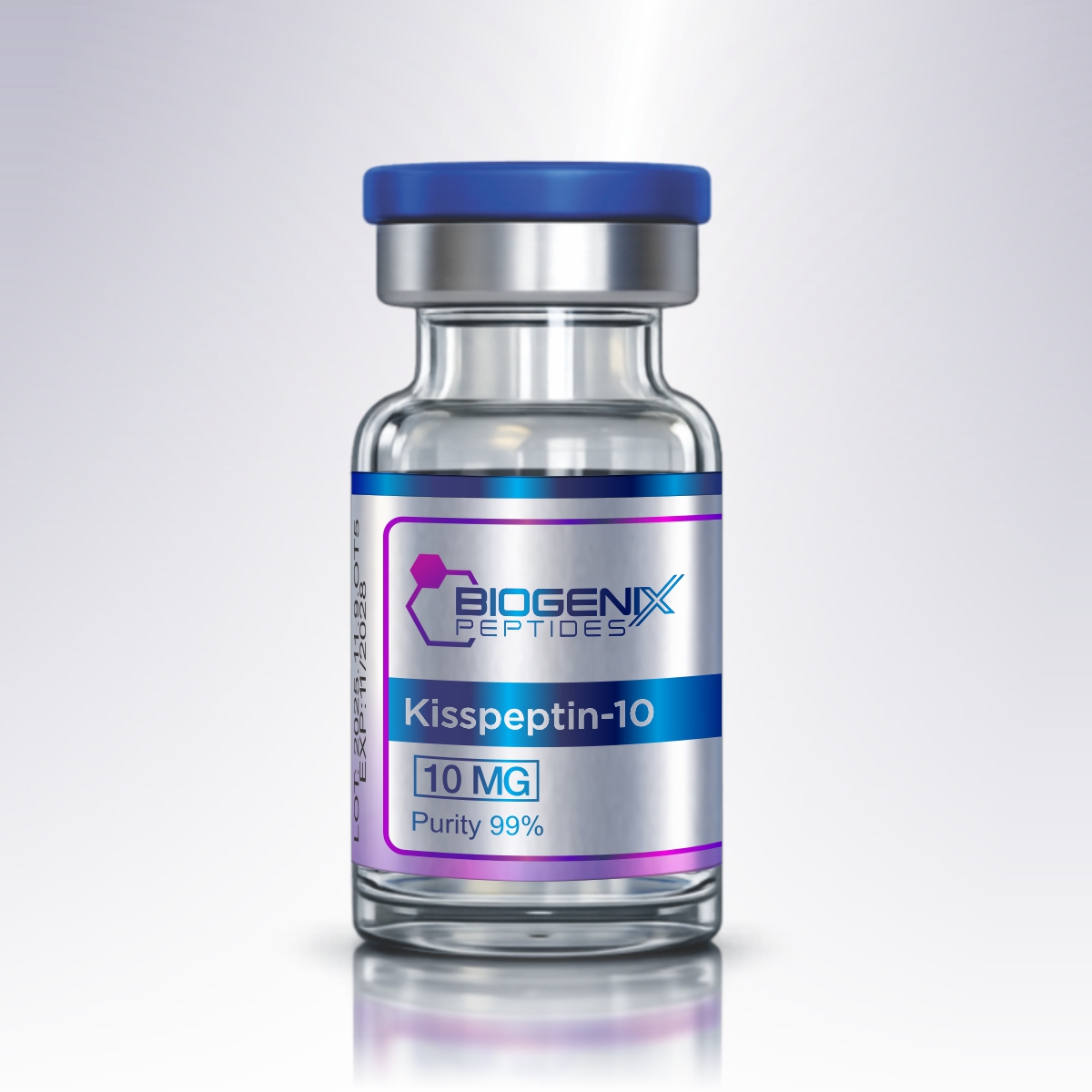
Kisspeptin-10 10mg
$68.00
Kisspeptin-10 (KP-10) is a 10-amino-acid peptide fragment produced from the KISS1 gene, which was first identified for its role in metastasis suppression. The full KISS1 precursor protein is cleaved into several active fragments—including Kisspeptin-54, -14, -13, and -10. KP-10, also known as Metastin 45–54, is the smallest naturally occurring sequence that can effectively activate the KISS1R (GPR54) receptor.
In Stock
Kisspeptin-10 (KP-10)
Kisspeptin-10 (KP-10) is a 10–amino-acid peptide fragment derived from the KISS1 gene product, originally identified as a metastasis suppressor gene. The KISS1 gene encodes a 145–amino acid precursor protein, which is cleaved to form smaller active fragments—Kisspeptin-54, Kisspeptin-14, Kisspeptin-13, and Kisspeptin-10. Of these, Kisspeptin-10 (Metastin 45–54) is the smallest naturally occurring sequence capable of activating the G-protein–coupled receptor KISS1R (also called GPR54).
Overview
Kisspeptin-10 is a high-affinity endogenous ligand for the KISS1R/GPR54 receptor. It plays a pivotal role in regulating the hypothalamic–pituitary–gonadal (HPG) axis. By binding to KISS1R, Kisspeptin-10 stimulates gonadotropin-releasing hormone (GnRH) neurons, which in turn promote the secretion of luteinizing hormone (LH) and follicle-stimulating hormone (FSH) from the pituitary gland. These actions make the Kisspeptin signaling system essential for the initiation of puberty, reproductive function, and fertility.
Mechanism of Action
Kisspeptin-10 activates GPR54/KISS1R, leading to intracellular signaling via the phospholipase C–IP3–Ca2+ pathway. This results in depolarization of GnRH neurons and release of GnRH into the hypophyseal portal circulation. Subsequent stimulation of pituitary gonadotrophs increases LH and FSH secretion, which act on the gonads to regulate sex steroid synthesis and gametogenesis.
Chemical Characteristics
| Compound | Type | Molecular Formula | Molecular Weight |
| Kisspeptin-10 | Synthetic decapeptide (KISS1-derived GnRH modulator) | C63H83N17O14 | 1302.5 g/mol |
Other Known Titles: Kisspeptin-10, Metastin 45–54, KP-10
Research and Clinical Studies
Kisspeptin-10 and Reproductive Hormone Release
Clinical trials have shown that Kisspeptin-10 administration stimulates LH and FSH secretion in both male and female subjects. Jayasena et al. (2011) demonstrated that intravenous bolus administration of Kisspeptin-10 in men led to rapid, dose-dependent increases in LH and FSH levels without significant alteration in cortisol or prolactin. In females, Kisspeptin-10 induced an LH surge particularly during the preovulatory phase of the menstrual cycle.
Kisspeptin-10 and Puberty Disorders
Mutations in the KISS1 or KISS1R genes can disrupt normal reproductive development. Loss-of-function mutations have been linked to idiopathic hypogonadotropic hypogonadism (IHH), characterized by delayed or absent puberty. Conversely, activating mutations in KISS1R have been associated with central precocious puberty. These genetic findings underscore the critical role of Kisspeptin-10 in puberty onset and reproductive axis regulation.
Kisspeptin-10 and Feeding Behavior
Animal studies indicate that Kisspeptin-10 may influence appetite regulation. Stengel et al. (2011) observed that central administration of Kisspeptin-10 reduced food intake in fasted mice during the initial post-fasting period. This effect may be mediated via alterations in hypothalamic neuropeptides such as neuropeptide Y (NPY) and brain-derived neurotrophic factor (BDNF).
Kisspeptin-10 and Neuroprotection
Recent preclinical studies suggest that Kisspeptin-10 may exhibit neuroprotective potential. It appears to interact with amyloid-beta and alpha-synuclein peptides, possibly mitigating their cytotoxicity in neuronal models. The peptide may reduce apoptosis and preserve mitochondrial function in affected neurons, an effect that appears to occur independently of KISS1R activation.
Kisspeptin-10 — References
- Kotani, M., Detheux, M., Vandenbogaerde, A., Communi, D., Vanderwinden, J. M., Le Poul, E., Brézillon, S., Tyldesley, R., Suarez-Huerta, N., Vandeput, F., Blanpain, C., Schiffmann, S. N., Vassart, G., Parmentier, M. The metastasis suppressor gene KiSS-1 encodes kisspeptins, the natural ligands of the orphan G protein–coupled receptor GPR54. Journal of Biological Chemistry. 2001;276(37):34631–34636.https://doi.org/10.1074/jbc.M104847200
- Gottsch, M. L., Cunningham, M. J., Smith, J. T., Popa, S. M., Acohido, B. V., Crowley, W. F., Seminara, S., Clifton, D. K., Steiner, R. A. A role for kisspeptins in the regulation of gonadotropin secretion in the mouse. Endocrinology. 2004;145(9):4073–4077.https://doi.org/10.1210/en.2004-0431
- Messager, S., Chatzidaki, E. E., Ma, D., Hendrick, A. G., Zahn, D., Dixon, J., Thresher, R. R., Malinge, I., Lomet, D., Carlton, M. B., Colledge, W. H., Caraty, A., Aparicio, S. A. Kisspeptin directly stimulates gonadotropin-releasing hormone release via G protein–coupled receptor 54. Proceedings of the National Academy of Sciences USA. 2005;102(5):1761–1766.https://doi.org/10.1073/pnas.0409330102
- Dhillo, W. S., Chaudhri, O. B., Patterson, M., Thompson, E. L., Murphy, K. G., Badman, M. K., McGowan, B. M., Amber, V., Patel, S., Ghatei, M. A., Bloom, S. R. Kisspeptin-54 stimulates the hypothalamic–pituitary–gonadal axis in human males. Journal of Clinical Endocrinology & Metabolism. 2005;90(12):6609–6615.https://doi.org/10.1210/jc.2005-1468
- Thompson, E. L., Patterson, M., Murphy, K. G., Smith, K. L., Dhillo, W. S., Todd, J. F., Ghatei, M. A., Bloom, S. R. Central and peripheral administration of kisspeptin-10 stimulates the hypothalamic–pituitary–gonadal axis. Journal of Neuroendocrinology. 2004;16(10):850–858.https://doi.org/10.1111/j.1365-2826.2004.01240.x
- Plant, T. M., Ramaswamy, S., Dipietro, M. J. Repetitive administration of kisspeptin-10 in the juvenile monkey elicits a sustained train of GnRH discharges. Endocrinology. 2006;147(2):1007–1013.https://doi.org/10.1210/en.2005-1264
- George, J. T., Veldhuis, J. D., Tena-Sempere, M., Millar, R. P., Anderson, R. A. Exploring the pathophysiology of hypogonadism using kisspeptin. Clinical Endocrinology. 2010;73(4):449–455.https://doi.org/10.1111/j.1365-2265.2010.03834.x
- Clarke, H., Dhillo, W. S., Jayasena, C. N. Comprehensive review on kisspeptin and its role in reproductive disorders. Human Reproduction Update. 2015;21(3):371–382.https://doi.org/10.1093/humupd/dmv003
.
NOTICE OF COMPLIANCE
The mission of BioGenix Peptides™ is to provide researchers with the highest-quality, Ultra-Pure Series™ compounds to help unlock the full potential of this evolving field. With precision, purity, and scientific integrity at the core of our operations, BioGenix Peptides™ is dedicated to supporting responsible exploration and discovery
Products from BioGenix Peptides™ are not intended for human consumption. They are supplied exclusively for in-vitro and pre-clinical research purposes.
By purchasing or using these products, the Customer accepts full responsibility for their handling and use, and agrees to indemnify and hold BioGenix Peptides™ harmless from any claims resulting from misuse.
Having trouble viewing? Use the buttons below to download or open the certificate.
Related products

In Stock