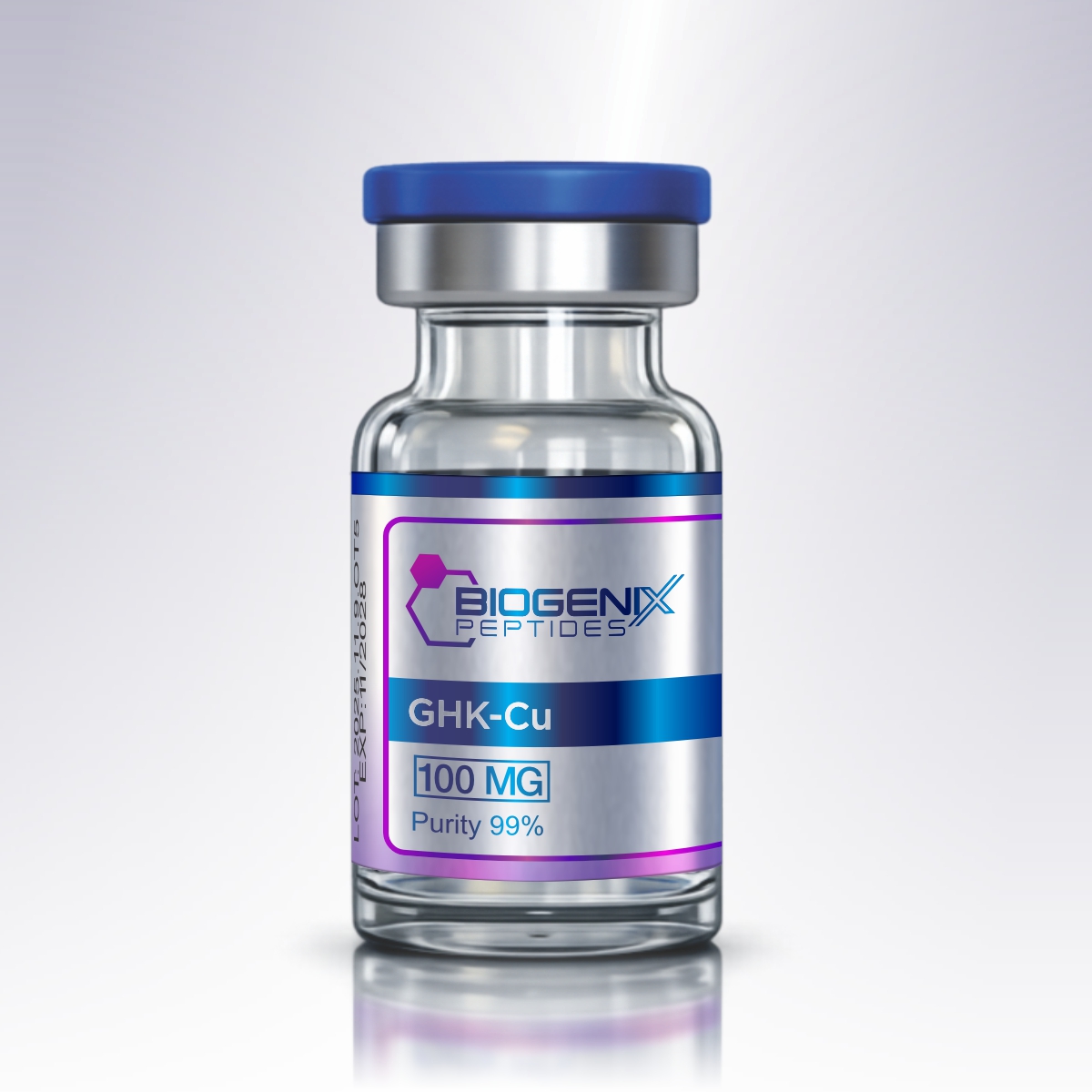
GHK-Cu 100mg
$96.00
GHK-Cu is a naturally occurring copper-binding tripeptide composed of glycyl-L-histidyl-L-lysine chelated to copper (II). It is present in plasma and is released at injury sites, where it is proposed to influence extracellular matrix synthesis and tissue repair. Reported circulating concentrations decline with age (e.g., ~200 ng/mL at ~20 years to ~80 ng/mL by ~60 years). In vitro and in vivo studies have explored GHK (with and without copper) for roles spanning collagen dynamics, antioxidant defenses, wound healing, gene expression modulation, and anti-inflammatory pathways.
In Stock
GHK-Cu (Copper) — Research Overview
Introduction
GHK-Cu is a naturally occurring copper-binding tripeptide composed of glycyl-L-histidyl-L-lysine chelated to copper (II). It is present in plasma and is released at injury sites, where it is proposed to influence extracellular matrix synthesis and tissue repair. Reported circulating concentrations decline with age (e.g., ~200 ng/mL at ~20 years to ~80 ng/mL by ~60 years). In vitro and in vivo studies have explored GHK (with and without copper) for roles spanning collagen dynamics, antioxidant defenses, wound healing, gene expression modulation, and anti-inflammatory pathways.
Chemical Characteristics
| Compound | Type | Molecular Formula | Molecular Weight |
| GHK-Cu | Copper peptide complex (glycyl-L-histidyl-L-lysine + Cu²⁺) | C₁₄H₂₄N₆O₄Cu | 403.86 g/mol |
Other Titles: Glycyl-L-histidyl-L-lysine–copper (II), GHK-Cu
Research Applications
1. Gene Expression and Cellular Reprogramming
– Research reports that nanomolar GHK can modulate broad gene networks, including pathways related to cell growth, DNA repair, and differentiation.- Hypothesized ‘genome reset’ effects have been described in models of carcinogenic transformation and COPD, suggesting restoration toward healthier expression profiles.
2. Extracellular Matrix and Tissue Repair
– Early studies proposed that injury releases GHK, which chelates circulating Cu(II) and stimulates decorin and collagen synthesis in fibroblasts.- GHK-Cu has been associated with increased total protein and DNA content at wound sites, and induction of TIMP-1/2 alongside matrix remodeling enzymes.
3. Wound Healing — Preclinical and Clinical
– Rabbit wound models: Topical GHK-Cu accelerated closure versus zinc oxide or placebo over 21 days, with histological signs of enhanced repair.- Comparative modalities: In rabbits, combining GHK-Cu with higher-dose HeNe laser parameters correlated with increased neovascularization and reduced neutrophil infiltration versus controls.- Human diabetic neuropathic ulcers: A GHK-Cu gel cohort achieved ~98% median closure of plantar ulcers versus ~61% in standard-care controls in a randomized, placebo-controlled setting.
4. Cell Modulation and Anti-Proliferative Research
– In murine tumor models, mixtures containing GHK-Cu and ascorbate reduced sarcoma growth.- In vitro, GHK-Cu increased expression of caspases and DNA-repair genes, reactivated apoptosis (caspase-3/7) in SH-SY5Y neuroblastoma and U937 lymphoma cells, while supporting proliferation of healthy NIH-3T3 fibroblasts.
5. Neurobehavioral Findings (Preclinical)
– Analgesia-like readouts: In hot-plate assays, GHK-Cu reduced latency to paw-licking versus controls.- Anxiolytic-like effects: Elevated plus-maze studies reported increased ‘open-arm’ time after GHK administration; shock-induced aggression paradigms showed ~5× fewer attacks post-exposure.
6. Antioxidant and Anti-Inflammatory Pathways
– Endogenous antioxidant candidate: Flow cytometry and ESR assays indicate GHK reduces ROS induced by tert-butyl hydroperoxide, with notable scavenging of hydroxyl (·OH) and peroxyl (ROO·) radicals.- Pulmonary models: In cigarette-smoke–exposed mice, GHK-Cu was associated with lower IL‑1β/TNF‑α in BALF, reduced MPO activity, decreased lipid peroxidation (MDA), and restoration of GSH. Proposed mechanisms include dampening NF‑κB activation (via IκBα phosphorylation) and boosting Nrf2 nuclear translocation and downstream cytoprotective gene expression.
7. Lipid Peroxidation and Iron Handling
– Theoretical and experimental work suggests GHK may limit ferritin-dependent iron release and complex formation in injured tissues, potentially lowering lipid peroxidation and inflammatory signaling.
Conclusion
Across cellular and animal models—and select clinical contexts—GHK-Cu has been explored for wound repair, extracellular matrix support, antioxidant and anti-inflammatory actions, and gene network modulation. While the breadth of reported effects is substantial, findings remain experimental and mechanism-specific outcomes can vary by model and dose. Continued research is clarifying its roles in tissue regeneration, redox balance, and immune modulation.
GHK-Cu (Copper Peptide) — References
- Pickart, L., Thaler, M. M. Tripeptide in human serum which prolongs survival of normal liver cells and stimulates growth in neoplastic liver. Nature New Biology. 1973;243(124):85–87. https://doi.org/10.1038/newbio243085a0
- Pickart, L., Freedman, J. H., Loker, W. J., Peisach, J., Perkins, C. M., Stenkamp, R. E., Weinstein, B. Growth-modulating plasma tripeptide may function by facilitating copper uptake into cells. Nature. 1980;288(5792):715–717. https://doi.org/10.1038/288715a0
- Pickart, L., Margolina, A. Regenerative and protective actions of the GHK-Cu peptide in the light of the new gene data. International Journal of Molecular Sciences. 2018;19(7):1987. https://doi.org/10.3390/ijms19071987
- Maquart, F. X., Bellon, G., Chaqour, B., Wegrowski, Y., Patt, L. M., Trachy, R. E., Monboisse, J. C., Borel, J. P. In vivo stimulation of connective tissue accumulation by the tripeptide-copper complex glycyl-L-histidyl-L-lysine-Cu²⁺ in rat experimental wounds. Journal of Clinical Investigation. 1988;82(3): 801–806. https://doi.org/10.1172/JCI113667
- Maquart, F. X., Chaqour, B., Simeon, A., Pasco, S., Monboisse, J. C., Borel, J. P. Specific modulation of collagen synthesis in cultured fibroblasts by the tripeptide-copper complex glycyl-L-histidyl-L-lysine-Cu²⁺. FEBS Letters. 1993;318(2):291–294. https://doi.org/10.1016/0014-5793(93)81465-2
- Kumar, N., Nagarajan, A., Uchil, P. D. Copper peptides in dermatology: A review. Dermatologic Therapy. 2018;31(6):e12727. https://doi.org/10.1111/dth.12727
- Abdulghani, A. A., Pastore, M. N., Matousek, J. L., Roberts, M. S., Grice, J. E. Topical delivery of copper tripeptide through microneedle treatment in human skin in vitro. International Journal of Pharmaceutics. 2020;587:119675. https://doi.org/10.1016/j.ijpharm.2020.119675
- Leyden, J. J., Stephens, T. J., Katz, L. M., Raney, S. G. Clinical evaluation of copper tripeptide cream in facial photoaging. Journal of Cosmetic Dermatology. 2002;1(4):237–244. https://doi.org/10.1046/j.1473-2130.2002.00058.x
- Pickart, L., Margolina, A. GHK peptide as a natural modulator of multiple biochemical pathways. BioMed Research International. 2018;2018:1–13. https://doi.org/10.1155/2018/6301094
- Siméon, A., Wegrowski, Y., Bontemps, Y., Maquart, F. X. Expression of glycosaminoglycans and small proteoglycans in wounds: modulation by the tripeptide-copper complex GHK-Cu. Journal of Investigative Dermatology. 2000;115(6):962–968. https://doi.org/10.1046/j.1523-1747.2000.00165.x
NOTICE OF COMPLIANCE
The mission of BioGenix Peptides™ is to provide researchers with the highest-quality, Ultra-Pure Series™ compounds to help unlock the full potential of this evolving field. With precision, purity, and scientific integrity at the core of our operations, BioGenix Peptides™ is dedicated to supporting responsible exploration and discovery
Products from BioGenix Peptides™ are not intended for human consumption. They are supplied exclusively for in-vitro and pre-clinical research purposes.
By purchasing or using these products, the Customer accepts full responsibility for their handling and use, and agrees to indemnify and hold BioGenix Peptides™ harmless from any claims resulting from misuse
Having trouble viewing? Use the buttons below to download or open the certificate.
Related products

In Stock