
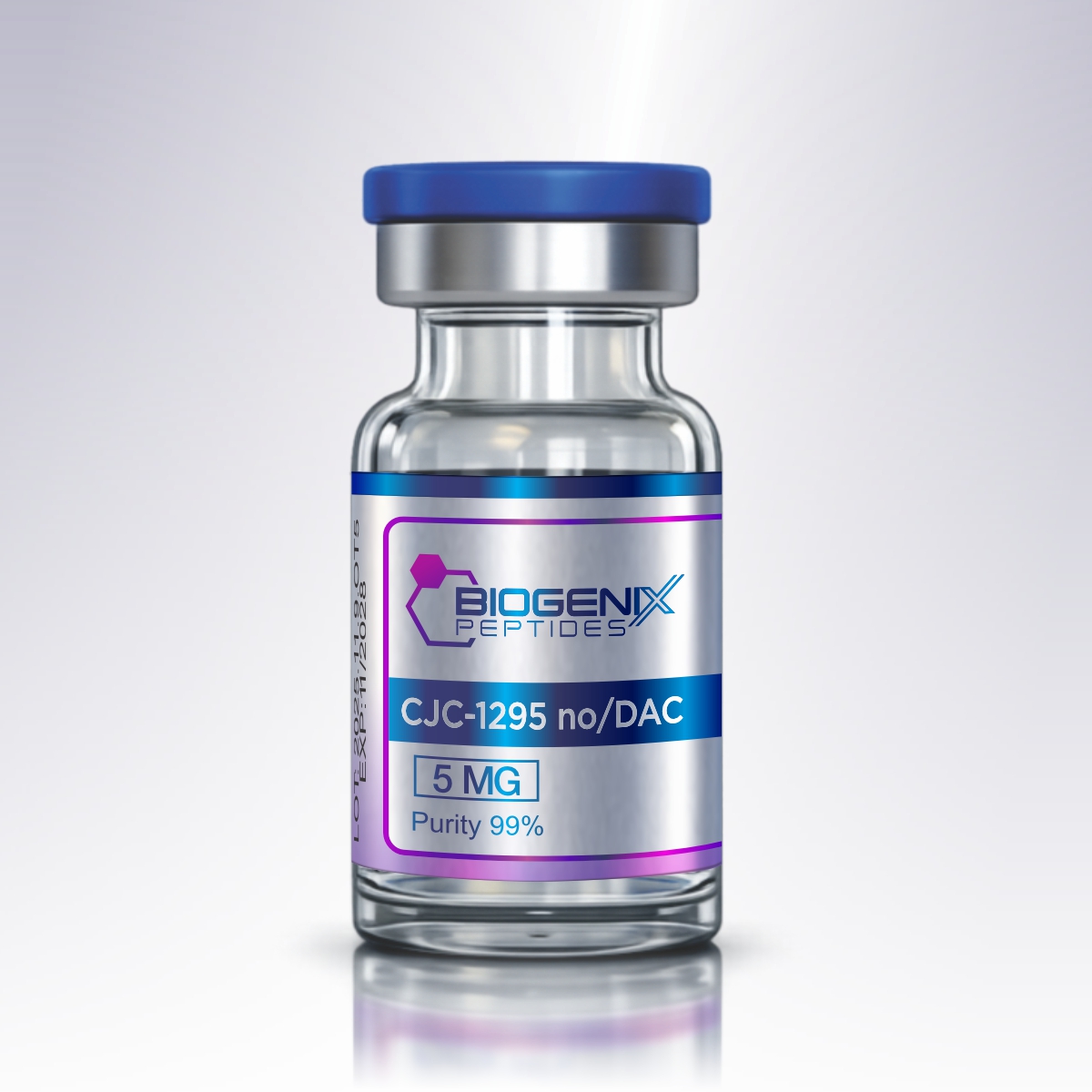
CJC-1295 no/DAC 5mg
$40.00
CJC-1295 (No DAC), also known as Modified GRF (1-29) or tetra-substituted GRF (1-29), is a synthetic analogue of growth hormone-releasing hormone (GHRH). This peptide consists of the first 29 amino acids of native GHRH, which are sufficient to bind to GHRH receptors and stimulate growth hormone (GH) release. Structural modifications at four positions (2, 8, 15, and 27) were introduced to reduce enzymatic degradation, thereby extending activity compared to the unmodified GRF (1-29). Unlike CJC-1295 DAC, this form does not include the Drug Affinity Complex (DAC), resulting in a shorter half-life but potentially allowing for more pulsatile GH release.
In Stock
CJC-1295 (No DAC) — Research Overview
Introduction
CJC-1295 (No DAC), also known as Modified GRF (1-29) or tetra-substituted GRF (1-29), is a synthetic analogue of growth hormone-releasing hormone (GHRH). This peptide consists of the first 29 amino acids of native GHRH, which are sufficient to bind to GHRH receptors and stimulate growth hormone (GH) release. Structural modifications at four positions (2, 8, 15, and 27) were introduced to reduce enzymatic degradation, thereby extending activity compared to the unmodified GRF (1-29). Unlike CJC-1295 DAC, this form does not include the Drug Affinity Complex (DAC), resulting in a shorter half-life but potentially allowing for more pulsatile GH release.
Background and Mechanism
– Peptide Design: Derived from the first 29 amino acids of GHRH, with substitutions that enhance stability against dipeptidyl peptidase-4 degradation.- Modifications: • Position 2: L-alanine → D-alanine (resists enzymatic breakdown) • Position 8: Asparagine → Glutamine (reduces amide hydrolysis) • Position 15: Glycine → Alanine (enhances activity) • Position 27: Methionine → Leucine (prevents oxidation)- Receptor Interaction: CJC-1295 (No DAC) binds to GHRH receptors on pituitary somatotroph cells, activating G-proteins and intracellular signaling cascades. This stimulates secondary messengers (cAMP, IP3), leading to protein kinase activation, phosphorylation of transcription factors, and GH release.
Chemical Characteristics
| Compound | Type | Molecular Formula | Molecular Weight |
| CJC-1295 (No DAC) | Synthetic growth hormone–releasing hormone (GHRH) analog | C₁₅₂H₂₅₂N₄₄O₄₂ | 3367.84 g/mol |
Research Applications
1. Pituitary and GH Release
– Acts at GHRH receptors in pituitary cells, stimulating GH secretion via intracellular second messenger pathways.- Promotes vesicle fusion and GH release into circulation, mimicking natural hormone signaling.
2. Growth Hormone Pulsatility
– Research has shown that CJC-1295 (No DAC) can increase mean GH release by 70–100% over 12-hour windows.- IGF-1 levels also rise (~28%), supporting anabolic activity in tissues.- Associated with increases in skin thickness, collagen production, and muscle hypertrophy in experimental settings.
3. Gastrointestinal and Cardiovascular Studies
– Experimental data suggest potential activity at VIP-related receptors in the gastrointestinal tract, influencing motility.- Preliminary cardiac studies indicate possible roles in tissue repair and enhanced cardiac function post-injury.
4. Peptide Combinations
– Frequently studied in combination with growth hormone secretagogues (GHSs) such as Ipamorelin.- Dual activation of GHRH and ghrelin receptors in pituitary somatotrophs may synergistically increase GH output.
Half-Life and Stability
– Native GHRH: ~7 minutes- CJC-1295 (No DAC): ~30 minutes (extended by amino acid substitutions)- CJC-1295 DAC: ~6–8 days (via albumin binding)CJC-1295 (No DAC) therefore remains shorter-acting, making it a candidate for studies where pulsatile GH stimulation is preferred.
Conclusion
CJC-1295 (No DAC) is a stabilized, short-acting GHRH analogue that supports pulsatile GH release. Its tetra-substituted structure enhances resistance to enzymatic degradation, but without the DAC extension, its activity window is shorter than CJC-1295 DAC. Researchers continue to explore its potential in growth hormone modulation, skin and muscle tissue repair, and as part of combination peptide protocols.
CJC-1295 (No DAC) — References
- Teichman, S. L., Neale, A., Lawrence, B., Gagnon, C., Castaigne, J. P., Frohman, L. A., Thorner, M. O. Prolonged stimulation of growth hormone (GH) and insulin-like growth factor I secretion by CJC-1295, a long-acting GH-releasing hormone analog, in healthy adults. The Journal of Clinical Endocrinology & Metabolism. 2006;91(3):799–805. https://doi.org/10.1210/jc.2005-1536
- Alvero, R., Veldhuis, J. D., Iranmanesh, A., et al. Stimulation of pulsatile growth hormone secretion by continuous 29–amino acid GH-releasing hormone infusion in healthy older men and women: A clinical model for CJC-1295 No DAC–type analogues. The Journal of Clinical Endocrinology & Metabolism. 1992;75(3): 884–891.
- Frohman, L. A., Kineman, R. D. Growth hormone-releasing hormone and pituitary somatotrope function. Endocrine Reviews. 2002;23(3): 416–450. https://doi.org/10.1210/edrv.23.3.0460
- Gertner, J. M., Horowitz, S., Brasel, J. A., et al. Biological activity of growth hormone-releasing hormone fragments in humans: Evidence for preserved activity in the 1–29 amino acid sequence. The Journal of Clinical Endocrinology & Metabolism. 1984;58(2): 284–289.
- Castaigne, J. P., Frohman, L. A., Thorner, M. O., et al. CJC-1295, a long-acting growth hormone-releasing hormone analog, increases growth hormone and insulin-like growth factor I levels in healthy adults. The Journal of Clinical Pharmacology. 2007;47(6): 681–692. https://doi.org/10.1177/0091270007300952
- Veldhuis, J. D., Roemmich, J. N., Richmond, E. J., Rogol, A. D., Lovejoy, J. C., Sheffield-Moore, M., Mauras, N., Bowers, C. Y. Endocrine control of body composition in infancy, childhood, and puberty. Endocrine Reviews. 2005;26(1): 114–146. https://doi.org/10.1210/er.2003-0038
NOTICE OF COMPLIANCE
The mission of BioGenix Peptides™ is to provide researchers with the highest-quality, Ultra-Pure Series™ compounds to help unlock the full potential of this evolving field. With precision, purity, and scientific integrity at the core of our operations, BioGenix Peptides™ is dedicated to supporting responsible exploration and discovery
Products from BioGenix Peptides™ are not intended for human consumption. They are supplied exclusively for in-vitro and pre-clinical research purposes.
By purchasing or using these products, the Customer accepts full responsibility for their handling and use, and agrees to indemnify and hold BioGenix Peptides™ harmless from any claims resulting from misuse
Having trouble viewing? Use the buttons below to download or open the certificate.
Related products

In Stock