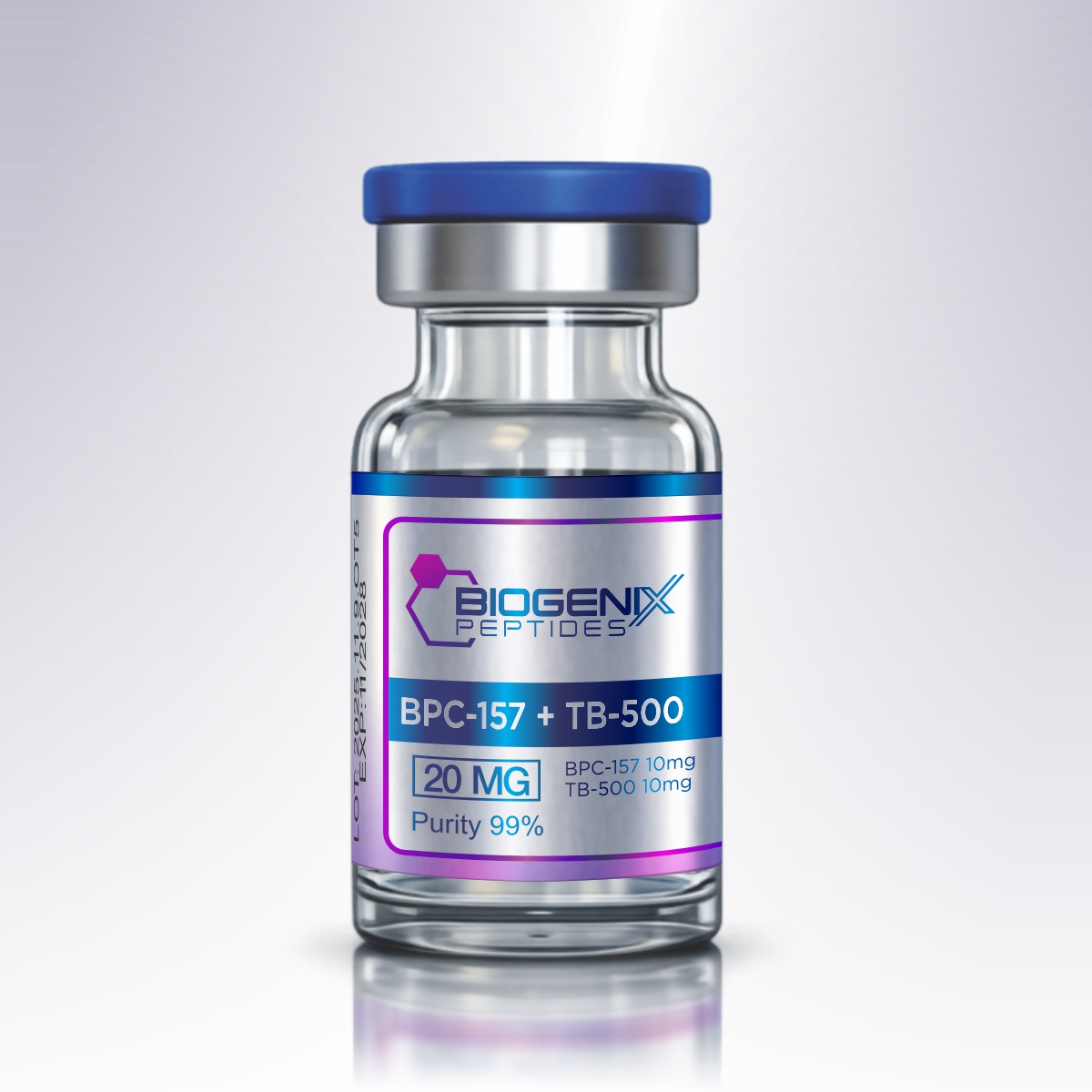
BPC-157 + TB-500 20mg Blend
$105.00
BPC-157 (Body Protection Compound-157) and TB-500 (synthetic thymosin beta-4) are two peptides commonly studied in experimental models for their roles in tissue repair and regeneration. While both compounds have distinct origins—BPC-157 as a pentadecapeptide derived from a gastric protein fragment, and TB-500 as a synthetic analogue of thymosin beta-4—they share overlapping potential in promoting wound healing, angiogenesis, and anti-inflammatory activity.Individually, BPC-157 has been explored for its influence on joint, tendon, muscle, and nerve repair, while TB-500 research has emphasized effects on cellular migration, tissue remodeling, neurological recovery, and cardiovascular resilience. When studied together as a blend, it is theorized that their complementary mechanisms may enhance healing processes beyond what either peptide demonstrates alone.
In Stock
BPC-157 & TB-500 Blend
Introduction
BPC-157 (Body Protection Compound-157) and TB-500 (synthetic thymosin beta-4) are two peptides commonly studied in experimental models for their roles in tissue repair and regeneration. While both compounds have distinct origins—BPC-157 as a pentadecapeptide derived from a gastric protein fragment, and TB-500 as a synthetic analogue of thymosin beta-4—they share overlapping potential in promoting wound healing, angiogenesis, and anti-inflammatory activity.Individually, BPC-157 has been explored for its influence on joint, tendon, muscle, and nerve repair, while TB-500 research has emphasized effects on cellular migration, tissue remodeling, neurological recovery, and cardiovascular resilience. When studied together as a blend, it is theorized that their complementary mechanisms may enhance healing processes beyond what either peptide demonstrates alone.
Background and Mechanism
BPC-157
– Composed of 15 amino acids, this pentadecapeptide has been shown in research to stimulate angiogenesis, collagen formation, and tissue remodeling.- It may interact with nitric oxide pathways, growth factor expression, and inflammatory cascades to support endothelial function and cellular recovery.- Suggested mechanisms include upregulation of VEGF, engagement with FAK-paxillin signaling, and protective effects under oxidative stress conditions.
TB-500
– A 43-amino acid synthetic peptide modeled after thymosin beta-4.- Reported to regulate actin dynamics via its LKKTETQ sequence, thereby influencing cellular migration and motility.- May also elevate microRNA-146a, which suppresses inflammatory pathways involving IRAK1 and TRAF6.- Preclinical studies point toward roles in wound contraction, tissue vascularization, and cardiac resilience under stress.
Chemical Characteristics
| Compound | Type | Molecular Formula | Molecular Weight |
| BPC-157 / TB-500 Blend | Synthetic peptide blend (BPC-157 + Thymosin β4 fragment) | C₆₂H₉₈N₁₆O₂₂ + C38H68N10O14 | ~5600 g/mol (combined) |
Research Highlights
1. Wound Healing and Tissue Repair
– In animal models, TB-500 increased re-epithelialization rates and accelerated wound closure compared to placebo controls.- Clinical trials with thymosin beta-4 analogues showed improved outcomes in patients with chronic pressure ulcers.- BPC-157 studies demonstrated higher collagen deposition, angiogenesis, and granulation tissue formation in injured tissue models.
2. Tendon and Ligament Recovery
– TB-500 has been associated with improved collagen alignment and mechanical strength in ligament repair models.- BPC-157 enhanced fibroblast survival, migration, and organization under stress conditions, possibly through FAK-paxillin activation.- Both peptides appear to influence tendon outgrowth and connective tissue regeneration.
3. Muscle and Bone Healing
– BPC-157 reversed corticosteroid-induced muscle damage in preclinical studies, restoring structure and function.- TB-500 showed potential in supporting cardiomyocyte survival and angiogenesis in ischemic models, with evidence of integrin-linked kinase (ILK) and Akt pathway involvement.- Early evidence suggests both compounds may support musculoskeletal healing and bone remodeling.
4. Neurological and Systemic Effects
– TB-500 has been investigated for its ability to support neurological recovery and enhance oligodendrocyte differentiation.- BPC-157 has demonstrated neuroprotective potential in models of traumatic brain injury and dopaminergic system imbalance.
Conclusion
BPC-157 and TB-500 represent two peptides with overlapping yet distinct regenerative properties. While direct studies of their combined use are limited, their individual mechanisms suggest potential synergy in tissue repair, angiogenesis, and anti-inflammatory regulation. The blend remains a subject of experimental interest for researchers studying musculoskeletal, cardiovascular, gastrointestinal, and neurological healing processes.
BPC-157 — References
Chang C-H, Tsai W-C, Lin M-S, Hsu Y-H, Su J-H. The promoting effect of pentadecapeptide BPC 157 on tendon healing involves tendon outgrowth, cell survival, and cell migration. Journal of Applied Physiology.
Gastric pentadecapeptide BPC 157 and soft tissue healing: review of literature. Histology and Histopathology. PMID: 30915550.
Sikiric P, Seiwerth S, Rucman R, Turkovic B, Rokotov DS, Brcic L, Sever M. The Stable Gastric Pentadecapeptide BPC 157: Pleiotropic Beneficial Activity and Possible Relations with Neurotransmitter Activity. Frontiers in Pharmacology. 2022;13:1026182.
Pharmacokinetics, distribution, metabolism, and excretion of BPC-157 in animals. Frontiers in Pharmacology. 2022.
Stable gastric pentadecapeptide BPC 157 and wound healing. Frontiers in Pharmacology. 2021;12:627533.
BPC-157 accelerates healing of colonic and skin defects; effect on fistula closure. ScienceDirect. 2019.
Stable gastric pentadecapeptide BPC 157 can improve healing in spinal cord injury in rats. Journal of Orthopaedic Surgery & Research. 2019.
Safety of Intravenous Infusion of BPC-157 in Humans: A Pilot Study. PubMed. PMID: 40131143.
USADA. BPC-157: Experimental Peptide Creates Risk for Athletes. United States Anti-Doping Agency. https://www.usada.org/spirit-of-sport/bpc-157-peptide-prohibited/
Cytoprotective gastric pentadecapeptide BPC 157 resolves major vessel occlusion disturbances. World Journal of Gastroenterology. 2022;28(1):23.
TB-500 — References
Kleinman HK, Sosne G. Thymosin β4 Promotes Dermal Healing. Vitam Horm. 2016;102:251-75. doi: 10.1016/bs.vh.2016.04.005.
Ho EN, Kwok WH, Lau MY, Wong AS, Wan TS, Lam KK, Schiff PJ, Stewart BD. Doping control analysis of TB-500, a synthetic version of an active region of thymosin β4, in equine urine and plasma by liquid chromatography-mass spectrometry. J Chromatogr A. 2012 Nov 23;1265:57-69.
Gurtner GC, Werner S, Barrandon Y, Longaker MT. Wound repair and regeneration. Nature. 2008 May 15;453(7193):314-21.
Santra, M., Zhang, Z. G., Yang, J., Santra, S., Santra, S., Chopp, M., & Morris, D. C. Thymosin β4 up-regulation of microRNA-146a promotes oligodendrocyte differentiation and suppression of the Toll-like proinflammatory pathway. The Journal of biological chemistry, 289(28), 19508–19518.
Katherine M. Malinda et al. Thymosin β4 Accelerates Wound Healing. Journal of Investigative Dermatology, Volume 113, Issue 3, 1999, Pages 364-368.
Treadwell T, Kleinman HK, Crockford D, Hardy MA, Guarnera GT, Goldstein AL. The regenerative peptide thymosin β4 accelerates the rate of dermal healing in preclinical animal models and in patients. Ann N Y Acad Sci. 2012 Oct.
Wei C, Kim IK, Li L, Wu L, Gupta S. Thymosin Beta 4 protects mice from monocrotaline-induced pulmonary hypertension and right ventricular hypertrophy. PLoS One. 2014 Nov 20;9(11):e110598.
Srivastava, D., Ieda, M., Fu, J., & Qian, L. Cardiac repair with thymosin β4 and cardiac reprogramming factors. Annals of the New York Academy of Sciences, 1270, 66–72.
Bock-Marquette, I., Saxena, A., White, M. D., Dimaio, J. M., & Srivastava, D. Thymosin beta4 activates integrin-linked kinase and promotes cardiac cell migration, survival and cardiac repair. Nature, 432(7016), 466–472.
Gao, Xy., Hou, F., Zhang, Zp. et al. Role of thymosin beta 4 in hair growth. Mol Genet Genomics 291, 1639–1646 (2016).
Huff, T., Müller, C. S., Otto, A. M., Netzker, R., & Hannappel, E. (2001). beta-Thymosins, small acidic peptides with multiple functions. The international journal of biochemistry & cell biology, 33(3), 205–220.
Freeman, K. W., Bowman, B. R., & Zetter, B. R. (2011). Regenerative protein thymosin beta-4 is a novel regulator of purinergic signaling. FASEB journal, 25(3), 907–915.
Lv, S., Cai, H., Xu, Y., Dai, J., Rong, X., & Zheng, L. Thymosin‑β 4 induces angiogenesis in critical limb ischemia mice via regulating Notch/NF‑κB pathway. International journal of molecular medicine, 46(4), 1347–1358.
Sosne, G., Qiu, P., & Kurpakus-Wheater, M. Thymosin beta 4: A novel corneal wound healing and anti-inflammatory agent. Clinical ophthalmology (Auckland, N.Z.), 1(3), 201–207.
NOTICE OF COMPLIANCE
The mission of BioGenix Peptides™ is to provide researchers with the highest-quality, Ultra-Pure Series™ compounds to help unlock the full potential of this evolving field. With precision, purity, and scientific integrity at the core of our operations, BioGenix Peptides™ is dedicated to supporting responsible exploration and discovery
Products from BioGenix Peptides™ are not intended for human consumption. They are supplied exclusively for in-vitro and pre-clinical research purposes.
By purchasing or using these products, the Customer accepts full responsibility for their handling and use, and agrees to indemnify and hold BioGenix Peptides™ harmless from any claims resulting from misuse
Having trouble viewing? Use the buttons below to download or open the certificate.
Related products

In Stock