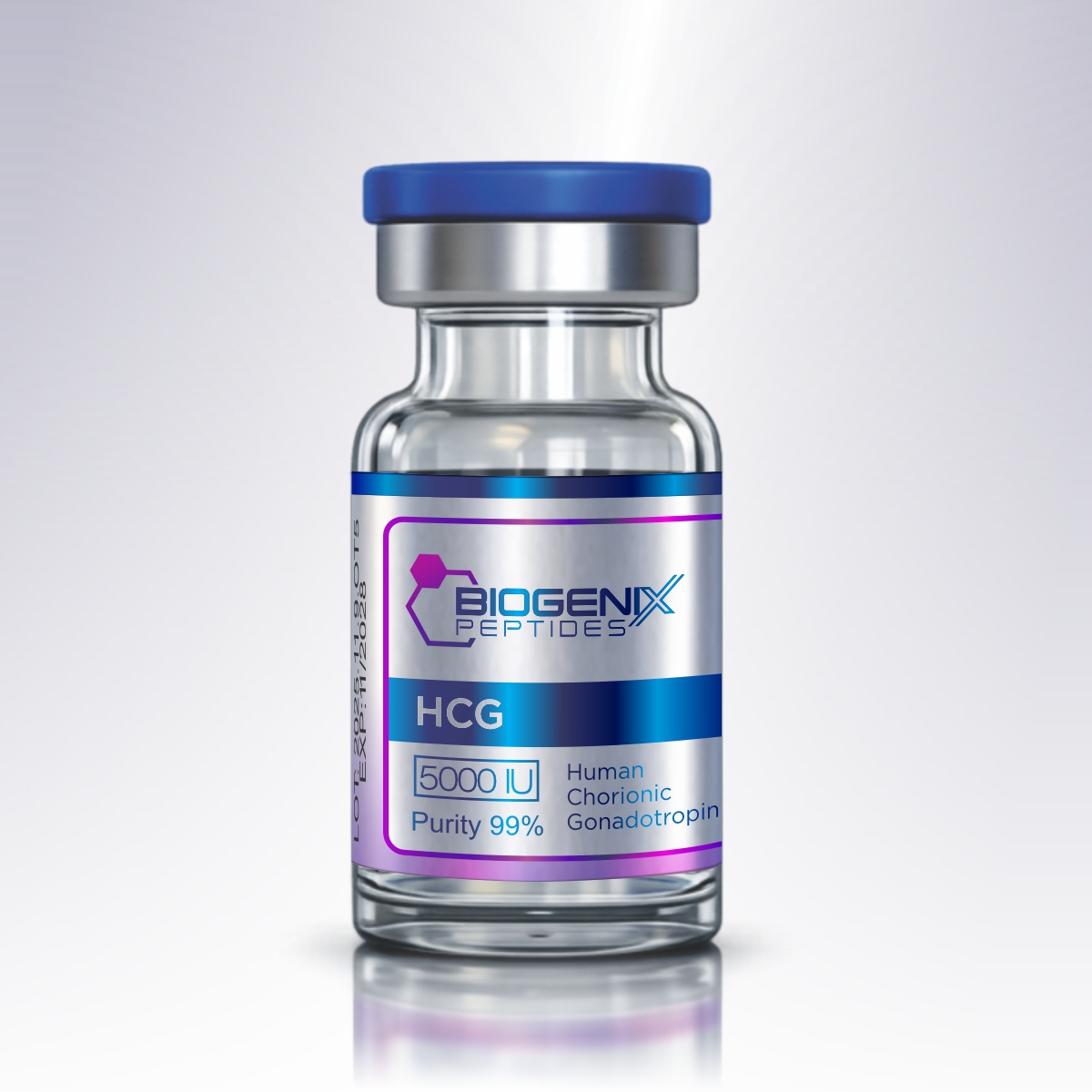
HCG 5000 iu
$56.00
Human Chorionic Gonadotropin (HCG) is a naturally occurring hormone made of two connected protein subunits. It plays an important role in fertility and hormone signaling. In research settings, HCG is used to explore how the body produces hormones such as testosterone, how the testes function, and how reproductive systems respond to hormonal signals.
Its structure includes stabilizing bonds and carbohydrate chains, which help the hormone remain active longer and provide a more steady, long-lasting effect in experimental models.
In Stock
HCG (Human Chorionic Gonadotropin) – Overview
Human Chorionic Gonadotropin (hCG) is a heterodimeric glycoprotein hormone composed of two non-covalently associated subunits (alpha and beta) and is physiologically produced by trophoblastic tissue during early pregnancy. In experimental and clinical research settings, hCG is widely used as a model gonadotropin for investigating steroidogenesis, gonadal function, and endocrine feedback mechanisms.
Chemical Identity & Basic Characteristics
- Chemical name: Human Chorionic Gonadotropin (hCG)
- CAS number: 9002-61-3
- Molecular formula: C1105H1770N318O336S26
- Molecular weight: 25,719.77 g·mol-1
- Type: Heterodimeric glycoprotein peptide hormone
- Structure: Two non-covalently bound subunits (α and β) with multiple disulfide bonds
- Glycosylation: Extensive N- and O-linked glycosylation creating multiple isoform
- Common synonyms: Choriogonadotropin, Chorionic gonadotropin, hCG
Molecular Structure
hCG belongs to the glycoprotein hormone family together with luteinizing hormone (LH), follicle-stimulating hormone (FSH), and thyroid-stimulating hormone (TSH). These hormones share a common structural motif: a disulfide-rich alpha subunit paired with a hormone-specific beta subunit.
- Subunit composition:
- α-subunit (alpha): 92 amino acids; structurally identical across hCG, LH, FSH, and TSH.
- β-subunit (beta): 145 amino acids; unique to hCG and responsible for receptor specificity (LH/hCG receptor).
- Amino acid count (intact heterodimer): 237 amino acids (92α + 145β, not including signal peptides or pre-pro sequences).
- Disulfide bonds: Both subunits are stabilized by multiple disulfide bonds, creating a compact,
cystine-rich tertiary structure characteristic of glycoprotein hormones. - Glycosylation:
- N-linked glycans on both α- and β-subunits.
- O-linked glycans on the extended C-terminal peptide of the β-subunit.
- Glycosylation accounts for ~30% of the total molecular mass and contributes to biological half-life and isoform heterogeneity.
High-resolution crystallographic and NMR studies have resolved the three-dimensional structure of hCG, revealing a “seat-belt” configuration where the β-subunit wraps around the α-subunit. The receptor-binding determinants cluster on one surface of the heterodimer, while carbohydrate chains extend outward, modulating stability, receptor
interactions, and clearance.
Molecular Weight & Physicochemical Parameters
- Molecular weight (protein core): ~36.7 kDa (intact heterodimer, without considering full glycan variability).
- Molecular weight (typical glycosylated forms): ~36.7–37.9 kDa; some placental variants may reach ~38–40 kDa due to extended glycosylation.
- Subunit molecular weights (approximate):
- α-subunit: ~14.5–14.9 kDa
- β-subunit: ~22–23 kDa (including the C-terminal peptide and glycosylation)
- Isoelectric point (pI): ~2.9–3.0 (highly acidic glycoprotein due to sialylated carbohydrate chains).
- Nature of molecule: Water-soluble, heavily glycosylated peptide hormone; sensitive to extremes of pH and temperature,
typically supplied as a lyophilized powder for reconstitution in buffered solutions.
Receptor Target & Mechanism of Action (Research Context)
hCG exerts its biological effects by binding to the LH/hCG receptor (LHCGR), a G protein–coupled receptor expressed primarily on Leydig cells in the testes, theca and granulosa cells in the ovary, and other reproductive tissues. This receptor is shared with luteinizing hormone (LH), but the longer half-life and distinct glycosylation of hCG yield a more prolonged signaling profile.
- Binding of hCG to LHCGR activates the Gs protein–adenylate cyclase pathway, increasing intracellular cAMP.
- Elevated cAMP drives steroidogenic enzyme expression and activity, supporting the synthesis of sex steroids
(e.g., testosterone in testicular tissue, progesterone in luteal cells). - In early pregnancy, hCG supports corpus luteum function and progesterone production; in research models,
these mechanisms are leveraged to study luteal support, steroidogenesis, and feedback regulation of the
hypothalamic–pituitary–gonadal axis.
Structural Variants & Isoforms
Multiple molecular forms of hCG are recognized in biological fluids:
- Regular (intact) hCG: The predominant pregnancy-associated form (intact αβ heterodimer).
- Hyperglycosylated hCG: Enriched during implantation and in certain trophoblastic diseases; characterized by more extensive glycosylation.
- Free β-subunit and degradation products: Including nicked hCG, hCG lacking the β C-terminal peptide, and isolated α or β subunits.
These isoforms may differ in receptor affinity, half-life, and immunoreactivity and are relevant for both
analytical assay design and mechanistic research.
Research & Experimental Applications
In controlled research environments, hCG is used to probe diverse aspects of reproductive and endocrine physiology:
- Male hypogonadism and androgen production: hCG has been investigated as a means to stimulate endogenous
testosterone production in men with hypogonadism, including those wishing to preserve fertility or recover
hypothalamic–pituitary–gonadal axis function after prolonged suppression. - Male infertility and spermatogenesis: In combination with other gonadotropins (e.g., hMG or FSH analogs),
hCG is widely used in research and clinical protocols studying the induction of spermatogenesis, testicular growth,
and restoration of fertility in hypogonadotropic hypogonadism and related conditions. - Exercise physiology and muscle function: Recombinant or purified hCG has been evaluated in select studies
for potential effects on muscle strength, physical function, and anabolic signaling in specific populations, under
strict experimental control. - Tumor-marker biology: Because certain germ-cell tumors and trophoblastic neoplasms produce hCG or its
β-subunit, hCG is a widely used tumor marker in oncology research, particularly for testicular cancer and
gestational trophoblastic disease models.
All uses described above refer to controlled experimental or clinical research settings. hCG preparations supplied as research materials are not intended for diagnostic, therapeutic, or human/animal consumption unless explicitly approved and regulated for such applications.
Key Reference Studies (Representative)
-
- Wu H, Lustbader JW, Liu Y, Canfield RE, Hendrickson WA. Structure of human chorionic gonadotropin at 2.6 Å
resolution (PDB ID: 1HCN). Structure. 1994. - Ezcurra D, Humaidan P. A review of luteinising hormone and human chorionic gonadotropin in assisted reproduction.
Reproductive Biomedicine Online. 2014. - de Medeiros SF, Norman RJ. Human choriogonadotrophin protein core and sugar branches: structure–function
relationships. Human Reproduction Update. 2009.
- Wu H, Lustbader JW, Liu Y, Canfield RE, Hendrickson WA. Structure of human chorionic gonadotropin at 2.6 Å
<
Having trouble viewing? Use the buttons below to download or open the certificate.
Related products

In Stock