
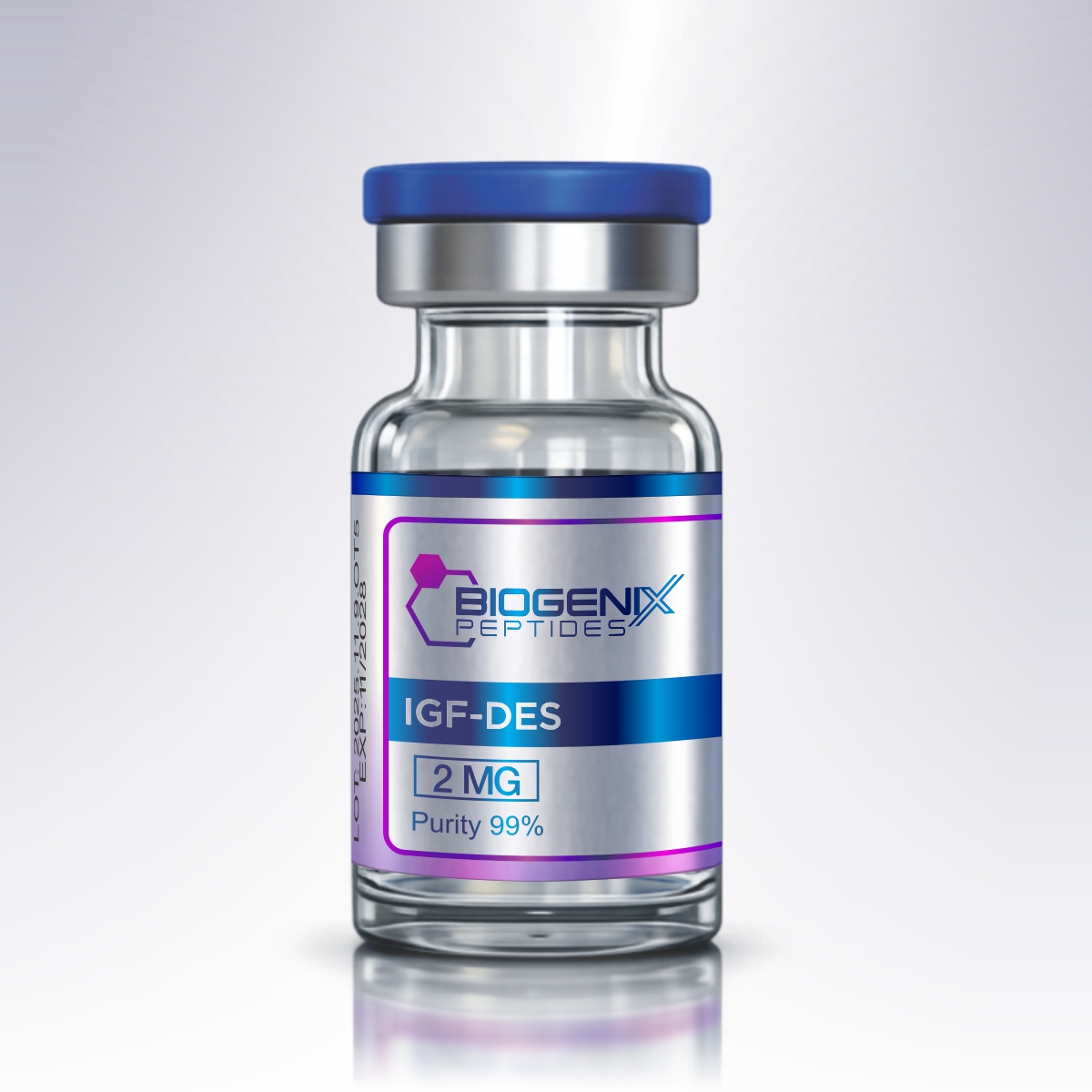
IGF-DES 2mg
$96.00
IGF-DES (also called DES(1-3)IGF-1) is a naturally occurring truncated variant of insulin-like growth factor-1 (IGF-1), missing the first three amino acids at the N-terminus of the protein. This modification alters its biological activity, increasing potency and decreasing its affinity for binding proteins compared to full-length IGF-1.Unlike IGF-1 LR3, which has an extended half-life, IGF-DES is short-acting but highly potent, with research suggesting it may play an important role in local tissue growth, repair, and regeneration.
Out of stock
IGF-DES (Insulin-like Growth Factor-1 DES)
IGF-DES (also called DES(1-3)IGF-1) is a naturally occurring truncated variant of insulin-like growth factor-1 (IGF-1), missing the first three amino acids at the N-terminus of the protein. This modification alters its biological activity, increasing potency and decreasing its affinity for binding proteins compared to full-length IGF-1.Unlike IGF-1 LR3, which has an extended half-life, IGF-DES is short-acting but highly potent, with research suggesting it may play an important role in local tissue growth, repair, and regeneration.
Overview
• Type: Peptide hormone analog• Alternate Names: DES(1-3)IGF-1, truncated IGF-1• Length: 67 amino acids (full IGF-1 is 70 amino acids)• Primary Research Interests: Muscle growth, cellular repair, angiogenesis, neuroprotectionIGF-DES is thought to avoid sequestration by IGF binding proteins (IGFBPs), particularly IGFBP-3, which normally restricts the bioavailability of circulating IGF-1. This allows for more localized action in tissues, particularly in response to injury or growth stimuli.
Chemical Characteristics
| Compound | Type | Molecular Formula | Molecular Weight |
| IGF-DES | Truncated insulin-like growth factor 1 analog (des(1-3) IGF-1) | C₃₃₂H₅₁₅N₉₇O₉₈S₇ | 7371.48 g/mol |
• Synonyms: DES(1-3)IGF-1, Truncated Insulin-like Growth Factor-1
Research and Clinical Studies
IGF-DES and Muscle Growth
IGF-DES has been studied in myoblast and skeletal muscle models for its potential role in local hypertrophy.• One study suggested that IGF-DES stimulated DNA synthesis in myoblasts more effectively than IGF-1, with stronger activation of mitogenic pathways (MAPK and PI3K/Akt).• In skeletal muscle cell culture, IGF-DES was reported to enhance satellite cell proliferation and differentiation, suggesting a role in muscle regeneration following injury.
IGF-DES and Tissue Repair
IGF-DES appears to promote angiogenesis (blood vessel formation) and accelerate wound healing.• Research models indicated that truncated IGF-1 increased vascular endothelial growth factor (VEGF) expression, which supports tissue repair mechanisms.
IGF-DES and Neurological Function
Experimental findings suggest IGF-DES may have neuroprotective potential.• Rodent models exposed to IGF-DES displayed improved neuronal survival after induced hypoxic or ischemic injury.• Mechanisms are thought to involve activation of Akt signaling and inhibition of apoptosis in neuronal tissue.
IGF-DES vs. IGF-1 LR3
• IGF-DES: Short-acting, highly potent, local action, resistant to IGFBPs.• IGF-1 LR3: Long-acting, systemic action, extended half-life (~20–30 hrs).Both analogs are widely studied for their distinct roles in muscle biology and regenerative medicine.
Lyophilized Peptide
IGF-DES is provided as a lyophilized (freeze-dried) powder without fillers, ensuring stability and integrity. Reconstitute with sterile bacteriostatic water before in-vitro research..
IGF-DES — References
- Francis, G. L., Upton, F. M., Ballard, F. J., McNeil, K. A., Wallace, J. C. Insulin-like growth factors 1 and 2 in bovine colostrum: sequences and biological activities compared with those of a potent truncated form of IGF-I (des(1–3)IGF-I). Biochemical Journal. 1988;251(1):95–103.https://doi.org/10.1042/bj2510095
- Ballard, F. J., Francis, G. L., Ross, M., Wallace, J. C. Des(1–3)IGF-I and Long R3 IGF-I: analogues of IGF-I with reduced binding to IGF-binding proteins and increased potency. Growth Regulation. 1996;6(1):1–8.https://pubmed.ncbi.nlm.nih.gov/8734477/
- Francis, G. L., Ballard, F. J., Milner, S. J., McNeil, K. A., Wallace, J. C. Enhanced biological potency of human IGF-I analogues with modified B-domains designed to resist IGF binding proteins. Biochemical and Biophysical Research Communications. 1990;168(3):1139–1145.https://doi.org/10.1016/0006-291X(90)91165-V
- Ross, M., Francis, G. L., Ballard, F. J., Wallace, J. C. Biological activity of IGF-I analogues in vitro and in vivo. Journal of Endocrinology. 1991;131(3):395–400.https://doi.org/10.1677/joe.0.1310395
- Baxter, R. C., Martin, J. L. Structure of the 150-kilodalton growth hormone-dependent insulin-like growth factor binding protein complex: determination by reconstitution and affinity-labeling. Proceedings of the National Academy of Sciences. 1989;86(18):6898–6902.https://doi.org/10.1073/pnas.86.18.6898
- Ooi, G. T., Orlowski, C. C., Brown, A. L., Becker, R. E., Unterman, T. G., Rechler, M. M. Different biological activities of des(1–3)IGF-I and IGF-I in the rat: clearance, tissue distribution and endocrine effects. Endocrinology. 1990;126(6):2796–2803.https://doi.org/10.1210/endo-126-6-2796
- Francis, G. L. Structural modifications of IGF-I and their effects on biological activity. Molecular Pathology. 1999;52(5):270–277.https://www.ncbi.nlm.nih.gov/pmc/articles/PMC395452/
NOTICE OF COMPLIANCE
The mission of BioGenix Peptides™ is to provide researchers with the highest-quality, Ultra-Pure Series™ compounds to help unlock the full potential of this evolving field. With precision, purity, and scientific integrity at the core of our operations, BioGenix Peptides™ is dedicated to supporting responsible exploration and discovery
Products from BioGenix Peptides™ are not intended for human consumption. They are supplied exclusively for in-vitro and pre-clinical research purposes.
By purchasing or using these products, the Customer accepts full responsibility for their handling and use, and agrees to indemnify and hold BioGenix Peptides™ harmless from any claims resulting from misuse.
No certificate available for this product.
Related products

Out of stock