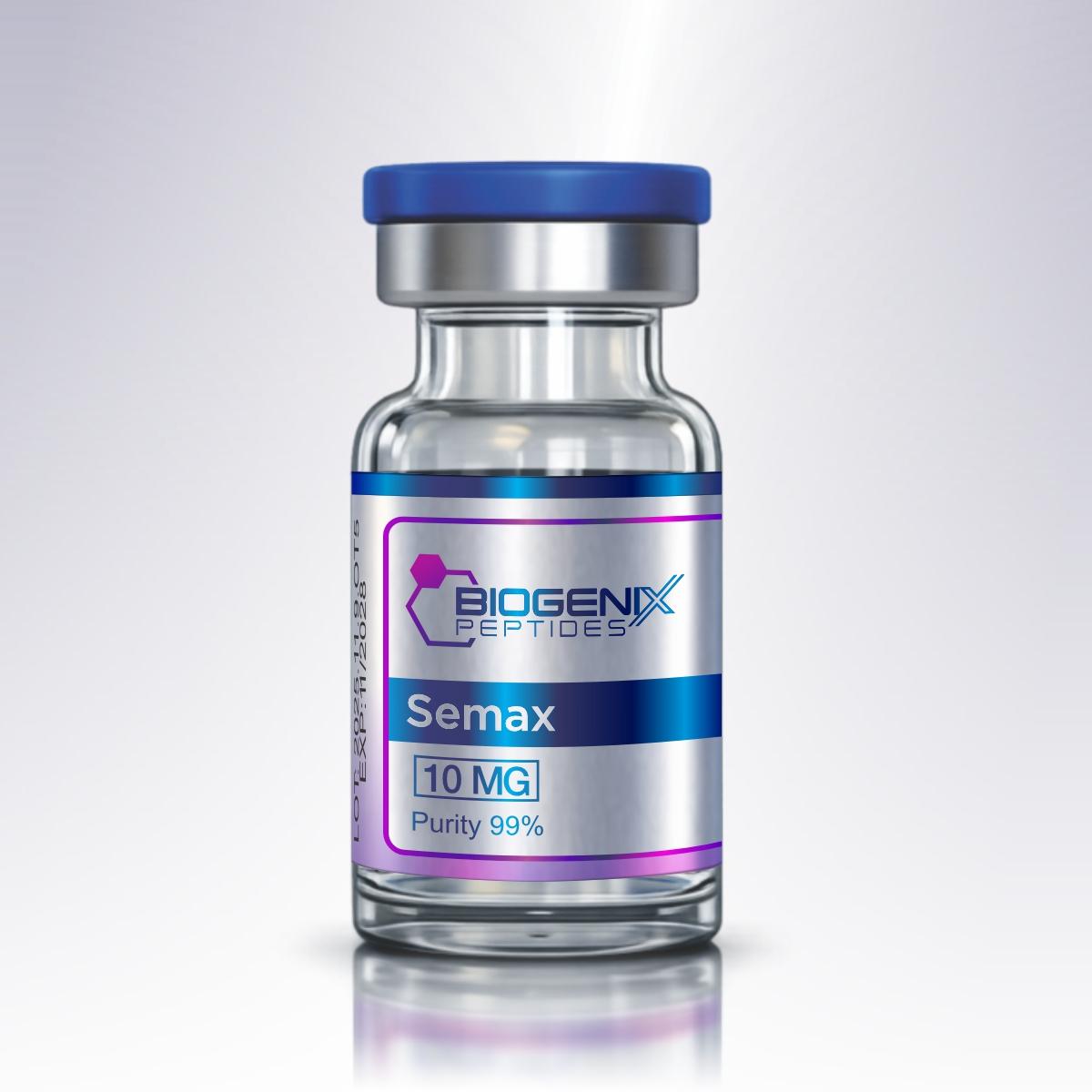
Semax 10mg
$60.00
Semax is a synthetic polypeptide derived from the ACTH(4–7) fragment, designed to retain central nervous system–related properties without the classical corticotropic effects of native ACTH. Research efforts have examined its potential influence on neuroadaptive processes, cognitive endpoints, and stress-response pathways. Semax incorporates the core Met-Glu-His-Phe (ACTH4–7) sequence extended with a C-terminal Pro-Gly-Pro (PGP) motif and is commonly produced in an acetylated form. The PGP addition is proposed to modify physicochemical behavior and may support passage across select biological barriers—such as the blood–brain barrier—through passive or carrier-assisted mechanisms, while acetylation may enhance resistance to proteolytic degradation.
In Stock
Semax — Research Overview
Introduction
Semax is a synthetic polypeptide modeled on the adrenocorticotropic hormone fragment ACTH(4‐7). Unlike native ACTH, this fragment does not share classical corticotropic actions; instead, research has focused on central nervous system endpoints and adaptive responses [1,2].
Semax extends the Met‐Glu‐His‐Phe (ACTH4‐7) sequence with a C‐terminal Pro‐Gly‐Pro (PGP) motif and is often prepared as an acetylated peptide. The PGP extension is hypothesized to influence physicochemical properties and may facilitate transit across selective biological barriers (e.g., blood–brain barrier) via passive and/or carrier‐mediated mechanisms, while acetylation may enhance proteolytic stability [3–5].
Chemical Characteristics
| Compound | Type | Molecular Formula | Molecular Weight |
| Semax | Synthetic heptapeptide (ACTH(4–10) analogue, nootropic peptide) | C₃₇H₅₁N₉O₁₀S | 813.93 g/mol |
Form: Lyophilized powder for reconstitution (research use)
Research Applications
1. Nootropic Indices and Monoaminergic Readouts
– In rodent studies, Semax exposure increased the serotonin metabolite 5‐HIAA (to ~180% of baseline within 4 hours) and altered monoaminergic activity under stimulant challenge [6].
– Reports include activation of dopaminergic and serotonergic systems in experimental settings [6].
2. Early‐Life SSRI Exposure and Anxiety‐Like Behaviors
– Following neonatal SSRI exposure, adolescent rats receiving Semax showed reduced anxiety‐like behaviors and improved task performance; effects were temporally persistent in follow‐up assessments [7].
3. Genome Expression and Immune/Vascular Signatures
– Transcriptomic analyses in focal ischemia models reported Semax‐associated changes in genes linked to immune and vascular pathways [5].
4. Post‐Infarction Cardiac Remodeling
– Post‐MI experiments noted prevention of diastolic pressure rise, LV remodeling signals, and attenuation of cardiomyocyte hypertrophy under Semax exposure [8].
5. Maternal Deprivation and Behavioral Reactivity
– In adolescent rats, Semax exposure after early maternal separation was associated with normalization of anxiety and reactivity toward control levels [9].
6. Neuroprotection in Ischemic Models
– Clinical observations in ischemic stroke cohorts reported improved recovery of neurological function with Semax exposure in the acute period, assessed with electrophysiologic mapping [10].
7. Acute Stress and Cognitive Readouts
– Small human experimental studies under high‐stress conditions reported short‐term changes in attention and memory‐related measures within 24 hours [11].
8. Enkephalin‐Degrading Enzymes
– In vitro work suggested Semax (and Selank) may inhibit select serum enzymes that degrade enkephalins, potentially affecting opioid‐linked signaling cascades [3].
Conclusion
Semax is an ACTH(4‐7)‐derived peptide extended with PGP, studied across neurochemical, behavioral, immunovascular, and cardiometabolic readouts. Experimental evidence spans monoaminergic activity, anxiety‐related behaviors, transcriptional profiles in ischemic models, and post‐infarction remodeling. All findings are research‐oriented; availability and use are limited to controlled laboratory investigation [1–11].
Semax — References
- Kolomin, T., Ilyina, A., & Myasoedov, N. A New Generation of Drugs: Synthetic Peptides Based on Natural Regulatory Peptides. Neuroscience & Medicine. 2013;4(4): 223–252.https://doi.org/10.4236/nm.2013.44035
- Dornbush, R. L., & Nikolovski, O. ACTH 4-10 and short-term memory. Pharmacology Biochemistry and Behavior. 1976;5(Suppl 1): 69–72.https://doi.org/10.1016/0091-3057(76)90331-2
- Kost, N. V., Sokolov, O. Iu., Gabaeva, M. V., Grivennikov, I. A., Andreeva, L. A., Miasoedov, N. F., & Zozulia, A. A. Semax and selank inhibit the enkephalin-degrading enzymes from human serum. Bioorganicheskaya Khimiya. 2001;27(3): 180–183.https://pubmed.ncbi.nlm.nih.gov/11443939
- Tsai, S.-J. Semax, an analogue of adrenocorticotropin (4–10), is a potential agent for the treatment of attention-deficit hyperactivity disorder and Rett syndrome. Medical Hypotheses. 2007;68(5): 1144–1146.https://doi.org/10.1016/j.mehy.2006.07.017
- Medvedeva, E. V., Dmitrieva, V. G., Povarova, O. V., et al. The peptide Semax affects the expression of genes related to the immune and vascular systems in rat brain focal ischemia: genome-wide transcriptional analysis. BMC Genomics. 2014;15: 228.https://doi.org/10.1186/1471-2164-15-228
- Eremin, K. O., Kudrin, V. S., Saransaari, P., Oja, S. S., Grivennikov, I. A., Myasoedov, N. F., & Rayevsky, K. S. Semax, an ACTH(4-10) analogue with nootropic properties, activates dopaminergic and serotoninergic brain systems in rodents. Neurochemical Research. 2005;30(12): 1493–1500.https://doi.org/10.1007/s11064-005-8826-8
- Glazova, N. Y., Manchenko, D. M., Volodina, M. A., Merchieva, S. A., Andreeva, L. A., Kudrin, V. S., Myasoedov, N. F., & Levitskaya, N. G. Semax, synthetic ACTH(4–10) analogue, attenuates behavioural and neurochemical alterations following early-life fluvoxamine exposure in white rats. Neuropeptides. 2021;86: 102114.https://doi.org/10.1016/j.npep.2020.102114
- Gavrilova, S. A., Golubeva, A. V., Lipina, T. V., Fominykh, E. S., Shornikova, M. V., Postnikov, A. B., Andrejeva, L. A., Chentsov, Iu. S., & Koshelev, V. B. Protective effect of peptide Semax (ACTH(4-7)Pro-Gly-Pro) on the rat heart rate after myocardial infarction. Rossiiskii Fiziologicheskii Zhurnal Imeni I.M. Sechenova. 2006;92(11): 1305–1321.https://pubmed.ncbi.nlm.nih.gov/17385423
- Volodina, M. A., Sebentsova, E. A., Glazova, N. Y., Levitskaya, N. G., Andreeva, L. A., Manchenko, D. M., Kamensky, A. A., & Myasoedov, N. F. Semax attenuates the influence of neonatal maternal deprivation on the behavior of adolescent white rats. Bulletin of Experimental Biology and Medicine. 2012;152(5): 560–563.https://doi.org/10.1007/s10517-012-1574-2
- Gusev, E. I., Skvortsova, V. I., Miasoedov, N. F., Nezavibat’ko, V. N., Zhuravleva, E. Iu., & Vanichkin, A. V. Effectiveness of Semax in acute period of hemispheric ischemic stroke (a clinical and electrophysiological study). Zhurnal Nevrologii i Psikhiatrii Imeni S. S. Korsakova. 1997;97(6): 26–34.https://pubmed.ncbi.nlm.nih.gov/11517472
- Asmarin, I. P., Nezavibat’ko, V. N., Miasoedov, N. F., Kamenskiĭ, A. A., Grivennikov, I. A., Ponomareva-Stepnaia, M. A., Andreeva, L. A., Kaplan, A. Ia., Koshelev, V. B., & Riasina, T. V. Nootropic analogue of adrenocorticotropin 4-10 Semax: 15 years experience in its design and study. Zhurnal Vysshei Nervnoi Deyatelnosti Imeni I. P. Pavlova. 1997;47(2): 420–430.https://pubmed.ncbi.nlm.nih.gov/9173745
NOTICE OF COMPLIANCE
The mission of BioGenix Peptides™ is to provide researchers with the highest-quality, Ultra-Pure Series™ compounds to help unlock the full potential of this evolving field. With precision, purity, and scientific integrity at the core of our operations, BioGenix Peptides™ is dedicated to supporting responsible exploration and discovery
Products from BioGenix Peptides™ are not intended for human consumption. They are supplied exclusively for in-vitro and pre-clinical research purposes.
By purchasing or using these products, the Customer accepts full responsibility for their handling and use, and agrees to indemnify and hold BioGenix Peptides™ harmless from any claims resulting from misuse.
Having trouble viewing? Use the buttons below to download or open the certificate.
Related products

In Stock