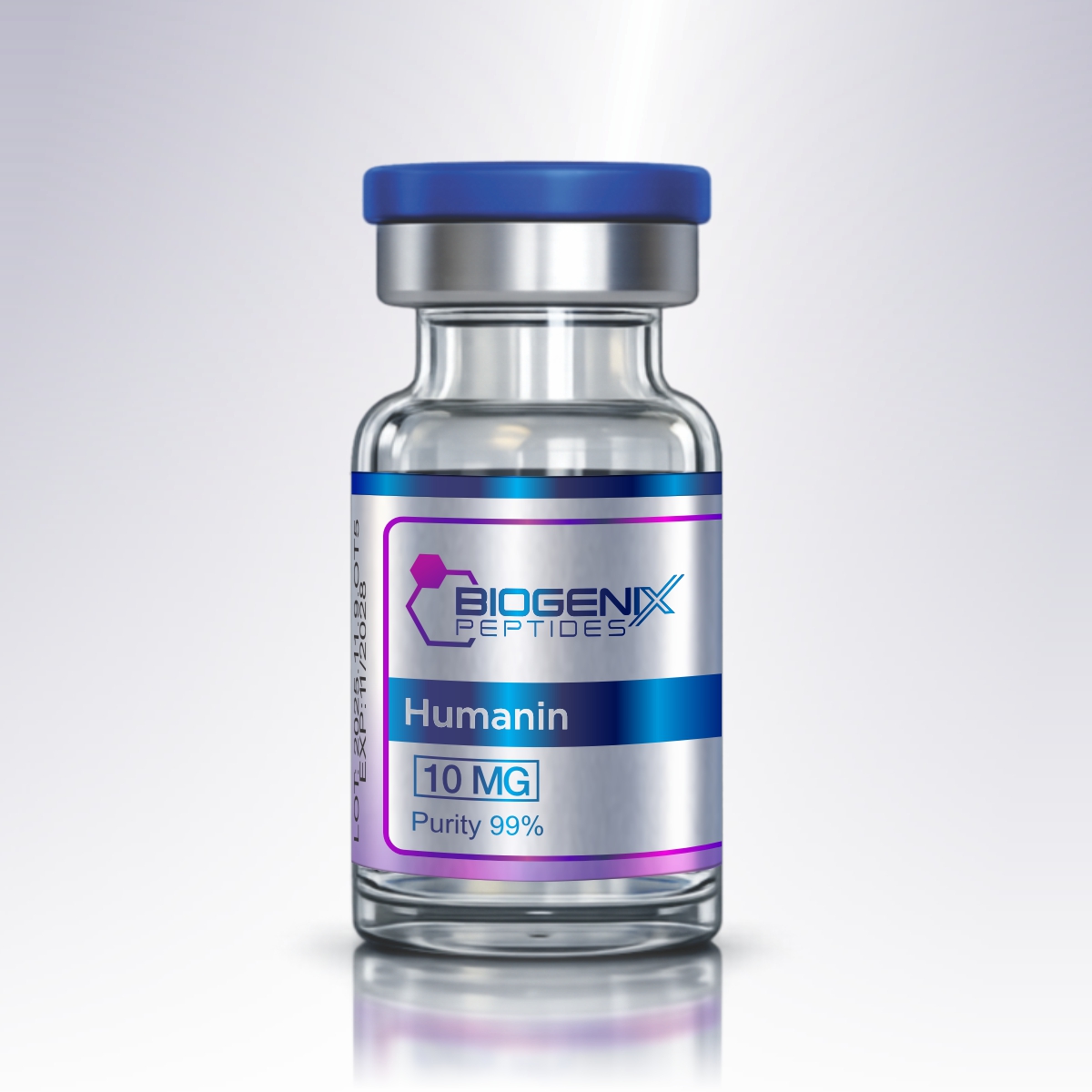
Humanin 10mg
$118.00
Humanin is a small 24–amino-acid peptide that comes from the mitochondria, the parts of the cell responsible for energy production. Researchers study Humanin because it appears to help protect cells during stress, support healthy energy balance, and promote normal metabolic function.
Early studies suggest Humanin may help shield cells from oxidative damage, support healthier mitochondrial activity, and influence pathways related to aging, energy use, and cell survival. It has also been explored for potential roles in brain health, insulin sensitivity, and general cellular resilience.
Humanin is part of a group of naturally produced “mitochondrial peptides” that may act as internal signals, helping the body respond to stress and maintain normal cellular function under challenging conditions.
Out of stock
Humanin — Overview & Chemical Characteristics
Humanin is a 24–amino-acid mitochondrial-derived peptide (MDP) originally identified
within the mitochondrial 16S rRNA region. It is part of a class of peptides that may act as retrograde
signals—communicating mitochondrial stress or metabolic status to the nucleus. Humanin has been widely
studied for its potential roles in cytoprotection, metabolic regulation, and cellular resilience under
oxidative or apoptotic stress.
Chemical Identity
- CAS Number: 330936-69-1
- Molecular Formula: C119H204N34O32S2
- Molecular Weight: 2687.3 g/mol
- Peptide Length: 24 amino acids
- Peptide Class: Mitochondria-derived peptide (MDP)
Structural Characteristics
Humanin possesses a compact 24-amino-acid structure with a mild helical core and regions capable of
binding multiple intracellular and extracellular partners. Several enhanced analogs exist
(e.g., HNG/Gly14→Ser) that show increased potency in experimental models.
- Lacks disulfide bonds; stability driven by hydrophobic interactions
- Known to interact with proteins such as BAX, BIM, and IGFBP3
- Can function both intracellularly and through membrane receptor complexes
Mechanisms of Action (Research Context)
1. Anti-apoptotic Activity
Humanin can bind and inhibit several pro-apoptotic BCL-2 family proteins, including
tBID, BAX, and BIM, helping prevent mitochondrial membrane permeabilization and
reducing programmed cell death.
2. Receptor-Mediated Signaling
Extracellular Humanin may signal through the CNTFR–WSX-1–gp130 receptor complex, activating:
- JAK2/STAT3 pathway
- MAPK/ERK signaling
- PI3K/AKT survival signaling
3. Mitochondrial Stress Modulation
Humanin is proposed to act as a retrograde mitochondrial signal, promoting genes involved in
oxidative-stress resistance, mitochondrial biogenesis, and metabolic balance.
4. Metabolic Effects
Research suggests potential benefits in insulin sensitivity, glucose processing, and energy-balance
pathways in both cellular and animal models.
Potential Research Applications
- Neuroprotection: Protection against oxidative stress, excitotoxicity, and β-amyloid challenges
- Metabolic Regulation: Improved insulin signaling and glucose homeostasis
- Longevity Research: Declines with age; studied for effects on mitochondrial health and cellular stress resistance
- Cardioprotection: Potential support during ischemia-reperfusion and endothelial dysfunction
Representative Studies
- Hashimoto et al. Nature, 2001 – Discovery of Humanin as a neuroprotective peptide.
- Cobb et al. Cell Metabolism, 2016 – Humanin as a mitochondrial longevity factor.
- Yen et al. PNAS, 2013 – Receptor-mediated Humanin signaling via gp130 complex.
- Zarse et al. Aging, 2012 – Humanin analogs in metabolic regulation.
- Muzumdar et al. JCEM, 2009 – Humanin’s role in insulin sensitivity.
For research use only. Not for human consumption.
No certificate available for this product.
Related products

Out of stock