
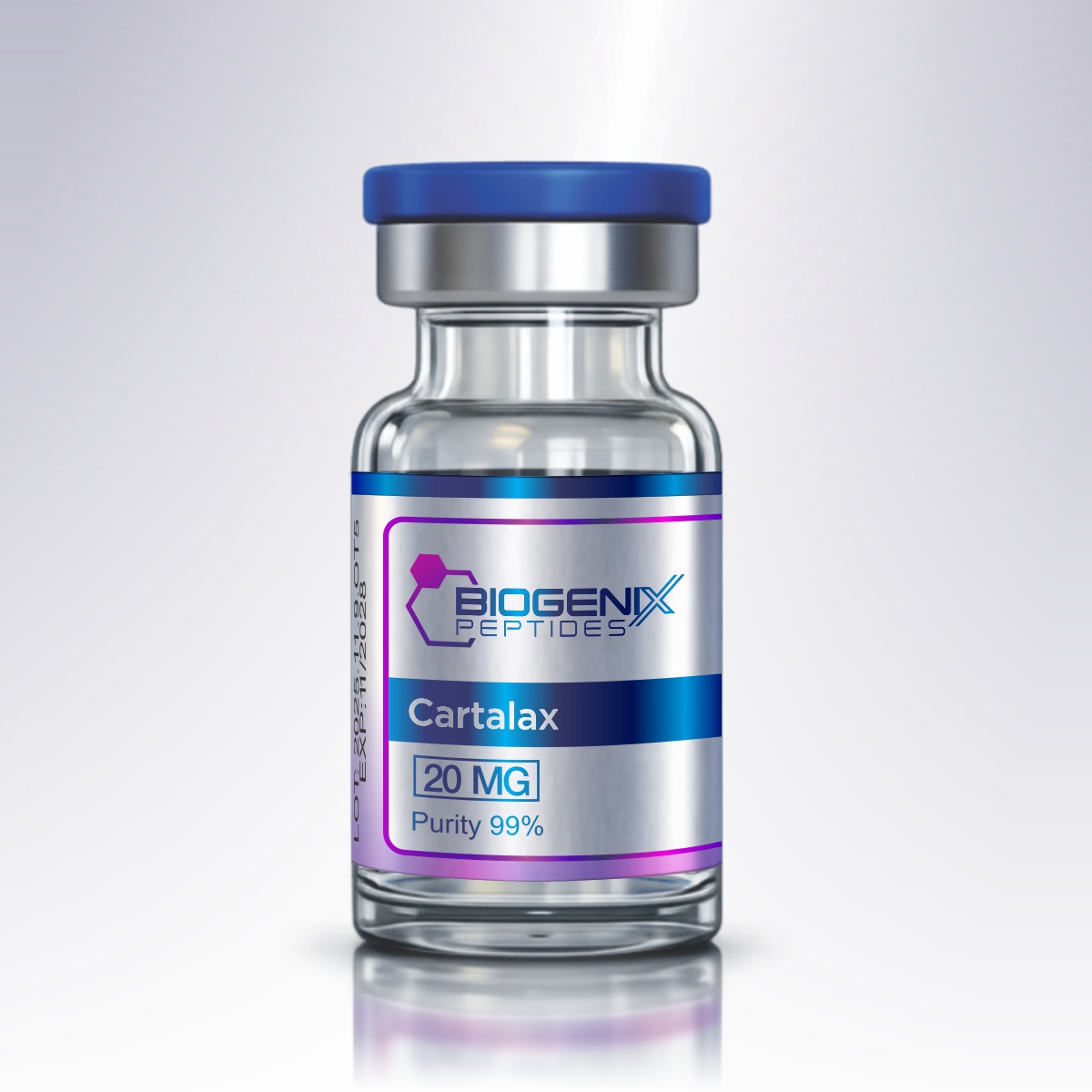
Cartalax 20mg
$68.00
Cartalax is a synthetic regulatory tetrapeptide composed of the amino-acid sequence Ala–Glu–Asp–Gly (AEDG). It belongs to a class of short peptides studied for their potential roles in cellular regulation, gene-expression normalization, and tissue-specific recovery processes.
Unlike classical receptor agonists, Cartalax is investigated for epigenetic-like modulation, acting at the level of transcriptional control rather than direct membrane signaling. This has led to research interest in cartilage homeostasis, joint integrity, inflammation pathways, and age-related degenerative conditions.
Studies describe Cartalax as a bioregulatory peptide, capable of influencing cellular responses to stress, injury, and metabolic challenge across multiple tissue types, with the strongest data centered on connective tissues.
In Stock
Cartalax (Bioregulator, AEDG Peptide) — Research Overview
Introduction
Cartalax is a synthetic regulatory tetrapeptide composed of the amino-acid sequence Ala–Glu–Asp–Gly (AEDG). It belongs to a class of short peptides studied for their possible role in cellular regulation, gene-expression normalization, and tissue-specific recovery processes.Unlike classical receptor agonists, Cartalax is investigated for epigenetic-like modulation, acting at the level of transcriptional control rather than direct membrane signaling. This has led to research interest in cartilage homeostasis, joint integrity, inflammation pathways, and age-related degenerative conditions.Studies exploring Cartalax describe it as a bioregulatory peptide, capable of influencing cellular responses to stress, injury, and metabolic challenge across multiple tissue types, with the strongest data centered on connective tissues.
Chemical Characteristics
Molecular Formula: C12H19N3O8
Molecular Weight: 333.29 g/mol
PubChem CID: 87815447
Mechanisms of Action
1. Gene-Expression Modulation
AEDG peptides have been proposed to interact with chromatin structures, DNA–protein complexes, and histone-associated regions. These interactions may alter the transcription of genes tied to inflammatory signaling (IL-1β, IL-6, TNF-α), extracellular-matrix remodeling (MMP-3, MMP-13), chondrocyte metabolic balance, and oxidative-stress defense systems. This mechanism is the basis for Cartalax’s classification as a bioregulatory or peptide-geroprotector candidate.
2. Anti-Inflammatory and Cytoprotective Modulation
In vitro and ex vivo research shows that AEDG peptides may reduce NF-κB pathway activity, lower inflammatory cytokine output, protect cells from apoptosis during inflammatory stress, and normalize tissue responses to catabolic and oxidative damage. This aligns with findings in joint-tissue models where Cartalax helps maintain structural and metabolic stability.
3. Support of Cartilage Matrix and Connective Tissue
Preclinical cartilage studies suggest potential influences on aggrecan expression, Type II collagen production, proteoglycan synthesis, and chondrocyte proliferation and survival. These mechanisms collectively support research into cartilage maintenance and repair.
4. Systemic Stress Adaptation and Redox Balance
Cartalax has been associated with reduced lipid peroxidation, stabilization of mitochondrial membrane potential, increased antioxidant enzyme activity (SOD, catalase, GPx), and overall improvement in cellular tolerance to stress. Such findings extend Cartalax’s relevance beyond connective tissue and into systemic cytoprotection research.
Research Applications
1. Connective-Tissue Support & Cartilage Integrity
Research models demonstrate downregulation of matrix-degrading enzymes (MMPs), reduction in inflammatory mediators, improved extracellular matrix density, and enhanced recovery of chondrocyte populations. These findings have led to increasing interest in Cartalax for cartilage preservation and joint research.
2. Anti-Inflammatory Actions
Studies indicate Cartalax may suppress NF-κB activation, normalize cytokine output, reduce inflammation-driven degradation, and protect cells from inflammatory injury. These effects align with its classification as a potential immune-modulatory regulatory peptide.
3. Epigenetic & Geroprotective Research
AEDG peptides are being investigated for normalization of gene-expression profiles that shift with aging, stabilization of chromatin structure, enhanced DNA repair signaling, and improved cellular resilience under age-associated stress. Cartalax is often included in research exploring biological aging, tissue longevity, and genomic stability.
4. Redox Regulation and Mitochondrial Protection
Findings include lower reactive oxygen species (ROS) levels, reduced damage to lipid membranes, improved mitochondrial function, and preservation of intracellular antioxidant reserves. These effects may contribute to Cartalax’s systemic cytoprotective profile.
5. Neurotissue & Cognitive Research (Secondary Area)
Although not Cartalax’s primary research domain, AEDG peptides have been observed to modulate glial inflammatory responses, support neuronal survival, enhance neuroplasticity markers, and influence neurotrophic-factor signaling. These findings parallel research on other regulatory peptides such as Pinealon and Epithalon.
Practical Considerations in Research Models
• Effects are time-dependent and typically appear after repeated exposures (multi-week).
• Tissue specificity may vary substantially depending on the target cell type.
• Activity often persists longer than expected from the short peptide half-life, consistent with transcription-level modulation.
• Dose-response curves may show diminishing returns once gene-expression normalization is achieved.
• Outcomes are model-dependent and can vary based on inflammatory status, metabolic state, and tissue type.
Conclusion
Cartalax (AEDG) is a synthetic regulatory peptide widely studied for its potential to influence gene expression, cartilage stability, anti-inflammatory pathways, and cellular resilience. Its activity profile—centered on transcriptional and epigenetic-like effects rather than direct receptor agonism—distinguishes it from classical signaling peptides and positions it within the field of bioregulatory and geroprotective peptide research. Across preclinical studies, Cartalax shows promise in supporting connective tissue, mitigating inflammatory stress, and enhancing cellular adaptation to aging or environmental challenge.
Having trouble viewing? Use the buttons below to download or open the certificate.
Related products

In Stock