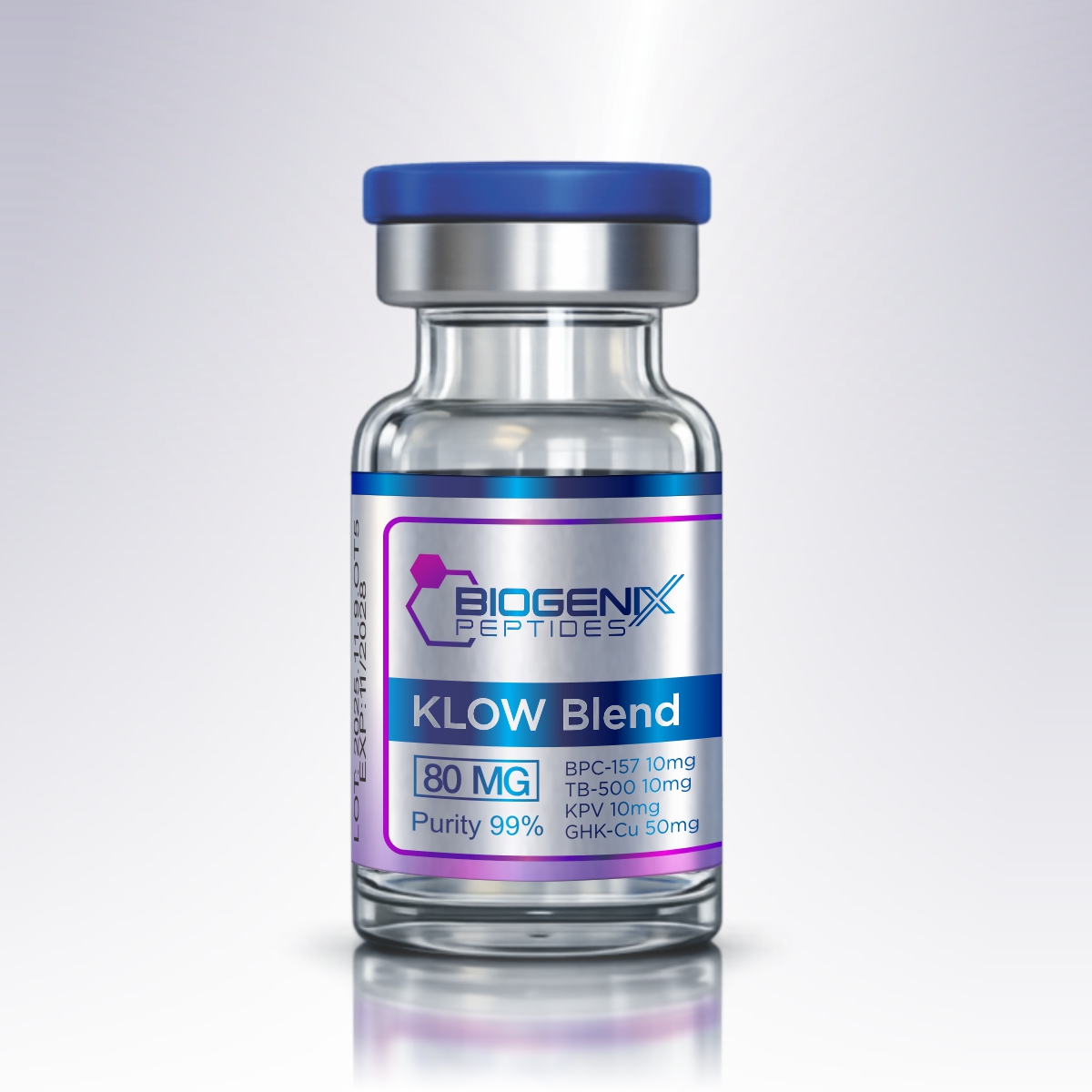
KLOW 80mg Blend
$176.00
The KLOW blend pairs four research peptides with complementary roles in tissue protection and repair. BPC-157 supports soft-tissue healing, angiogenesis, and cytoprotection. TB-500 promotes cell migration and vascular growth through actin-related pathways. GHK-Cu enhances collagen and ECM remodeling while modulating repair-associated genes. KPV provides anti-inflammatory activity via NF-κB/MAPK suppression. Together, they allow researchers to examine coordinated effects on healing, remodeling, and inflammation control in soft-tissue or mucosal-injury models.
In Stock
BPC-157|TB-500|KPV|GHK-Cu (KLOW Blend)
Description
The KLOW blend combines four research peptides with complementary pathways relevant to tissue protection, repair, and remodeling:• BPC-157 (pentadecapeptide) is widely studied for wound and soft-tissue repair, angiogenesis, and cytoprotection. Preclinical work reports improvements across skin, tendon/ligament, muscle, and bone models, and modulatory effects on nitric-oxide and growth-factor signaling.• TB-500 (Thymosin β4–derived) promotes cell migration and angiogenesis via G-actin sequestration and integrin-linked kinase (ILK) signaling, with extensive literature in wound and cardiac repair models.• GHK-Cu (glycyl-L-histidyl-L-lysine–copper) up-regulates repair genes, stimulates collagen and ECM remodeling, and shows antioxidant/anti-inflammatory activity; it has human data in wound care.• KPV (Lys-Pro-Val; melanocortin-derived tripeptide) demonstrates anti-inflammatory activity via NF-κB/MAPK pathway suppression and PepT1-mediated uptake in gut and immune cells; it reduces colitis severity in multiple murine IBD models.Rationale (putative synergy):• Matrix activation (GHK-Cu) + cell motility/angiogenesis (TB-500) may coordinate deposition and organization of new tissue.• Cytoprotection & repair signaling (BPC-157) may support microvascular stability and tendon/muscle healing.• Inflammation control (KPV) can dampen NF-κB/MAPK-driven cytokines and support barrier integrity—potentially improving remodeling conditions.This preparation is intended to let researchers probe combined effects across ECM remodeling (GHK-Cu), cell migration/angiogenesis (TB-500), cytoprotection (BPC-157), and inflammation resolution (KPV) in controlled models of soft-tissue injury or mucosal inflammation.
Chemical Characteristics
| Compound | Type | Molecular Formula | Molecular Weight |
| BPC-157 / TB-500 / GHK-Cu / KPV Blend | Synthetic multi-peptide + copper peptide blend (BPC-157 + Thymosin β4 fragment + GHK-Cu + KPV) | C₆₂H₉₈N₁₆O₂₂ + C₂₁₂H₃₅₀N₅₆O₇₈S + C₁₄H₂₄CuN₆O₄ + C₁₈H₂₅N₅O₅ | ~6150 g/mol (combined) |
Composition (per vial)
Lyophilized blend totaling 80 mg: BPC-157 – 10 mg | TB-500 – 10 mg | KPV – 10 mg | GHK-Cu – 50 mg
Peptide Facts (for reference)
GHK-Cu — Sequence: Gly-His-Lys·Cu²⁺ | Reported actions: ↑ collagen/ECM genes; MMP/TIMP balance; wound closure; antioxidant.BPC-157 — 15 aa gastric peptide; reports of enhanced tendon outgrowth, angiogenesis, and multi-tissue healing in animals.TB-500 (Tβ4-derived) — Actin-binding motif LKKTETQ; promotes migration/angiogenesis via ILK and related signaling; used in dermal and myocardial models.KPV — α-MSH(11–13) fragment; oral uptake via PepT1; inhibits NF-κB/MAPK and reduces cytokines; effective in DSS/TNBS colitis models.
Example Research Endpoints
• Structural repair: collagen I/III content, hydroxyproline, tensile strength, scar index (GHK-Cu ± TB-500).• Cell migration/angiogenesis: scratch/wound-closure assays, endothelial tube formation, CD31/VEGF staining (TB-500 ± BPC-157).• Inflammation & barrier: NF-κB p65 nuclear translocation, IL-1β/TNF-α/IL-6, MPO, TEER, FITC-dextran leak (KPV ± BPC-157).• Functional recovery: time-to-closure, gait/load bearing, tendon pull-out strength, mucosal histology scores.
Reconstitution & Storage (laboratory)
• Reconstitute each vial with sterile solvent immediately before use.• Prepare aliquots to avoid repeat freeze–thaw.• Store lyophilized at 2–8 °C (short-term)
Selected Evidence (high-signal sources)
BPC-157: Narrative/umbrella reviews and wound-healing data across tissues. Tendon study demonstrating enhanced fibroblast outgrowth and migration. Alkali-burn model with pro-angiogenic and proliferative effects.TB-500 / Thymosin β4: Canonical Nature paper: ILK activation → cardiomyocyte/endothelial migration; cardiac repair.GHK-Cu: Gene-level and ECM remodeling review (collagen, elastin, TIMPs). Classic fibroblast collagen-stimulation study. Wound-healing in humans (diabetic ulcers).KPV (Lys-Pro-Val): PepT1-mediated uptake; NF-κB/MAPK inhibition; cytokine reduction; protection in DSS/TNBS colitis. IBD murine models showing anti-inflammatory efficacy, partly MC1R-independent. Contemporary review of the melanocortin system in IBD highlighting KPV.
References
1. Sikiric P, et al. ‘Stable Gastric Pentadecapeptide BPC 157 and Wound Healing.’ Int J Mol Sci. 2021;22(21):11616. doi:10.3390/ijms222111616.
2. Chang CH, et al. ‘Pentadecapeptide BPC 157 Enhances the Growth Hormone Receptor Expression in Tendon Fibroblasts.’ Biomedicines. 2018;6(4):79. doi:10.3390/biomedicines6040079.
3. Wu J, et al. ‘Body Protective Compound-157 Enhances Alkali-Burn Wound Healing in Vivo.’ Drug Des Devel Ther. 2021;15:3461–3473. doi:10.2147/DDDT.S314861.
4. Mikus P, et al. ‘Gastric Pentadecapeptide BPC 157 Accelerates Healing of Transected Achilles Tendon.’ J Orthop Res. 2003;21(5):976–983.
5. Pickart L, et al. ‘Regenerative and Protective Actions of the GHK-Cu Peptide in the Light of the New Gene Data.’ Int J Mol Sci. 2018;19(7):1987.
NOTICE OF COMPLIANCE
The mission of BioGenix Peptides™ is to provide researchers with the highest-quality, Ultra-Pure Series™ compounds to help unlock the full potential of this evolving field. With precision, purity, and scientific integrity at the core of our operations, BioGenix Peptides™ is dedicated to supporting responsible exploration and discovery
Products from BioGenix Peptides™ are not intended for human consumption. They are supplied exclusively for in-vitro and pre-clinical research purposes.
By purchasing or using these products, the Customer accepts full responsibility for their handling and use, and agrees to indemnify and hold BioGenix Peptides™ harmless from any claims resulting from misuse.
Having trouble viewing? Use the buttons below to download or open the certificate.
Related products

In Stock